Cremonese Triumph Over Udinese in Serie A Showdown
Bluenergy Stadium – Stadio Friuli felt like a crossroads rather than a simple late‑season backdrop. In Serie A’s Regular Season – 37, a Udinese side sitting 10th on 50 points welcomed an anxious Cremonese, 18th on 34 points and staring at relegation. Ninety minutes later, the scoreboard read Udinese 0–1 Cremonese, a narrow result that carried a much heavier narrative weight than the single goal suggested.
Heading into this game, the seasonal DNA of both teams was clear. Udinese had built their mid‑table platform on a balanced, if unspectacular, profile: overall 14 wins, 8 draws, 15 defeats from 37, with 45 goals for and 47 against – a goal difference of -2. At home, they had been cautious almost to a fault, averaging 0.9 goals scored and 1.1 conceded, failing to score in 7 of 19 home fixtures but collecting 6 clean sheets. Cremonese, by contrast, arrived as specialists in suffering. Overall, they had 8 wins, 10 draws and 19 losses, with 31 goals for and 53 against – a goal difference of -22. Their attack was blunt (0.8 goals per game overall, just 0.7 on their travels), but they had clawed out 11 clean sheets and were used to defending for long stretches.
Both coaches mirrored each other on the tactical board, lining up in 3‑5‑2. For Kosta Runjaic, M. Okoye stood behind a back three of T. Kristensen, C. Kabasele and O. Solet. The wing‑backs and midfield band – H. Kamara wide left, J. Arizala right, with A. Atta, J. Karlstrom and L. Miller inside – were tasked with bridging a structural gap that has dogged Udinese all season: the disconnect between a relatively solid defensive block and an attack that only sparks intermittently at home. Up front, A. Buksa partnered K. Davis, the latter the clear talisman of this side with 10 league goals and 4 assists in 29 appearances, underpinned by 38 shots (25 on target) and 29 key passes.
Opposite, Marco Giampaolo’s Cremonese offered their own 3‑5‑2 variation. E. Audero anchored a defence of S. Luperto, M. Bianchetti and F. Terracciano. Across midfield, G. Pezzella and T. Barbieri patrolled the flanks, with Y. Maleh, A. Grassi and M. Thorsby forming a gritty central triangle. Up front, F. Bonazzoli and J. Vardy provided a mix of penalty‑box craft and vertical threat. Bonazzoli’s season – 9 goals, 1 assist, 55 shots (31 on target) – has been the clearest attacking reference point for a side otherwise averaging less than a goal a game.
The absentees added a layer of tactical voids. Udinese were deprived of K. Ehizibue (suspended for yellow cards), plus J. Ekkelenkamp, N. Zaniolo and A. Zanoli through injury. The loss of Zaniolo in particular stripped Runjaic of his leading creator: 6 assists, 5 goals, 53 key passes and a dribbling volume (94 attempts, 33 successful) that often tilts games in the half‑spaces. Without him, the creative burden shifted heavily onto Davis dropping off the line and the central trio trying to punch passes through Cremonese’s compact block.
Cremonese were also shorn of important depth: F. Baschirotto, W. Bondo, F. Ceccherini and F. Moumbagna all missed out. In a team that leans into duels and last‑ditch defending, losing Baschirotto and Ceccherini reduced Giampaolo’s options for rotating his back line and protecting leads late on.
Discipline loomed as a quiet subplot. Heading into this game, Udinese’s yellow‑card pattern showed a pronounced late‑game surge: 27.94% of their bookings arrived between 61–75 minutes and 22.06% from 76–90, a sign of a side that often ends matches under physical and mental strain. Cremonese were similar, with 26.09% of their yellows in the 76–90 window. G. Pezzella, with 8 yellows and 1 red this season, epitomises that edge; his 49 tackles and 11 interceptions come at the cost of 47 fouls committed. In a tight, relegation‑tinged fixture, such profiles risk tilting the balance with one mistimed challenge.
On the pitch, the game unfolded as a battle between Udinese’s structured possession and Cremonese’s clarity of purpose. Runjaic’s 3‑5‑2 sought width from Kamara and Arizala, with Atta and Miller tasked with breaking lines to reach Davis between defenders. Yet Udinese’s season‑long home numbers – only 18 goals from 19 matches, and 10 total fixtures failing to score overall – hinted at what ultimately transpired: sterile dominance, more phases of control than incision.
Cremonese’s plan was more direct. With Bonazzoli and Vardy, Giampaolo had two forwards comfortable playing with their back to goal or running channels. Bonazzoli’s 242 duels (125 won) and 76 fouls drawn show a striker adept at making every ball into a contest, buying territory and set‑pieces. Behind him, Maleh and Grassi recycled second balls, while Thorsby’s engine gave Cremonese the ability to step out and press in waves rather than simply retreat to their box.
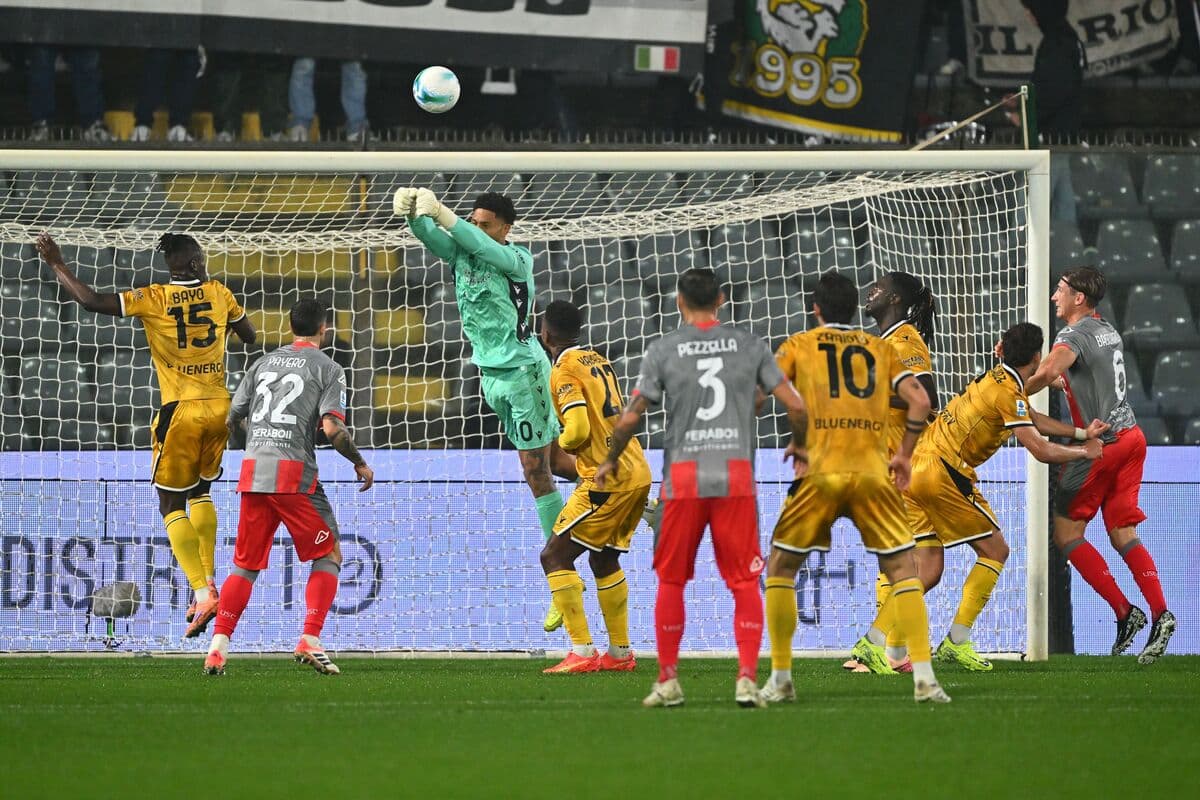
The decisive moment came before the interval, reflected in the half‑time score of 0–1. Once ahead, Cremonese leaned into what their season stats suggest they can do: protect a margin. On their travels they had already kept 5 clean sheets despite conceding 1.5 goals per away game on average. That paradox – a side either shipping multiple goals or locking the door entirely – tilted towards resilience in Udine, with Audero and his back three repelling crosses and direct balls aimed at Davis and Buksa.
From a “Hunter vs Shield” perspective, the duel between Davis and Cremonese’s defence encapsulated the contest. Davis, with 44 dribbles attempted and 30 successful, usually thrives when he can isolate defenders. But Giampaolo’s compact 5‑3‑2 out of possession rarely allowed him single coverage; Luperto and Bianchetti stepped in aggressively, while Grassi screened the central lane. On the other side, Bonazzoli hunted against a Udinese rearguard that, despite conceding only 1.3 goals per game overall, has occasionally collapsed in key moments. Here, one precise attacking sequence was enough.
In the “Engine Room”, Udinese’s Karlstrom and Miller tried to orchestrate, but without Zaniolo’s vertical dribbling and with Cremonese’s midfield three compressing space, the hosts lacked the extra gear to unpick a low block. For Cremonese, Pezzella’s dual identity – part wide outlet, part enforcer – and Thorsby’s industry gave them enough ball‑winning to launch counters and enough composure to slow the tempo when needed.
Statistically, the pre‑match Expected Goals landscape would have tilted slightly towards Udinese: a mid‑table side, at home, facing a relegation candidate that scores only 0.7 goals per away game and has failed to score in 10 away fixtures. Yet defensive solidity and game‑state management overrode those probabilities. Udinese’s 11 clean sheets overall and Cremonese’s identical total hinted that one goal might decide it; the visitors found it, and then leaned on structure and suffering to see it through.
Following this result, the narrative is of a Cremonese side that, despite a -22 goal difference and chronic scoring issues, still possesses the tactical clarity and defensive discipline to win knife‑edge games. Udinese, meanwhile, are reminded that without their primary creator and with a home attack averaging only 0.9 goals, even a well‑drilled 3‑5‑2 can run aground against a desperate, organised opponent.