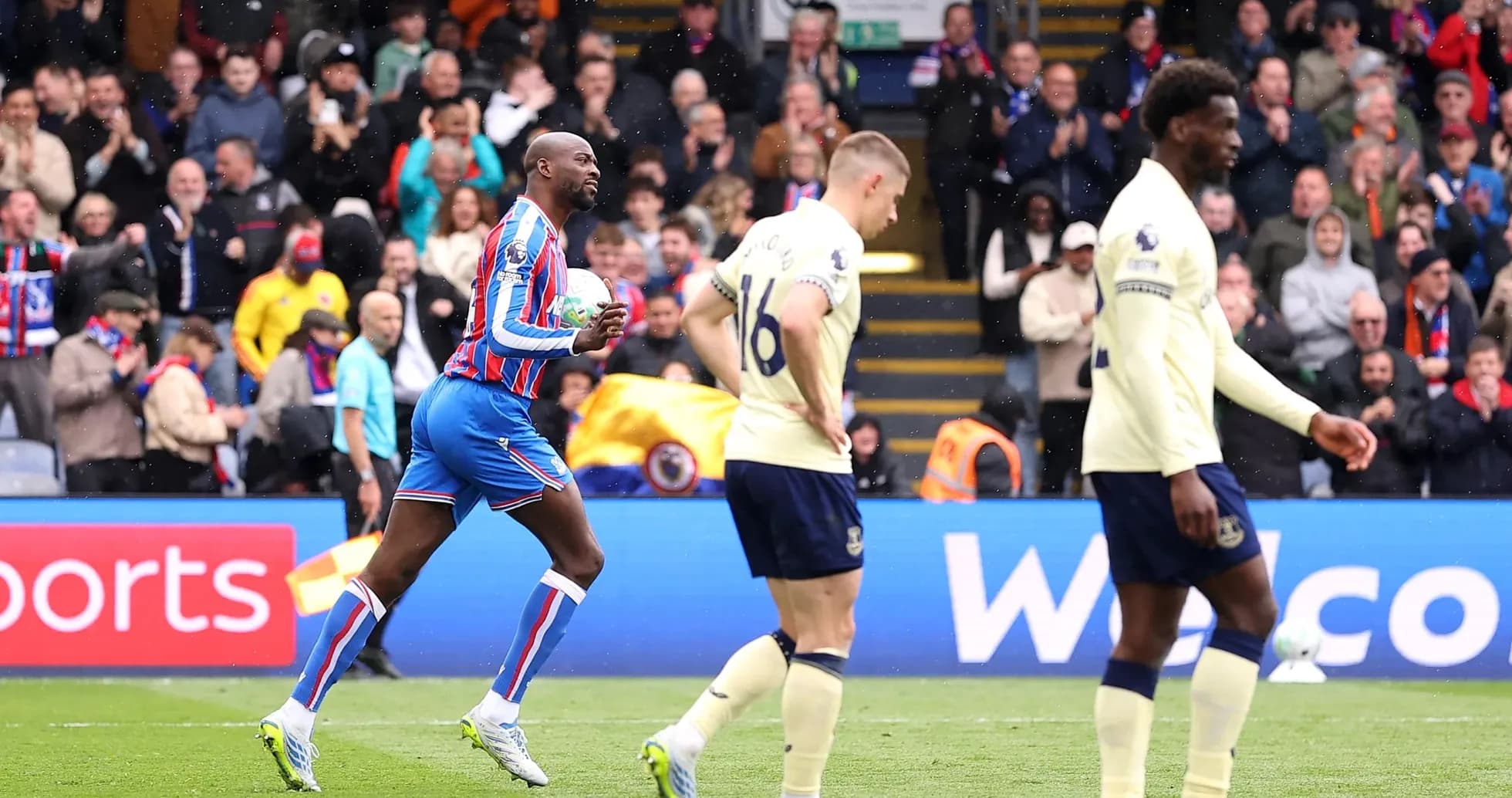
Crystal Palace vs Everton: A 2-2 Draw at Selhurst Park
Selhurst Park had the air of a late-season crossroads as Crystal Palace and Everton shared a 2-2 draw in a Premier League contest that said as much about their evolving identities as it did about the points dropped. Match Finished, regular time only, and yet the narrative felt anything but settled.
Heading into this game, Palace were 15th with 44 points, their goal difference of -6 a precise reflection of a campaign defined by fine margins: 38 goals scored and 44 conceded overall. Everton arrived safer and slightly surer of themselves in 10th on 49 points, with a perfectly balanced goal difference of 0 from 46 goals for and 46 against. The table framed this as mid-table comfort; the football suggested two sides still testing the limits of what they might become.
I. The Big Picture: Structures and Seasonal DNA
Oliver Glasner doubled down on his structural manifesto, rolling again with the 3-4-2-1 that has become Palace’s default setting. Across the season they have used it in 31 league matches, and the lineup here was a pure expression of that shape.
Daniel Henderson anchored the back three of J. Canvot, Maxence Lacroix and Chris Richards, a triangle built less on raw dominance and more on coordinated aggression. Ahead of them, the wing-backs and double pivot underlined Palace’s hybrid nature: Daniel Muñoz and Tyrick Mitchell stretching the width, Adam Wharton and Daichi Kamada controlling the centre, with Ismaïla Sarr and B. Johnson floating behind J. S. Larsen.
This is a side that at home averages 1.0 goals for and 1.2 goals against per match. Selhurst has not been a fortress, but it has been a theatre of tension: 18 goals scored and 21 conceded in 18 home games, 7 clean sheets but also 7 home matches where they failed to score. The 2-2 draw fits that profile – chaotic, fragile, and never entirely under control.
Everton, by contrast, arrived with a more traditional spine, even if the formation was not explicitly logged on the day. Their season template is clear: 4-2-3-1 in 21 games, occasionally 4-3-3. Here, Jordan Pickford sat behind a back four of J. O’Brien, James Tarkowski, Michael Keane and Vitalii Mykolenko. In front, Tim Iroegbunam and James Garner formed the engine, with M. Rohl, K. Dewsbury-Hall and I. Ndiaye supporting Beto.
Everton’s season numbers tell of a team that walks the tightrope but rarely falls: on their travels they have scored 21 and conceded 22 in 18 away games, averaging 1.2 goals for and 1.2 against. They are compact, pragmatic, and often rely on moments rather than waves. The 2-2 scoreline, with parity at both half-time and full-time, mirrored that equilibrium.
II. Tactical Voids: Absences and Discipline
Both managers had to stitch around significant absences.
For Palace, the continued loss of C. Doucoure (knee injury) removed a natural ball-winner and transition anchor from midfield. E. Guessand and E. Nketiah, both sidelined with knee and thigh injuries respectively, stripped Glasner of alternative attacking profiles, while B. Sosa’s injury limited flexibility on the left flank. The result was a bench heavy on technical midfielders – W. Hughes, J. Lerma, Y. Pino, J. Devenny, R. Cardines – but lighter on like-for-like forwards, with J. Mateta the lone recognised striker option in reserve.
Everton’s problems ran through the spine. Jarrad Branthwaite’s hamstring injury forced reliance on the Keane–Tarkowski axis, a pairing that can dominate in the air but is less comfortable when dragged wide or attacked in space. The absence of Idrissa Gueye removed their best pure destroyer from the pivot, while J. Grealish, missing with a foot injury despite being one of the league’s top assist providers, left a creative void between the lines.
Disciplinary trends framed the risk profiles. Palace’s yellow-card distribution this season shows a spike in the 31-45 minute window, where 19.72% of their yellows arrive, and a steady stream through 46-60 (18.31%). Everton, meanwhile, are at their most combustible late: 21.74% of their yellows come between 76-90 minutes, with another 20.29% in the 46-60 range. This match, tight and emotionally charged, played directly into those patterns, with both midfields walking a disciplinary tightrope as legs tired and distances grew.
III. Key Matchups: Hunter vs Shield, Engine vs Enforcer
The most intriguing “Hunter vs Shield” duel was conceptual rather than strictly positional. Palace’s primary scoring threat across the season has been Jean-Philippe Mateta, with 11 league goals from 29 appearances. He started on the bench here, but his presence in reserve shaped Everton’s defensive behaviour. Tarkowski and Keane had to manage not only Larsen’s movement but also the looming possibility of Mateta entering as a late-game finisher.
Everton’s shield, in structural terms, is a unit rather than an individual. On their travels they concede 1.2 goals per match, underpinned by disciplined line-keeping and penalty-box dominance. Yet without Branthwaite and Gueye, that shield was thinner. Any introduction of Mateta would have targeted the aerial zones between Keane and Tarkowski, especially at the back post, and the second phases around Garner and Iroegbunam.
In the “Engine Room”, the duel between Kamada and Wharton on one side and Garner and Iroegbunam on the other was decisive. Garner, one of the league’s premier chance creators with 7 assists and 52 key passes, is also Everton’s top yellow-card collector with 11 bookings. His role is double-edged: progress the ball, then immediately counter-press. Palace’s task was to pull him into uncomfortable defensive zones, forcing him to choose between a tactical foul and space opening behind him.
Kamada’s capacity to receive between the lines and switch play, combined with Wharton’s tempo control, repeatedly asked Everton whether they could compress the central lane without exposing the half-spaces. With Sarr and Johnson drifting inside, Palace tried to overload the channels around O’Brien and Mykolenko, testing Everton’s lateral coverage without Gueye’s sweeping presence.
At the back, Lacroix’s influence was quietly central. Across the season he has blocked 17 shots, a marker of his proactive defending. Here, his reading of Beto’s runs and willingness to step into duels early were vital in preventing Everton’s lone striker from pinning Palace deep for extended spells.
IV. Statistical Prognosis: xG Shadows and Defensive Solidity
While explicit xG numbers are not provided, the statistical scaffolding of both seasons offers a clear frame. Heading into this game, Palace’s overall averages of 1.1 goals scored and 1.3 conceded per match, combined with Everton’s 1.3 for and 1.3 against, pointed towards a narrow, multi-goal contest with neither side likely to completely shut the other down. A 2-2 draw fits snugly within those expected ranges.
Palace’s 12 clean sheets overall underline that, when their structure holds, they can be defensively sound. Yet the home record – 21 conceded in 18 – suggests that once their press is broken, they struggle to fully close games out. Everton’s 11 clean sheets, 5 of them away, reflect a team more comfortable in containment, but their away record of 22 conceded in 18 matches shows they almost always give up something.
Penalties offered no hidden volatility: Palace are perfect from the spot this season, scoring all 7 they have taken, while Everton have converted both of their 2. There were no misses hanging over either side, no psychological scars from the spot to distort decision-making in the box.
Following this result, the story is one of trajectories more than table positions. Palace, still in 15th, remain a work in progress under Glasner, their 3-4-2-1 producing both structural promise and emotional chaos. Everton, steady in 10th, continue to inhabit the space between solidity and ambition, their balanced goal difference mirrored in a performance that was as resilient as it was vulnerable.
In tactical terms, this 2-2 was less a dead end than a branching path: Palace learning how to turn structural dominance into control, Everton discovering what they lose – and what they must reinvent – without the injured pillars of Branthwaite, Gueye and Grealish.