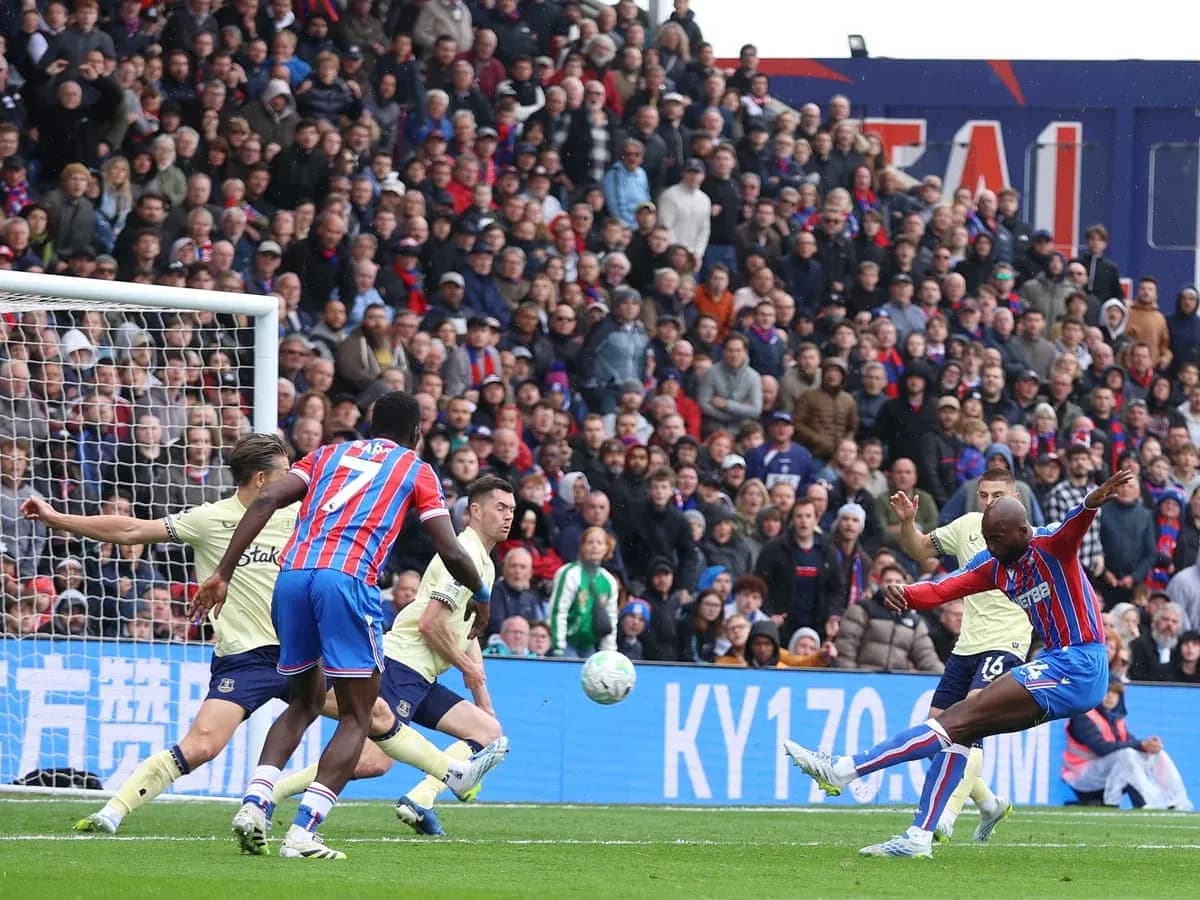
Crystal Palace vs Everton: Tactical Analysis of a 2-2 Draw
Crystal Palace and Everton shared a 2-2 draw at Selhurst Park in Premier League Regular Season - 36, a match where contrasting structures and approaches produced a tactically rich stalemate. Palace, in Oliver Glasner’s 3-4-2-1, dominated territory and the ball but had to come from behind twice after early and then second-half Everton strikes. Everton’s 4-2-3-1 leaned on compactness, direct play and set-piece threat, with Jordan Pickford and the centre-backs absorbing sustained pressure as Palace generated superior shot volume and xG but could not find a decisive third goal.
I. Scoring Sequence & Disciplinary Log
Everton struck first on 6', when James Tarkowski converted a “Normal Goal” to give the visitors a 0-1 lead, immediately validating their set-piece and aerial focus. The first disciplinary action came at 30':
30' James Garner (Everton) — Foul
That yellow underlined Everton’s willingness to disrupt Palace’s rhythm in midfield. Palace responded on 34', Ismaïla Sarr finishing a “Normal Goal” to level at 1-1, a reward for growing control in wide and half-space zones.
On 45', the second booking arrived:
45' Vitaliy Mykolenko (Everton) — Foul
Everton thus reached halftime with both full-space control issues and disciplinary risk on the left side, but the scoreline at 45' was Crystal Palace 1-1 Everton.
Right after the restart, Everton reasserted their lead: on 47', Beto finished a “Normal Goal” assisted by Tarkowski, pushing the score to Crystal Palace 1-2 Everton and highlighting Everton’s direct, vertical punch. Glasner’s first adjustment came on 65': Jørgen Strand Larsen (OUT) was replaced as Jean Philippe Mateta (IN) came on for him, adding a more penalty-box-oriented striker profile.
On 70', Everton mirrored that centre-forward refresh: Beto (OUT) departed as Thierno Barry (IN) came on for him, maintaining a focal point but with fresher legs to press and run channels. Palace’s pressure finally told again on 77', when Jean Philippe Mateta scored a “Normal Goal” to make it 2-2, justifying Glasner’s substitution vector.
Further midfield reshaping followed on 80': Brennan Johnson (OUT) made way as Jefferson Lerma (IN) came on for him, moving Palace toward greater central stability and second-ball control. At the same minute, Everton altered their attacking midfield: Merlin Röhl (OUT) left as Tyrique George (IN) came on for him, adding fresh running in the line of three. In added time, Everton adjusted their advanced midfield again: on 90+4', Kiernan Dewsbury-Hall (OUT) was withdrawn as Carlos Alcaraz (IN) came on for him, a late attempt to inject energy and ball-carrying.
Card totals from the events are locked as: Crystal Palace: 0, Everton: 2, Total: 2.
II. Tactical Breakdown & Personnel
Palace’s 3-4-2-1 was built around controlled possession and width from the wing-backs. Chris Richards, Maxence Lacroix and Jaydee Canvot formed a back three tasked with initiating play and defending transitions against Beto’s runs. Daniel Muñoz and Tyrick Mitchell operated as nominal midfielders but functionally as wing-backs, stretching Everton’s 4-2-3-1 horizontally and pinning full-backs, especially Mykolenko, who was already under disciplinary pressure by halftime.
Central to Palace’s circulation were Adam Wharton and Daichi Kamada as the double pivot. Wharton provided tempo and vertical passes into the half-spaces, while Kamada linked phases, stepping into pockets behind Everton’s first pressing line. Ahead of them, Ismaïla Sarr and Brennan Johnson supported Jørgen Strand Larsen, attacking the channels between full-back and centre-back. Sarr’s goal on 34' reflected Palace’s capacity to exploit those inside-right lanes when Everton’s block was stretched.
Glasner’s key in-game shift was the 65' substitution: Jean Philippe Mateta (IN) came on for Jørgen Strand Larsen (OUT). Mateta’s more classic No. 9 profile allowed Palace to attack more directly into the box, using crosses and cut-backs from Muñoz and Mitchell. His equaliser on 77' underlined how Palace’s structure funneled play into high-value central areas; with 15 shots inside the box out of 21 total, the system consistently created close-range opportunities.
Everton’s 4-2-3-1, without a listed coach in the data, leaned heavily on the double pivot of Tim Iroegbunam and James Garner to screen the back four and contest Palace’s central combinations. Garner’s yellow card for “Foul” at 30' showed the physical edge required to disrupt Kamada and Wharton, but it also slightly reduced his margin for aggressive pressing afterward. In the back line, Tarkowski and Michael Keane were central to defending the box, while Tarkowski’s goal and assist illustrated Everton’s reliance on set-pieces and direct deliveries.
Merlin Röhl, Kiernan Dewsbury-Hall and Iliman Ndiaye formed the band of three behind Beto, tasked with transitioning quickly when Everton recovered possession. Beto’s 47' goal, assisted by Tarkowski, captured Everton’s directness: using early balls into the striker and capitalising on second phases. The later substitutions — Thierno Barry (IN) for Beto (OUT) on 70', Tyrique George (IN) for Merlin Röhl (OUT) on 80', and Carlos Alcaraz (IN) for Kiernan Dewsbury-Hall (OUT) at 90+4' — were about maintaining energy and running power in attack rather than changing the fundamental structure.
In goal, Dean Henderson for Palace registered 5 saves, aligning with Everton’s 6 shots on target and underlining his role in preventing the visitors from overperforming their 1.44 xG. Jordan Pickford, with 6 saves against 8 Palace shots on target, was even more central: his shot-stopping was crucial in holding Palace to 2 goals from 2.66 xG, especially as Palace increased the volume and quality of chances after Mateta’s introduction.
III. The Statistical Verdict
The statistical profile reinforces the tactical story. Palace dominated possession with 59% to Everton’s 41%, completing 459 passes, 382 accurate (83%), compared to Everton’s 313 passes, 232 accurate (74%). That passing superiority, combined with 21 total shots (8 on goal) and 2.66 xG, reflects a side structurally set up to control territory and generate sustained pressure, particularly through wing-back width and a crowded central lane.
Everton, with 13 total shots and 6 on goal, produced fewer but relatively efficient attempts, matching their 1.44 xG with 2 goals. Their 10 corner kicks to Palace’s 5 show how often they turned limited attacking phases into set-piece platforms, exactly where Tarkowski and Beto did their damage. Defensively, Everton’s 13 fouls and 2 yellow cards versus Palace’s 5 fouls and 0 cards underline a more combative, disruptive approach, especially in midfield and on the flanks.
Goalkeeper performance was broadly symmetrical in raw saves (Henderson 5, Pickford 6), but context matters: Palace’s higher xG and shot volume meant Pickford faced more sustained pressure, while Henderson’s interventions were about preventing Everton’s more sporadic but dangerous direct attacks from deciding the match. Both sides finished with two goals, but the underlying metrics suggest Palace’s structure and ball dominance merited more, while Everton maximised their set-piece and direct play model to extract a point.