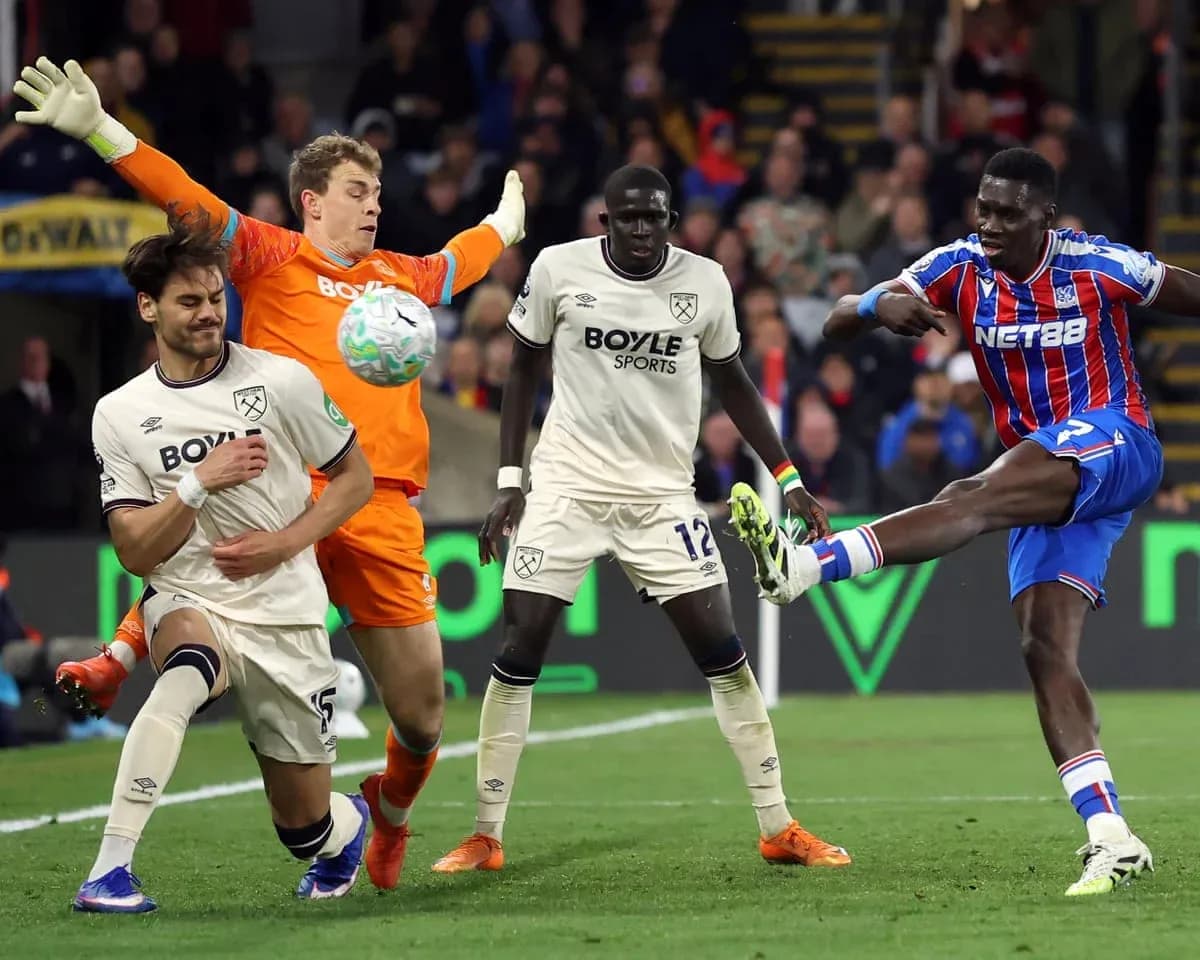
Crystal Palace and West Ham Draw 0–0 in Tactical Stalemate
Selhurst Park hosted a tight, tactical stalemate as Crystal Palace and West Ham cancelled each other out in a 0–0 draw in Premier League Regular Season - 33. Palace’s 3-4-2-1 structure sought to dominate territory and possession, while West Ham’s 4-4-1-1 prioritised compactness and fast transitions. The numbers underline the balance: both sides finished with nine total shots, and xG remained low and close (0.73 for Palace, 0.61 for West Ham), reflecting a match of half-chances rather than clear openings. Palace edged the ball and passing metrics, but West Ham carried the sharper threat in front of goal, forcing more saves despite less possession.
The scoring sequence was simple: there were no goals, and the halftime score of 0–0 accurately reflected a first period where both teams probed without breaking defensive lines. Palace’s best work came through structured possession rather than penetration, while West Ham’s front pair of Pablo Felipe and Valentín Castellanos offered vertical runs but without a decisive final action.
Disciplinary incidents began on 21', when Brennan Johnson received a yellow card for a foul, a moment that slightly tempered Palace’s aggression in the press on his flank. The game remained controlled until stoppage time, when emotions finally surfaced. At 90+2', Daniel Muñoz was booked for argument, signalling frustration more than tactical disruption. Seconds later, also at 90+2', El Hadji Malick Diouf collected a yellow card for a foul, West Ham’s only caution of the evening. No reds were shown, and there were no VAR goal interventions to shape the narrative; the contest remained decided purely by structure, duels, and decision-making in open play.
Tactical Overview
Tactically, Palace’s 3-4-2-1 was built on a back three of Chris Richards, Maxence Lacroix, and Jaydee Canvot, with Muñoz and Tyrick Mitchell as wing-backs. Jefferson Lerma and Will Hughes formed the central pivot, with Yéremy Pino and Brennan Johnson supporting Jørgen Strand Larsen. The system delivered control: 54% possession, 454 total passes at 81% accuracy, and a territorial feel of dominance. Yet the attacking output exposed a key limitation: just one shot on target from nine attempts, and an xG of 0.73 that matched the eye test of a side circulating the ball well but rarely accessing high-value central zones.
Palace’s wing-backs were crucial. Muñoz advanced aggressively on the right, often stepping into midfield to create a 3-2-5 in possession, while Mitchell provided width and underlaps on the left. However, West Ham’s narrow 4-4-1-1 block, with Tomáš Souček and Mateus Fernandes screening the back four, forced Palace wide and into lower-quality shooting positions—reflected in four shots from outside the box and only five inside it, most under pressure.
The triple substitution on 59' was a clear tactical pivot from Palace. Daichi Kamada (IN) came on for W. Hughes (OUT), adding more vertical passing and late runs from midfield. Ismaïla Sarr (IN) replaced Y. Pino (OUT), injecting direct pace on the flank, while Jean-Philippe Mateta (IN) came on for J. S. Larsen (OUT), offering a more physical, penalty-box presence. The intention was obvious: turn sterile possession into penalty-area occupation. Yet West Ham’s centre-back pairing of Konstantinos Mavropanos and Axel Disasi handled crosses and duels well, and Palace’s xG remained modest despite the attacking reshuffle.
At 78', Justin Devenny (IN) came on for B. Johnson (OUT), further tilting Palace towards technical control between the lines, but without fundamentally altering the shot profile. Palace’s Overall Form in this match read as controlled but blunt; defensively, their structure was sound, conceding only nine shots and an xG of 0.61, indicating a solid Defensive Index performance.
West Ham's Tactical Approach
West Ham’s 4-4-1-1 had Mads Hermansen in goal behind a back four of Kyle Walker-Peters, Mavropanos, Disasi, and Diouf. Jarrod Bowen and Crysencio Summerville operated as wide midfielders, with Souček and Fernandes central, Pablo Felipe in the support role, and Castellanos as the lone striker. Out of possession, West Ham were compact and horizontally tight, allowing Palace to have the ball but aggressively contesting entries into zone 14 and the half-spaces.
In transition, West Ham were more incisive than Palace despite having less of the ball (46% possession). They matched Palace’s nine shots but produced four on target versus Palace’s one, reflecting better shot selection and more effective use of counters. Hermansen had to make only one save, while Dean Henderson made three, underlining that West Ham’s attacking sequences asked more direct questions of the goalkeepers.
West Ham’s substitutions were conservative but logical. On 75', Callum Wilson (IN) came on for Pablo (OUT), shifting the attacking reference point to a more traditional penalty-box striker and allowing Castellanos to vary his movement. At 84', Mohamadou Kanté (IN) replaced T. Castellanos (OUT), freshening legs in the attacking band while maintaining the 4-4-1-1 structure. These changes preserved West Ham’s defensive stability while keeping a counter-attacking outlet, but did not significantly alter the xG profile.
Statistical Summary
Statistically, the match was finely poised. Palace: 54% possession, nine shots (one on target), four corners, 454 passes at 81% accuracy, 13 fouls, two yellow cards, three saves by Henderson, xG 0.73. West Ham: 46% possession, nine shots (four on target), six corners, 366 passes at 74% accuracy, 12 fouls, one yellow card, one save by Hermansen, xG 0.61. Both goalkeepers recorded zero goals prevented by the model, consistent with a game of relatively low-quality chances.
From a Statistical Verdict standpoint, Palace’s Overall Form on the ball was positive—control, circulation, and field position—but their attacking efficiency lagged behind their possession share. Defensively, their Defensive Index was strong, limiting West Ham to low xG despite conceding more shots on target. West Ham, conversely, showed a pragmatic Overall Form: less of the ball but more incisive in the final third, and a solid Defensive Index anchored by a compact block and effective central defending. The 0–0 outcome, supported by the xG balance and save counts, accurately reflects a match where neither side did quite enough to merit all three points.