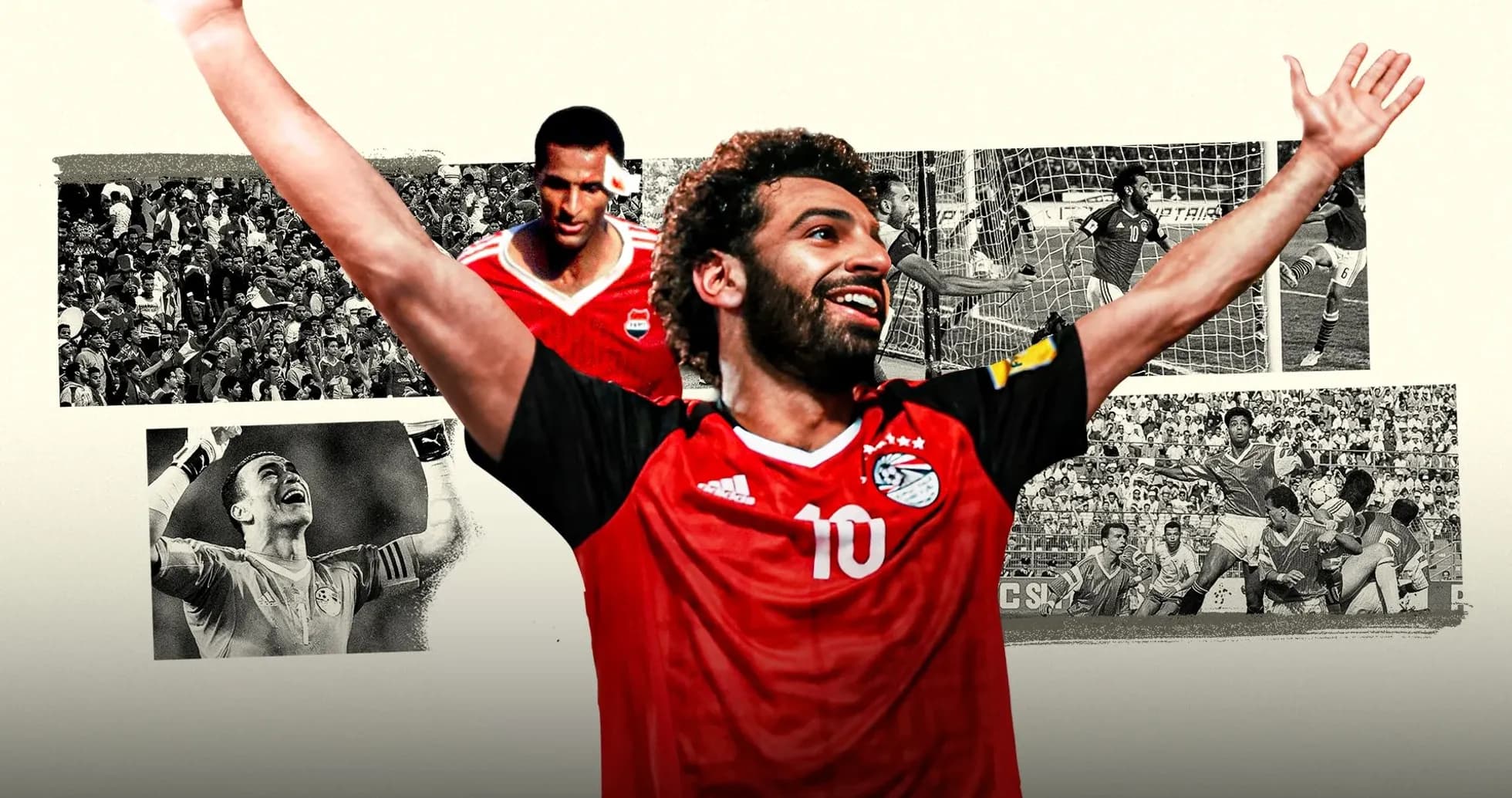
Egypt's Football Journey: From 1934 to the World Cup
In 1934, before television, before replays, before football became a global industry, there was a ship cutting slowly across the Mediterranean and a crackling radio signal trying to keep up.
On board that ship were 11 Egyptians and a dream that felt bigger than the ocean.
The First Cry
Egypt’s national team sailed to Italy to become the first Arab and African country to appear at a World Cup. The journey was long, the vessel old, the comforts few. None of it mattered. They had come through qualifying wins over Palestine; they had earned the right to step into a world that had barely heard their name.
In Rome, they met Hungary, one of Europe’s giants. Egypt lost 4-2, but the scoreline never told the full story. Abdelrahman Fawzi scored twice, the first African player ever to score at a World Cup. A statistic on paper, a revolution in the alleys of Cairo.
There, people huddled around radios, straining to catch every broken word through the static. Smiles broke out. Hands clapped. Eyes filled with a new kind of pride. In that moment, a nation realised football could carry its flag to the furthest corners of the world.
Then, silence.
War came. Guns drowned out the sound of crowds. Egypt rebuilt itself with bricks and sweat, while the World Cup became something distant, followed only in black-and-white photos and small-print headlines.
Generations of talent emerged. Saleh Selim. Taha Ismail. Hassan Shehata. Mahmoud El Khatib. In Africa, Egypt ruled. They lifted trophies, built a continental dynasty. Yet the World Cup remained a faraway light in the night sky: visible, but untouchable.
Return to the World Stage
Fifty-six years after that first voyage, the silence finally broke.
In 1990, under the stern, meticulous leadership of Mahmoud El Gohary, Egypt clawed its way back to the World Cup. The qualifiers were a grind, every match a test of nerve. Then came the defining moment: Hossam Hassan’s goal against Algeria.
That night, the streets turned into rivers of people. Flags streamed from balconies. Car horns, drums, and chants merged into a single roar. Egypt had broken through its glass ceiling.
In June, the Pharaohs returned to Italy, this time to Palermo, to face the European champions, the Netherlands. The names on the other side were intimidating: Marco van Basten, Ruud Gullit, Frank Rijkaard. The first half ended goalless, Egypt organised and unafraid.
In the 58th minute, Wim Jonk finally broke through after a Van Basten cross. For many teams, that would have been the moment the resistance cracked. Egypt refused to fold.
Then came the 83rd minute. Hossam Hassan burst into the box, was dragged down, and the referee pointed to the spot. A nation held its breath.
Magdy Abdelghany stepped up. One deep breath. One clean strike. Goal.
“Goal for Egypt!” the commentator screamed. Years later, Abdelghany would turn that penalty into a running joke, reminding fans of it at every opportunity, as if it were the only thing Egypt had ever done in football. But in that instant, it was something else entirely.
It was a bridge. From Fawzi in 1934 to Abdelghany in 1990. From radio static to colour television. From one generation of believers to the next.
The match finished 1-1. On paper, a draw. In Egyptian hearts, a victory.
Next came Ireland. Ninety minutes of tension, sweat, and shouting. Egypt’s defence held its line with stubborn defiance. Ahmed Shobeir, in goal, treated every shot as if it were a final exam. He saved, delayed, and disrupted, his time-wasting so brazen that many fans around the world later linked it to FIFA’s introduction of the back-pass rule.
The match ended 0-0. Another draw that felt like more.
People began to ask: who are these Africans fighting like lions? The media found a label: “The solid Egyptian team.”
England followed. A narrow 1-0 defeat, a match played largely under pressure, but not under fear. El Gohary refused to treat it as failure. “We’ve planted the seed today… Someone will harvest it tomorrow,” he said.
He had no idea that the boy who would harvest it was growing up in a small village called Nagrig.
The Egyptian King
Mohamed Salah’s story is now football folklore. From Al Mokawloon to Basel, Chelsea to Fiorentina, Roma to Liverpool. Each move a step. Each goal another chapter.
In the 2018 World Cup qualifiers, he became more than a star. He became the heartbeat. His goals dragged Egypt forward. His presence turned hope into expectation.
One night at Borg El Arab, that expectation finally exploded.
Egypt needed a win against Congo. The score stood at 1-1 as the match crept into stoppage time. The stadium felt like it was holding its breath. Commentator Medhat Shalaby’s voice climbed with every attack: “Give us something, ya akhi!”
Then, in the 94th minute, Trezeguet went down in the box. Penalty. Shalaby’s cry cut through the chaos: “Allahu Akbar!”
Salah picked up the ball. Placed it on the spot. A faint smile. Then the strike.
The net bulged. The stadium shook. Alexandria roared as if the sea itself had joined in. People poured into the streets. Children cried tears they didn’t fully understand. After 28 years, Egypt were going back to the World Cup.
One month before Russia 2018, Kyiv hosted the Champions League final: Real Madrid vs Liverpool. The world’s cameras tracked Salah’s every step. His “Egyptian King” chant echoed through the city. This was supposed to be his coronation.
Instead, it became a nightmare.
Midway through the first half, a tangle with Sergio Ramos sent Salah crashing to the turf. He clutched his shoulder, grimaced, tried to rise. He couldn’t. The pain turned to tears as he walked off.
In Cairo, noise died. Cafes fell silent. Screens froze on Salah’s face. Children who had been dancing now stared, motionless. It felt as though an entire country had gone down with him.
Weeks later, he came back. Not fully fit, but unbroken. His message was simple: “Bodies may fall… But dreams never do.”
Russia: Pain and Perspective
At Russia 2018, Egypt returned to the World Cup stage for the first time since 1990. The script, however, did not follow the dream.
Salah, nursing that damaged shoulder, started on the bench against Uruguay. Even without him, Egypt defended with remarkable discipline. They frustrated the South Americans, created belief, and seemed set for a precious point.
Then, in the 89th minute, came the blow. A late goal, a 1-0 defeat. Cruel. The performance suggested this would not define their tournament. The reality turned out harsher.
“Wait until Salah returns. Everything will change,” people said before the second match, against hosts Russia in Saint Petersburg. Salah started, smiling for the cameras, but his body still betrayed the pain.
By the time he scored from the penalty spot, Egypt were already 3-0 down. His goal was a consolation, not a lifeline. The tournament, effectively, was over with a game to spare.
He scored again in the final group match against Saudi Arabia. Another neat finish, another reminder of his quality. The result, though, was the same. Defeat. Egypt went home without a single point.
The Hardest Chapter
After Russia, the story darkened.
The same core of players returned to host AFCON 2019 on home soil. Expectations soared. The script felt familiar: packed stadiums, a nation behind them, a trophy waiting at the end.
Instead, South Africa arrived in the last 16 and tore the script in half. Egypt crashed out. The shock reverberated from Alexandria to Aswan. The questions grew louder.
Two years later, in Cameroon 2021, Egypt walked into a different kind of tournament. Humid air, difficult pitches, draining travel. Their performances were far from perfect, but the spirit changed.
Salah led a team that played with grit and heart. They lost to Nigeria in their opener, then rose. Ivory Coast fell. Morocco fell. Cameroon, the hosts, fell. Each step came with extra time, penalties, and frayed nerves.
In the final against Senegal, Egypt went to penalties for the third time in the tournament. This time, fate twisted in a new way. The shootout ended before Salah could even take his kick. Senegal lifted the trophy. Egypt were left with the familiar sting of what-ifs.
Weeks later, the two sides met again, now with a World Cup place for 2022 on the line. Again, the tie went to penalties. Again, the spotlight found Salah.
He stood on the spot, lasers flashing across his face from the stands, green beams cutting through the night. He looked calm, composed. Then he struck.
The ball flew over the crossbar and into the darkness.
Egypt froze. The dream of another World Cup disappeared in a single heartbeat. Yet the belief did not die. Dreams built over nearly a century do not collapse in one missed kick.
A New Generation, Same Dream
Then came the 2026 qualifiers. This time, Salah was no longer a lone hero dragging a nation on his shoulders. Around him stood a new generation who had grown up watching his rise, his falls, his comebacks. To them, he was not a distant superstar. He was an older brother.
From the opening match against Djibouti, something felt different. Egypt were organised, compact, and hungry. The fear that had once crept into big games seemed to have vanished.
Salah still scored, of course. But now Omar Marmoush buzzed around him, stretching defences. Ahmed Sayed “Zizo” dazzled, threading passes and carrying the ball with swagger. The attack no longer revolved around one man; it moved as a unit.
On the touchline, Hossam Hassan lived every second. He paced, shouted, gestured, demanded. “Press! Don’t back down!” was more than an instruction; it was a manifesto.
He restored an identity that had been missing. Egypt looked like Egypt again: intense, combative, united. Young players who had once watched Salah on television now exchanged one-twos with him under the floodlights.
Match by match, the unbeaten run grew. Ten qualifiers. Eight wins. Two draws. No panic, no drama, just a steady march to the top of the group. When the final whistle blew on the last qualifier, there were no wild scenes.
Hossam Hassan stood on the sideline and allowed himself a quiet smile. The first mission was complete. The players celebrated, but with restraint, as if to say: this is only the beginning.
Now, the gaze turns to the World Cup once more.
Hassan is already plotting. Salah, battle-scarred but still burning with the same fire that carried him from Nagrig to the world, has made his promise: “This time, it won’t just be about taking part.”
For a country that first dared to dream in 1934, the question is no longer whether Egypt belongs on the biggest stage.
It’s what they are finally ready to do when they get there.