Espanyol's Tactical Mastery in 2-0 Victory Over Athletic Club
Espanyol’s 2-0 win over Athletic Club at RCDE Stadium was built on structural control rather than sheer chance creation. Manolo Gonzalez set his side up in a classic 4-4-2 that dominated the ball (63% possession) and, crucially, controlled where the game was played. Ernesto Valverde’s 4-2-3-1 carried threat in transition and produced a similar xG profile (0.76 vs 0.82), but Athletic were forced to attack from suboptimal zones and rarely managed to destabilise Espanyol’s back four.
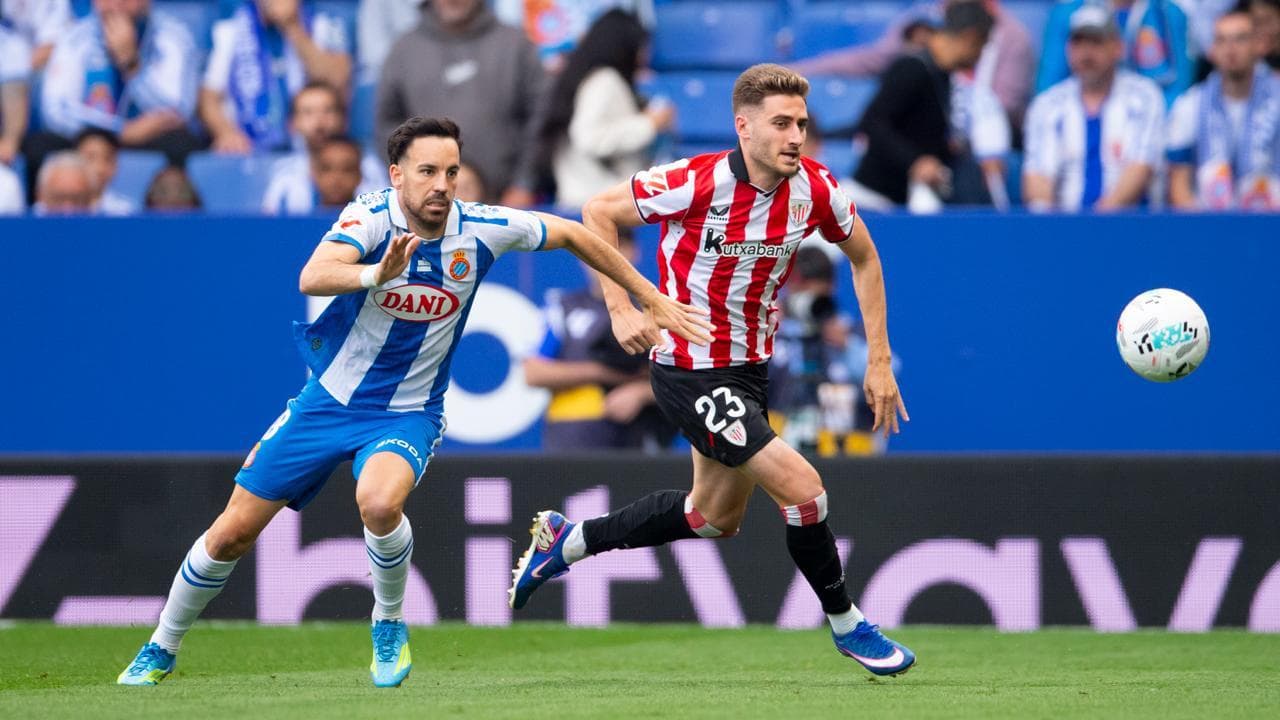
In the first phase, Espanyol’s build-up was methodical. With M. Dmitrovic as a short outlet, centre-backs C. Riedel and L. Cabrera split while full-backs O. El Hilali and C. Romero advanced to pin Athletic’s wide players. The double pivot of U. Gonzalez and P. Lozano (from the starting shape) offered constant angles, creating a 2-4 base in possession. This allowed Espanyol to progress via the flanks, using wide midfielders R. Sanchez and A. Roca to receive on the touchline and combine with the overlapping full-backs.
Athletic’s 4-2-3-1 defended in a mid-block, with I. Williams curving his pressing runs to screen passes into Espanyol’s pivots. Behind him, R. Navarro and A. Berenguer tucked in narrow, trying to congest the central lane and funnel Espanyol outside. The away side accepted a territorial deficit (37% possession) but looked to spring quickly once the ball was regained, using Williams’ depth runs and the supporting movements of U. Gomez between the lines.
Despite Athletic finishing with more shots inside the box (10 to Espanyol’s 7), the pattern of those chances mattered. Many of their looks came from quick, direct attacks where the final action was rushed or from half-clearances after set pieces. Espanyol’s central defensive pairing held a relatively deep line, preferring to protect the space behind rather than compress the pitch aggressively. This choice limited clear one-on-ones for Williams and forced Athletic to attempt low-percentage cutbacks or shots under pressure.
The key tactical shift came on 63 minutes. Gonzalez introduced P. Milla (IN) for A. Roca (OUT) and Jofre (IN) for R. Sanchez (OUT), injecting more verticality and direct running into the wide areas. At the same time, Valverde reshaped his attack with G. Guruzeta (IN) for I. Williams (OUT) and M. Jauregizar (IN) for I. Ruiz de Galarreta (OUT). Athletic moved towards a more penalty-box-focused presence with Guruzeta, but they lost some of Williams’ ability to stretch the back line in behind.
Espanyol’s first goal at 69 minutes crystallised their flank-oriented plan. P. Milla, arriving from the bench into the left-sided channel, finished a move assisted by left-back C. Romero. The pattern was emblematic: full-back advancing high, wide player attacking the half-space, and forwards occupying the centre-backs to open a lane for the late runner. By that stage, Espanyol’s superiority in total passes (492 vs 273) and pass accuracy (386 accurate at 78% vs Athletic’s 180 at 66%) had worn down Athletic’s block, creating the small timing gaps needed for Romero to deliver and Milla to arrive.
Valverde responded with further changes: A. Gorosabel (IN) for J. Areso (OUT) at 71 minutes and N. Serrano (IN) for U. Gomez (OUT) at 78 minutes. These substitutions tilted Athletic towards a more aggressive, crossing-heavy approach from the right, seeking to overload Espanyol’s left side. However, Espanyol’s defensive structure remained compact. The home side’s wide midfielders tracked diligently, effectively turning the back four into a situational back six when defending deep, which helped them manage the nine corner kicks Athletic generated.
Gonzalez’s late-game management was equally decisive. At 84 minutes, R. Terrats (IN) for Exposito (OUT) and K. Garcia (IN) for R. Fernandez Jaen (OUT) refreshed both the midfield engine and the forward line. Terrats provided extra ball security and the ability to carry through pressure, while K. Garcia offered a more mobile, pressing-oriented presence up front. In stoppage time, C. Pickel (IN) for U. Gonzalez (OUT) at 90+1 minutes further solidified the central area.
The second goal at 90 minutes, scored by K. Garcia and assisted by R. Terrats, was the logical endpoint of these adjustments. With Athletic committing numbers forward in search of an equaliser, Espanyol exploited the stretched structure. Terrats’ involvement as provider underlined his role as a press-resistant outlet who could break the first line and then play into space for the fresh striker. The timing – at 90 minutes in regular time – emphasised Espanyol’s capacity to remain dangerous even while protecting a lead.
From a defensive standpoint, both goalkeepers had mixed statistical profiles. Dmitrovic made four saves but registered goals prevented of -0.9, suggesting that, relative to shot quality, he slightly underperformed the model. However, the clean sheet speaks to the collective defensive work: Espanyol allowed 11 total shots, but many were from constrained body positions or crowded zones. At the other end, U. Simon faced 12 shots and made three saves, also posting -0.9 goals prevented. The fact that Espanyol scored twice from an xG of 0.76 points to efficient finishing and some vulnerability in Athletic’s last line when forced to defend wide-to-central combinations.
Discipline-wise, the match was relatively clean in terms of card sanctions (none recorded), but the foul count – 9 for Espanyol and 14 for Athletic – aligned with the tactical narrative. Athletic’s higher foul volume reflected their need to disrupt Espanyol’s rhythm in midfield and halt transitions after turnovers, while Espanyol’s lower count matched their more positionally controlled, possession-based approach.
Statistically, the verdict is clear: Espanyol converted territorial and passing dominance into high-leverage moments, even without generating a huge xG volume. Their 8 corner kicks and repeated wide overloads gradually prised open Athletic’s structure. Athletic’s similar xG and higher number of shots inside the box show they were not outclassed in chance creation, but their attacks were more chaotic and less repeatable in pattern. Over 90 minutes, the contrast in control – 63% vs 37% possession, 492 vs 273 passes – made Espanyol’s 2-0 home win a tactically coherent outcome rather than a smash-and-grab.