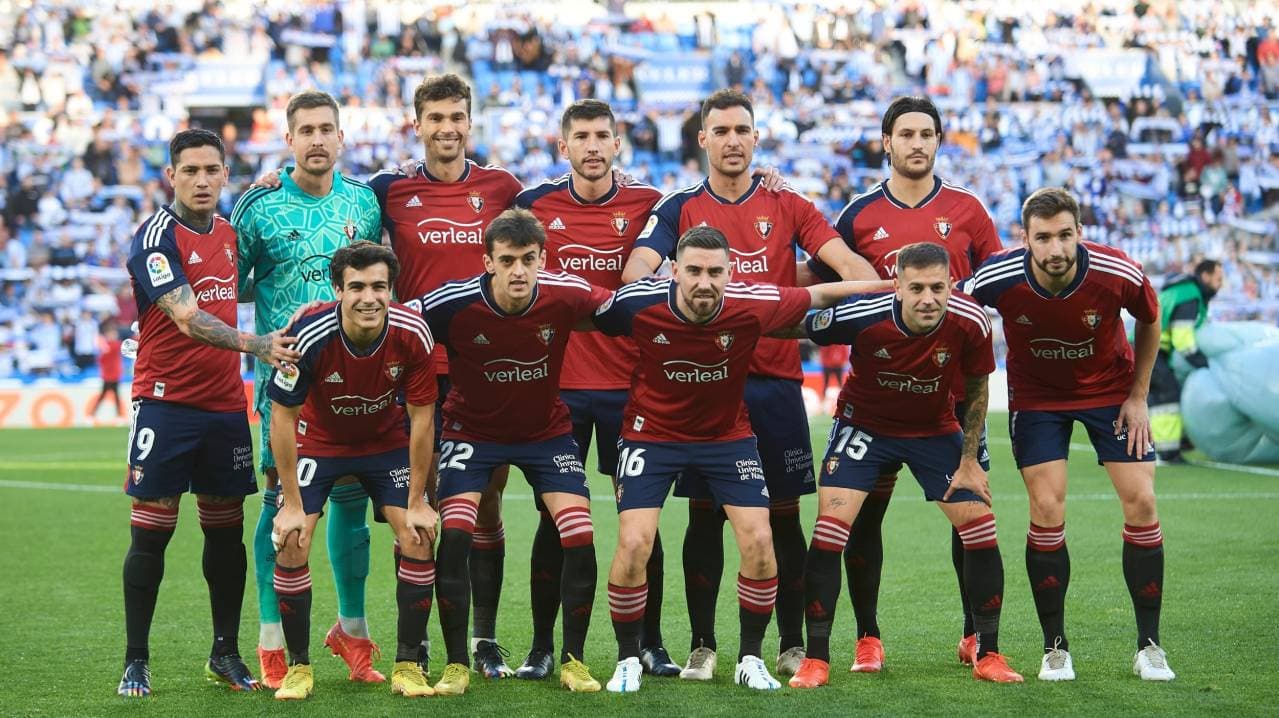
Osasuna's Fragile Season Ends in Defeat to Espanyol
The late-afternoon light at Estadio El Sadar dimmed on a season of strain and survival as Osasuna’s 2–1 home defeat to Espanyol closed the curtain on their home campaign with a familiar mix of courage and fragility. Following this result in La Liga’s Regular Season - 37, the table tells a blunt story: Osasuna sit 16th on 42 points with a goal difference of -5 (44 scored, 49 conceded overall), while Espanyol, now on 45 points with a goal difference of -12 (42 for, 54 against overall), consolidate an 11th-place finish that feels more stable than spectacular.
I. The Big Picture – Structures Under Stress
Alessio Lisci doubled down on Osasuna’s seasonal identity, rolling out the trusted 4-2-3-1 that has been his primary structure (22 league uses). The shape was familiar: Sergio Herrera behind a back four of V. Rosier, Alejandro Catena, F. Boyomo and A. Bretones; a double pivot of L. Torro and Jon Moncayola; then a line of three with R. Garcia, Aimar Oroz and V. Munoz supporting lone striker Ante Budimir.
This was the architecture of a side that has been strong at home but brittle overall. Heading into this game, Osasuna had played 19 times at home, winning 9, drawing 5 and losing 5, scoring 31 and conceding 24 at El Sadar. That home average of 1.6 goals for and 1.3 against contrasted sharply with their away struggles, where they averaged only 0.7 goals for and 1.4 against on their travels.
Espanyol arrived with a 4-4-2 that mirrored their season-long tactical split: a team oscillating between 4-2-3-1 and 4-4-2, but always with a clear spine. M. Dmitrovic anchored the back line of O. El Hilali, C. Riedel, L. Cabrera and C. Romero. Across midfield, T. Dolan and U. Gonzalez flanked central operators Pol Lozano and Pere Milla, while Edu Expósito (listed as Exposito) and K. Garcia formed a flexible front pair, one dropping, one running channels.
Espanyol’s numbers framed their approach: overall they averaged 1.1 goals scored and 1.5 conceded, but away from home that offensive figure ticked up slightly to 1.2 goals for, even as they leaked 1.6 against. This is a side that travels with intent to score, accepting chaos as the price.
II. Tactical Voids – The Missing Pieces and Discipline
Both coaches had to navigate absences that reshaped their benches and, subtly, their plans. Osasuna were without R. Moro, listed as “Missing Fixture” through injury, a loss that narrowed Lisci’s wide attacking options and put more creative burden on V. Munoz and Aimar Oroz between the lines.
Espanyol’s absences were more structurally significant: C. Ngonge and J. Puado, both out with knee injuries, stripped Manolo Gonzalez of two key vertical threats. Without them, the front line leaned heavily on K. Garcia’s movement and Expósito’s ability to drift into pockets rather than simply threaten in behind.
Across the season, discipline has been a volatile undercurrent for both sides. Osasuna’s yellow-card profile shows a late-game spike: 21.35% of their yellows arrive between 76-90', with another 14.61% in the 91-105' range. Espanyol are even more combustible late on, with 30.00% of their yellows in the 76-90' window and 16.67% between 91-105'. This match was always likely to tighten and fray in the final quarter-hour, and the referee Miguel Angel Ortiz Arias walked into a fixture primed for late tension.
Red-card histories only deepened that sense. Catena, already one of the league’s leading yellow collectors with 11, also carries a red this season; on the other side, C. Pickel and Pere Milla have both seen red for Espanyol. Even when they are not on the pitch from the start (as with Pickel here), their histories inform how opponents and officials interpret duels in the middle third.
III. Key Matchups – Hunter vs Shield, and the Engine Room
The headline duel was always going to be “Hunter vs Shield”: Ante Budimir against an Espanyol defence that has creaked all year. Budimir’s campaign has been outstanding: 17 league goals overall from 36 appearances, built on 88 shots with 41 on target. He is not just a finisher but a constant aerial and physical presence, engaging in 365 duels and winning 169. Crucially, his penalty record is not spotless: he has scored 6 but also missed 2, a detail that matters in tight, high-pressure contests where spot-kicks often decide narratives.
Espanyol’s back line, especially away, has been porous, conceding 31 goals on their travels at an average of 1.6 per game. Yet within that fragile unit, L. Cabrera and C. Riedel offered the primary resistance against Budimir’s movement and aerial threat, while O. El Hilali’s 40 interceptions and 15 blocked shots over the season underlined his importance as a covering full-back. The question was whether this “shield” could hold long enough against a striker who thrives on half-chances and second balls around the box.
The “Engine Room” confrontation was just as decisive. For Osasuna, Moncayola’s 1,369 passes and 38 key passes this season have made him the metronome and connector, while L. Torro provided the ballast. Against them stood a snarling Espanyol axis: Pol Lozano and Edu Expósito. Lozano’s profile is that of a classic enforcer-playmaker hybrid—945 passes at 87% accuracy, 38 tackles, 22 interceptions, but also 64 fouls committed and 11 yellow cards (plus a yellow-red). He sets the tone physically.
Beside him, Expósito has been Espanyol’s creative brain: 6 assists, 80 key passes and 965 total passes at 76% accuracy. His ability to drop off the front line, receive between Torro and Moncayola, and turn play forward was the hinge on which Espanyol’s transitions swung. Every time he found space behind Osasuna’s double pivot, K. Garcia and the wide midfielders had lanes to attack.
IV. Statistical Prognosis – xG Shadows and Defensive Reality
Even without explicit xG numbers, the season-long patterns sketch a clear expected-goals landscape. Osasuna at home, averaging 1.6 scored and 1.3 conceded, typically live in narrow margins: games that tilt on a single big chance or a set piece. Espanyol away, at 1.2 for and 1.6 against, inhabit a similar band of volatility.
The 2–1 scoreline fits that probabilistic corridor almost perfectly: Espanyol punching slightly above their usual away scoring rate, Osasuna landing close to their home expectation but undone by defensive slips that echo their overall concession of 49 goals in 37 matches (1.3 per game overall).
Clean-sheet data reinforces the story. Osasuna have managed 7 clean sheets overall (5 at home), Espanyol 10 (5 away). These are not teams built on impermeable structures; they are sides who accept that they will concede and must therefore maximise their own attacking phases. In that context, Espanyol’s more balanced away record—5 wins, 5 draws, 9 losses—gave them a platform to exploit Osasuna’s need to chase the game in front of their own crowd.
Following this result, the tactical ledger reads like this: Osasuna’s 4-2-3-1 remains a coherent but fragile project, heavily dependent on Budimir’s finishing and Moncayola’s control, yet undermined by defensive lapses and late-game disciplinary risk. Espanyol’s 4-4-2, powered by Expósito’s creativity and Lozano’s edge, has evolved into a functional, if imperfect, mid-table machine—one capable of bending but not breaking in hostile venues like El Sadar, and of turning small statistical edges into decisive away victories.