Everton vs Sunderland: Tactical Analysis of a 1-3 Defeat
Everton’s 1-3 home defeat to Sunderland at Hill Dickinson Stadium unfolded as a classic case of structural control versus penalty-box efficiency. Both sides lined up in a 4-2-3-1, but the way they occupied space and managed transitions shifted dramatically over the 90 minutes, turning an Everton-dominated first half into a Sunderland-controlled second period.
Everton, under Leighton Baines, built their game on a compact, possession-based structure: 49% of the ball, 406 passes, 346 accurate (85%). With Jordan Pickford behind a back four of Jake O’Brien, James Tarkowski, Michael Keane and Vitaliy Mykolenko, the home side tried to progress methodically through the double pivot of James Garner and Tim Iroegbunam. The three behind Beto — M. Rohl, Kiernan Dewsbury-Hall and I. Ndiaye — were tasked with finding pockets between Sunderland’s lines.
The approach initially worked. Everton generated 10 total shots to Sunderland’s 7, and crucially 6 of those came inside the box. Their xG of 1.07 reflected a steady accumulation of medium-quality chances rather than clear one-on-ones. The opening goal on 43 minutes encapsulated their plan: M. Rohl arrived from the second line to score, assisted by centre-back M. Keane. That sequence underlined how Everton’s centre-backs were allowed to step into midfield, with Keane’s distribution and willingness to break the first press providing an extra passing lane against Sunderland’s first line.
Defensive Struggles
Defensively, however, Everton’s structure was less convincing. Fourteen fouls and three yellow cards — all for “Foul” — signalled a team increasingly stretched by Sunderland’s transitions. Tim Iroegbunam’s 25th-minute yellow card came early, subtly altering his ability to be aggressive in duels in front of the back four. When Jake O’Brien was booked at 47 minutes, also for “Foul”, both sides of the Everton defensive block were operating under caution. That mattered as Sunderland began to target wide and half-space channels after the break.
Sunderland's Strategy
Sunderland, guided by Regis Le Bris, were more patient early on, content to hold a narrow territorial edge with 51% possession and 430 passes, 365 accurate (85%). Their double pivot of Granit Xhaka and N. Sadiki screened the back four and allowed the attacking band — T. Hume, E. Le Fee and N. Angulo — to drift into pockets rather than hold rigid positions. The away side’s xG of 0.73 suggests they did not create a high volume of chances, but they were ruthless with what they had: 3 shots on target, all three ending in goals.
The equaliser on 59 minutes was the turning point. B. Brobbey’s finish, assisted by E. Le Fee, stemmed from Sunderland’s improved verticality. With Everton’s midfield line slightly disjointed, Le Fee found a seam between the lines, and Brobbey’s movement across the centre-backs exploited the hesitation of a back line wary of committing a “Foul” in dangerous zones after earlier bookings. From that moment, Sunderland’s 4-2-3-1 became more assertive, with their No. 10 and wingers pressing higher on Everton’s build-up.
Tactical Changes
Le Bris’s substitutions at 60 and 77 minutes were tactically decisive. T. Hume (OUT) for C. Talbi (IN), N. Angulo (OUT) for C. Rigg (IN), N. Sadiki (OUT) for H. Diarra (IN) and B. Brobbey (OUT) for W. Isidor (IN) collectively refreshed every line of Sunderland’s structure. Rigg, in particular, added an extra creative presence between the lines, immediately reflected in his assist for E. Le Fee’s 81st-minute goal. That strike — Le Fee arriving to finish after Rigg’s supply — highlighted Sunderland’s superior management of central spaces as Everton’s midfield tired and their defensive distances grew.
Diarra’s introduction gave Sunderland more ball-carrying power in transition, and he later assisted W. Isidor’s 90th-minute goal. That third goal was emblematic of Sunderland’s second-half pattern: quick progression through midfield, direct running at a stretched back line, and high efficiency in the box. With Everton pushing forward and having removed key structural pieces — T. Iroegbunam (OUT) for T. George (IN), Beto (OUT) for T. Barry (IN), J. O’Brien (OUT) for Seamus Coleman (IN), and M. Rohl (OUT) for Dwight McNeil (IN) — their rest defence weakened further.
Everton's Response
Everton’s substitutions were aggressive but destabilising. Removing Iroegbunam at 73 minutes to introduce T. George shifted the balance of the double pivot, leaving Garner with more ground to cover. Beto’s withdrawal at the same moment for T. Barry traded a central reference point for more mobility, but it also reduced Everton’s ability to pin Sunderland’s centre-backs, making Sunderland’s first pass out of pressure easier. Late changes — O’Brien for Coleman and Rohl for McNeil at 88 minutes — added experience and width but came too late to reassert control.
Goalkeeping Performance
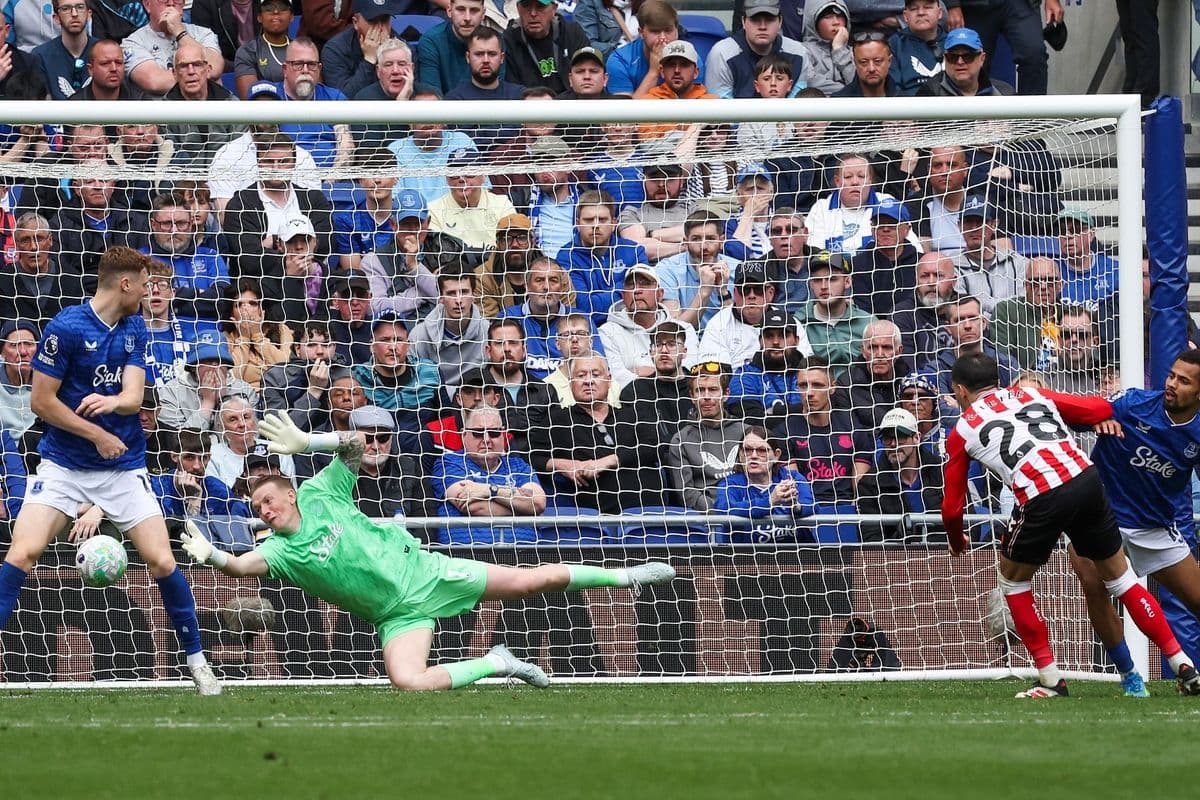
From a goalkeeping perspective, the numbers tell a stark story. Everton registered 4 shots on target but were met by R. Roefs, who made 3 saves and posted 0.02 goals prevented — a tidy, if unspectacular, performance that underpinned Sunderland’s resilience. In contrast, Everton’s J. Pickford recorded 0 goalkeeper saves and 0.02 goals prevented. Sunderland turned all 3 of their shots on target into goals, indicating that Everton’s defensive line allowed too many unpressured or high-quality finishing situations for Pickford to realistically intervene.
Discipline and Tactical Narrative
Discipline further framed the tactical narrative. Sunderland finished with 0 yellow cards and only 9 fouls, reflecting controlled defending and well-timed pressure. Everton’s third yellow card — James Garner at 90+6 minutes, again for “Foul” — summed up a side increasingly chasing the game and arriving late into duels. The cumulative effect of bookings and fouls reduced Everton’s ability to counter-press aggressively in the final quarter of an hour, allowing Sunderland to manage the tempo and protect their lead while still carrying a threat on the break.
Statistically, Everton’s higher shot volume and slightly higher xG underline that they were not outclassed in chance creation, but Sunderland’s structural evolution after the interval — aided by incisive substitutions and efficient use of central channels — flipped the match. Everton’s 4-2-3-1 lost its compactness as they chased the game, whereas Sunderland’s mirrored shape became more vertical and ruthless, turning a 0-1 deficit into a 1-3 away win built on tactical clarity, disciplined defending, and clinical finishing.