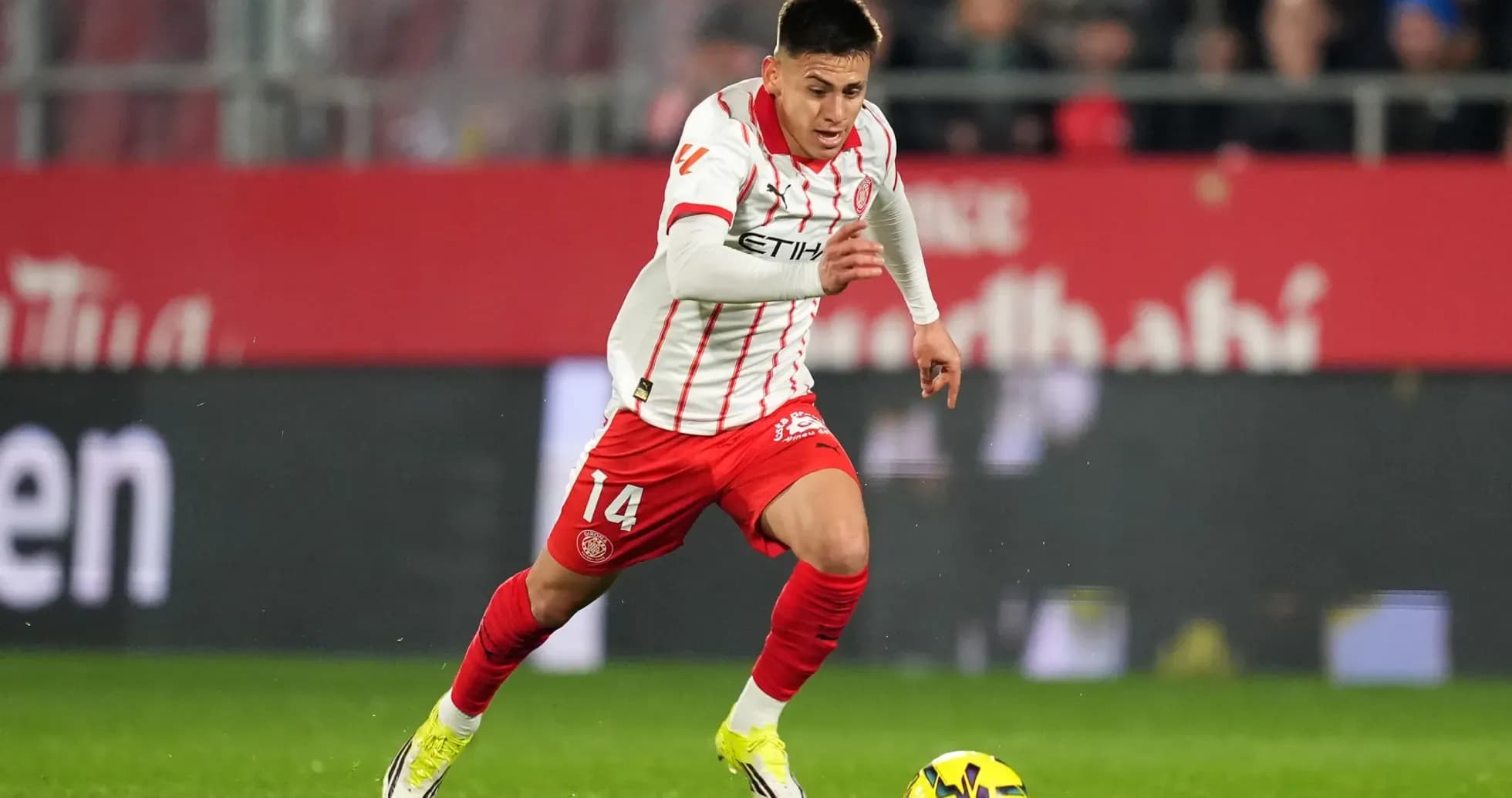
Girona vs Real Sociedad: Tactical Analysis of a 1-1 Draw
Girona and Real Sociedad shared the points at Estadio Municipal de Montilivi in a 1-1 draw that felt, tactically, like attack versus control. Girona dominated territory, possession and shot volume, yet needed a second-half adjustment and the impact of substitutes to cancel out Real Sociedad’s first-half advantage in La Liga’s Regular Season - 36 round.
Real Sociedad struck first and defended deep for long stretches, while Girona’s 4-3-3 structure kept the visitors pinned back after the break. Ultimately, the match evolved into a classic pattern: Girona’s positional play and wing overloads against Real Sociedad’s compact 4-2-3-1 mid-to-low block, with both goalkeepers largely protected by their defensive structures.
I. Executive Summary
The match finished Girona 1-1 Real Sociedad, with the visitors leading 0-1 at half-time and Girona equalising after the interval. Girona’s 60% possession and 29 total shots contrasted sharply with Real Sociedad’s 6 efforts, underscoring how Michel’s side controlled the flow. However, Real Sociedad’s 4-2-3-1, anchored by A. Remiro in goal and a disciplined back four, limited Girona’s clear chances relative to volume. The draw reflected Girona’s territorial dominance but also Real Sociedad’s efficiency and resilience in managing the game state once ahead.
II. Scoring Sequence & Disciplinary Log
Goals (verified against final score: Girona 1-1 Real Sociedad; Real Sociedad 1 goal, Girona 1 goal):
- 28' J. Martin (Real Sociedad) — assisted by S. Gomez
- A set defensive platform from Real Sociedad’s back four paid off when J. Martin, operating from the defensive line, found the opener. Sergio Gómez delivered the assist, and the visitors used the lead to retreat into a more conservative block.
- 66' C. Stuani (Girona) — assisted by A. Martinez
- Michel’s substitution at half-time proved decisive. After Girona increased pressure down the left, A. Martinez advanced from full-back to provide the delivery for C. Stuani, whose presence in the box converted Girona’s territorial dominance into a deserved equaliser.
Cards (chronological, with reasons exactly as given):
- 12' Ander Barrenetxea (Real Sociedad) — Foul
- 53' Jon Aramburu (Real Sociedad) — Foul
- 59' Mikel Oyarzabal (Real Sociedad) — Foul
- 62' Alejandro Francés (Girona) — Foul
- 73' Sergio Gómez (Real Sociedad) — Foul
- 76' Joel Roca (Girona) — Foul
- 82' Duje Ćaleta-Car (Real Sociedad) — Time wasting
- 88' Gorka Carrera Zarranz (Real Sociedad) — Foul
- 90' Beñat Turrientes (Real Sociedad) — Foul
Totals: Girona: 2 yellow cards, Real Sociedad: 7 yellow cards, Total: 9.
The card distribution illustrates Real Sociedad’s increasingly reactive defending, repeatedly breaking up Girona’s rhythm, especially after the equaliser.
III. Tactical Breakdown & Personnel
Michel set Girona up in a 4-3-3 with P. Gazzaniga in goal, a back four of A. Moreno, Vitor Reis, Alejandro Francés and A. Martinez, and a midfield trio of I. Martin, A. Witsel and A. Ounahi. Up front, B. Gil, V. Tsygankov and Joel Roca formed a fluid front line. The structure aimed at controlled circulation and width, and the numbers back it: 560 total passes, 508 accurate (91%), and 60% possession. Girona’s 29 total shots, with 17 inside the box, show how consistently they managed to enter the final third.
Real Sociedad’s 4-2-3-1, coached by Pellegrino Matarazzo, had A. Remiro behind a defence of S. Gomez, D. Caleta-Car, J. Martin and J. Aramburu. J. Gorrotxategi and Y. Herrera sat as the double pivot, with T. Kubo, L. Sucic and A. Barrenetxea supporting M. Oyarzabal as the lone forward. Their 401 passes, 330 accurate (82%), and 40% possession underline a more selective, transition-oriented approach.
The first half saw Real Sociedad use their full-backs aggressively in early phases. S. Gomez’s forward movement created the assist lane for J. Martin’s 28th-minute goal, capitalising on a rare moment when Girona’s defensive line did not reset quickly enough. After going ahead, Real Sociedad progressively dropped their block, compressing central spaces and forcing Girona into wide deliveries and shots from around the box.
Michel’s in-game management was central to the turnaround. At 46', C. Stuani (IN) came on for B. Gil (OUT), adding a penalty-box reference point. At 57', he refreshed midfield control and verticality: T. Lemar (IN) came on for I. Martin (OUT), and F. Beltran (IN) came on for A. Witsel (OUT). These changes increased tempo between the lines and improved Girona’s ability to sustain pressure after losing the ball, as Beltran and Lemar pressed higher and recycled possession quicker.
For Real Sociedad, the 57' double change — C. Soler (IN) for J. Gorrotxategi (OUT) and G. Carrera (IN) for T. Kubo (OUT) — was about legs and transitions, but it also coincided with Girona’s best spell. The visitors’ fouls count (19) and the run of yellow cards from 73' onwards highlight how the fresh Girona midfield and Stuani’s presence tilted the game.
The equaliser at 66' was a direct product of this shift. With Girona camped in the attacking half, A. Martinez pushed high from left-back, exploiting Real Sociedad’s narrow back four. His assist to C. Stuani rewarded the repeated pattern of wide overloads and crosses into the box. Later, at 80', C. Echeverri (IN) came on for V. Tsygankov (OUT), adding fresh dribbling and another central threat between the lines, further locking Real Sociedad in their half.
Defensively, Girona’s overall form remained solid: they limited Real Sociedad to 6 total shots, only 2 on target, and P. Gazzaniga needed just 1 save. Real Sociedad, meanwhile, faced 4 shots on goal; A. Remiro made 4 saves, underlining his importance in preserving the draw, especially as Girona’s shot quality rose after the substitutions.
IV. The Statistical Verdict
The underlying numbers align closely with the tactical picture. Girona’s xG of 2.22 against Real Sociedad’s 0.33 confirms that Michel’s side created the bulk of meaningful chances, even if their finishing lagged behind their volume. Girona’s goalkeeper, P. Gazzaniga, registered 1 save with goals prevented at 0.1, indicating he was rarely exposed and that the concession stemmed more from structural detail on the set attacking phase leading to J. Martin’s goal than from repeated defensive breakdowns.
On the other side, A. Remiro’s 4 saves and goals prevented of 0.1, in the context of 29 shots faced, show that Real Sociedad’s defensive index relied heavily on collective compactness rather than exceptional individual shot-stopping. The 19 fouls and 7 yellow cards, with reasons ranging from “Foul” to “Time wasting”, capture a team increasingly focused on protecting a point.
Overall, Girona’s superior possession, passing accuracy and xG suggest they were the more proactive and structurally dominant side. Real Sociedad, however, executed a pragmatic away-game plan well enough to turn limited attacking output into a valuable draw, anchored by disciplined, if often cynical, defensive work.