Harry Kane: Bayern Munich's Best Transfer Ever
Uli Hoeness has never been shy of a grand statement. The Bayern Munich president has spent a lifetime dealing in big calls and bigger emotions, so when he emerged from the DFB-Pokal final and declared Harry Kane “the best transfer the club has ever made” after a Kane hat-trick sealed a 3-0 win, it sounded like classic Hoeness theatre.
A month on, with the confetti swept away and the adrenaline gone, the line still stands. Inside Bayern, the verdict is the same: Kane isn’t just a success. He’s the standard.
From doubted finisher to global headliner
Kane’s journey to this point has not been a straight climb. Euro 2024 painted a picture of a striker running out of road, still trophyless and seemingly carrying the weight of too many nearly seasons. Outside England, scepticism had long lingered. Even his Golden Boot at Russia 2018 was picked apart. “Top goalscorer despite not having scored from the quarter-finals on,” sniffed Le Journal du Dimanche, as if his most prolific years were destined to be filed under admirable but futile.
Now look at the company he keeps.
When Time assembled the faces of this World Cup, the roll call read like a modern pantheon: Lionel Messi, Cristiano Ronaldo, Neymar, Kylian Mbappé, Lamine Yamal, Jude Bellingham. And there, finally, stood Kane. Not the hardworking nearly man. Not the noble loser. A leading man in his own right.
“When we bought him for more than €100m, that was new territory for us and a crazy risk,” Hoeness admitted. “But he’s paid back every single euro. Not just because he scores so many goals, but because he is a role model in the dressing room.”
The quiet leader who took over Bayern
Hoeness loves to tell the stories. Kane with an arm around a teenager. Kane staying behind to talk through movements and finishing. Kane, in a dressing room he still can’t fully address in German, commanding absolute respect.
The language barrier never really bit. His contract includes German lessons, and he is taking them, but Bayern’s core speaks fluent English. Vincent Kompany runs the dressing room in English. Communication is simple. Influence is obvious.
Hoeness, a World Cup winner from a far rougher era, marvels at how Kane absorbs the punishment. “I think you’d have to cut off his head or his arm to stop him playing,” he said, half-joking, fully admiring. Defenders in the Bundesliga kick him. He gets up. They kick him again. He keeps coming.
Inside that dressing room, staff speak of only two players in recent times having this kind of presence: Manuel Neuer and Thomas Müller. Both are club institutions, Bayern to the bone. Kane arrived as the outsider. He has become the reference point.
A British star abroad – and actually at home
When the Kane family initially delayed their full move to Munich, the old stereotype stirred. The British player abroad. The Ian Rush myth at Juventus. The suspicion that the Premier League star might yearn for home comforts the moment the novelty wore off.
The reality has been very different.
Kane and his wife, Kate, have settled into a rural home once owned by Lucas Hernández, near the affluent suburb of Grünwald. Talk to Kane about life off the pitch and you hear about Bavarian winters, the children – Ivy, Vivienne, Louis and Henry – taking to skiing, the family embracing Alpine weekends in Garmisch. Kane is barred from the slopes by contract, of course, but he goes along, watches, lives the rhythm of the region.
Then there was the day in Kirchweidach, a village of 2,000 near the Austrian border, when Bayern dropped their superstar into the heart of Bavarian tradition. Kane stirred soup at a fan day as wedding couples do to symbolise unity with the region. He played a rustic version of skittles, knocking down pins with litre beer steins. He called it “a bit crazy” with typical English understatement, but he threw himself into it.
This is not a man counting the days until he can go home. He has one.
A forward reborn – and redefining his peak
Bayern knew they were signing a world-class striker. They did not expect this level of domination, this breadth of technical authority.
The dam finally broke with the Bundesliga title in 2025, the trophy that ended Kane’s personal drought. He has since added another league crown and a DFB-Pokal, but the silverware only tells part of the story. Over the past two years, he has looked lighter, quicker, more ruthless. The numbers are staggering. The football behind them even more so.
Think of the Champions League goal against Atalanta. A drag-back, a swivel that sent two defenders the wrong way, then that familiar, ruthless, low finish. Or his second in the recent cup final, the strike that effectively killed the contest on 80 minutes. A vicious curling effort from outside the box crashed off the bar. Lesser forwards would have watched and cursed their luck. Kane didn’t pause. As the ball dropped, he produced another drag-back, carved out his own yard of space, and finished. Clinical, inventive, utterly in control.
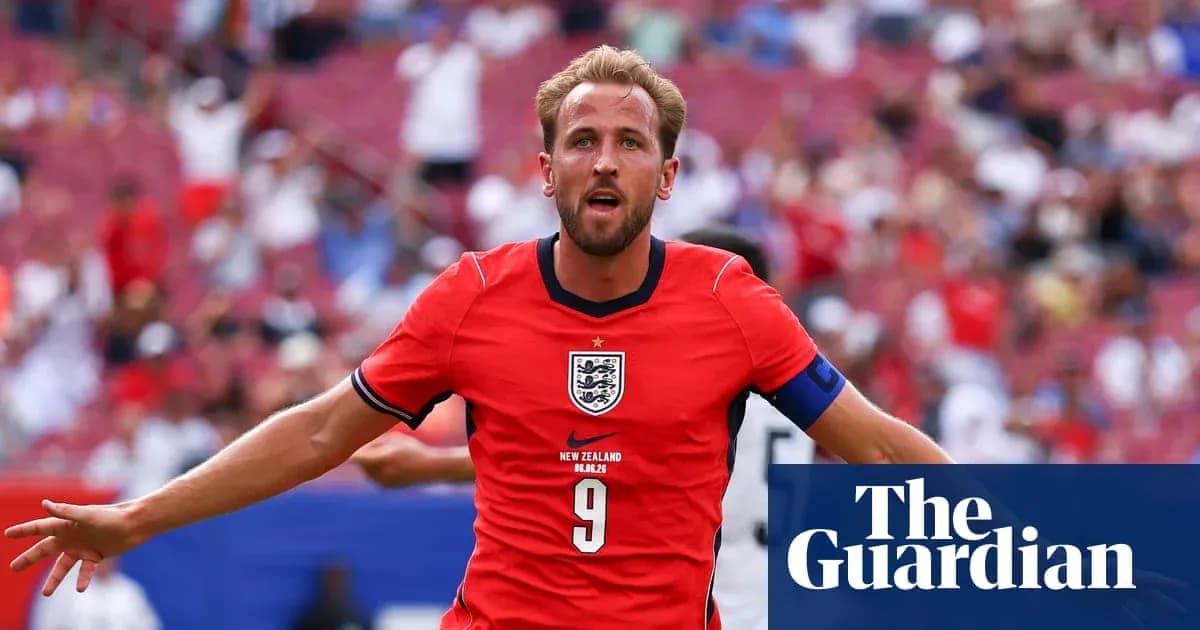
He has 61 goals for Bayern and, across all competitions, 67 this season after the game against New Zealand in Tampa. In Europe’s major leagues, only Erling Haaland lives in the same statistical postcode. The comparison with Messi and Ronaldo’s peak numbers, once absurd, now feels logical. Ronaldo hit 66 in a season without a summer tournament, Messi 73. Kane is operating in that stratosphere.
But he is not just a penalty-box machine. For Bayern he often drops as deep as a No 6 when they are out of possession, collecting the ball, dictating play. His passing range has become a weapon in its own right. The assist for Luis Díaz in the Champions League semi-final first leg against Paris Saint-Germain – a precise, incisive delivery – underlined how complete his game has become. It is no surprise Thomas Tuchel intends to lean heavily on the Bayern blueprint at the World Cup.
From Ballon d’Or outsider to genuine contender
At Tottenham, Kane’s Ballon d’Or candidacy was always theoretical, the kind of debate that lived on phone-ins and fan forums rather than in the minds of voters. Without trophies, without deep Champions League runs, he remained on the fringes of the conversation.
That has changed.
Now he plays in the latter stages of the Champions League as a matter of routine. Now he lifts trophies. Now, at 32, with a World Cup looming, he stands among the genuine contenders. So much hinges on what happens this summer, but the broader arc is hard to ignore: the slow burner who has timed his ascent perfectly, the tortoise closing in on the finish line while the hares fade.
The kid nobody bet on
To those who knew him as a teenager at Spurs, the idea of Kane as a global superstar would once have sounded fanciful. By the brutal standards of elite academies, he was slightly overweight, not quick, not the most gifted technician. One youth coach admitted: “You would never have thought that he would be what he is now.”
Then came the growth spurt at 14. The body changed. The technique sharpened. The ball started to leap off his boot in a different way. The striking quality – the way he hit through it, the repeatability – stood out. Every instruction stuck. Tell him once about gym work or finishing drills and it was done, absorbed, applied.
The early loans brought more humiliation than glory. Norwich was a particular low point: a glaring miss on debut against West Ham, then the ignominy of being hauled off at half-time in an FA Cup defeat to non-league Luton. In between, he was dropped to the under-21s and wasn’t allowed to take penalties because he wasn’t considered good enough.
At Leicester, he started both legs of the 2013 Championship playoff semi-final against Watford on the bench, sitting alongside Jamie Vardy, hardly the profile of a future global No 9.
Even when he returned to Spurs, the doubts lingered. In pre-season 2014, Mauricio Pochettino saw a forward who did not yet look like a Premier League spearhead. Kane remembers the wake-up call vividly. “We had our body fat test done and I was the highest in the team, something like 18%,” he recalled. He went to see Pochettino, who laid it out bluntly: the numbers were too high, the effort not at the level required. Then came the twist. “He told me: ‘You can be the best striker in the world.’”
At the time, it sounded like motivational exaggeration. Just as Hoeness’s verdict in Berlin sounded like emotional excess.
Both men, it turns out, were simply telling the future.