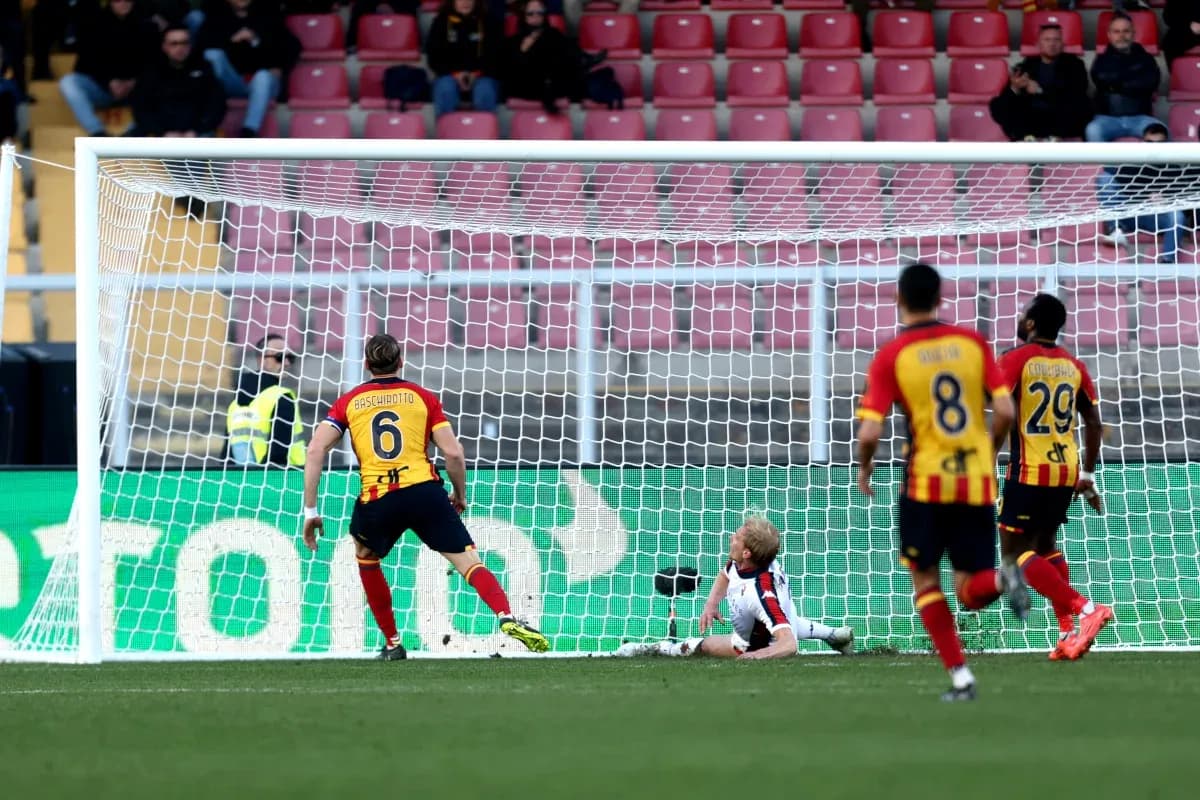
Lecce Secures Survival with 1–0 Victory Over Genoa
The curtain falls on Lecce’s Serie A season at Via del Mare with a narrow 1–0 win over Genoa, a result that neatly encapsulates the campaign’s margins for both sides. Following this result, Lecce close out the year 17th on 38 points, Genoa 16th on 41, separated by a shared fragility rather than any great gulf in quality.
I. The Big Picture – Survival Football, One Goal at a Time
Across 38 league matches, Lecce’s identity has been stark: survival built on scarcity. Overall they scored just 28 goals and conceded 50, giving them a goal difference of -22. At home, the picture is even more austere: 13 goals for and 24 against from 19 fixtures, averages of 0.7 scored and 1.3 conceded. Yet this final-day victory fits their pattern of eking out results when it matters, with 10 total wins split evenly between home and away.
Genoa, by contrast, have been marginally more expansive but just as brittle. Overall they finished with 41 goals scored and 51 conceded, a goal difference of -10. On their travels, they managed 19 goals and let in 25, averaging 1.0 for and 1.3 against away from home. The 1–0 defeat in Lecce is a familiar storyline: a side that can create enough to score, but too often fails to turn that into points, especially given their 11 total draws and 17 losses.
Tactically, the lineups at Via del Mare told the story of two coaches leaning into their seasonal DNA. Eusebio Di Francesco went with his most-used shape, a 4-2-3-1 that Lecce employed 22 times this campaign. Daniele De Rossi mirrored Genoa’s structural comfort with a three-at-the-back system, opting for a 3-5-1-1, a close cousin of the 3-5-2 and 3-4-2-1 that have defined their year.
II. Tactical Voids – Absences and Discipline
Both squads arrived with significant absentees that shaped the match’s texture more than its box score. Lecce were without M. Berisha (thigh injury) and R. Sottil (back injury), limiting Di Francesco’s options between the lines and on the flanks. It placed extra creative and transition burden on L. Banda and the attacking midfield trio behind W. Cheddira.
Genoa’s list was far more dramatic. T. Baldanzi (illness), M. Cornet (muscle injury), J. Ekhator (foot injury), C. Ekuban (injury), Junior Messias (muscle injury), R. Malinovskyi (inactive), J. Onana (injury), L. Ostigard (knock) and Vitinha (suspension for yellow cards) were all unavailable. That stripped De Rossi of ball-carrying threats, set-piece quality, and depth at both ends of the pitch. The 3-5-1-1 with M. E. Ellertsson off L. Colombo became less a choice and more a necessity.
Season-long disciplinary trends underpinned the risk profile of this fixture. Lecce’s yellow-card distribution shows a pronounced late-game surge: 30.43% of their bookings arrived between 76–90 minutes, with another 20.29% between 61–75. Genoa, for their part, peaked between 61–75 minutes as well, with 25.40% of their yellows in that window. Both sides have also flirted with red: Lecce’s campaign featured two reds in total (notably L. Banda and Kialonda Gaspar in the league-wide stats), while Genoa’s season red-card profile is spread across early, mid, and added-time phases.
In a tight, high-stakes final day, that meant the final quarter-hour was always likely to be chaotic, card-heavy, and tactically conservative—exactly the kind of environment in which a 1–0 lead becomes both precious and precarious.
III. Key Matchups – Hunter vs Shield, Engine Room vs Enforcer
Without official top-scorer data, the attacking “Hunter” roles have to be read from structure and known responsibilities. For Lecce, W. Cheddira led the line, flanked by the volatility of L. Banda and the work rate of S. Pierotti and L. Coulibaly. Their mission: squeeze production out of a team that, in total this campaign, averaged only 0.7 goals per match. Against a Genoa side conceding 1.3 goals per game overall and 1.3 away, the margin for Lecce’s forwards was narrow but real. The lone goal they found fits that statistical corridor: not an explosion, but a nudge just above their usual home output.
On the other side, Genoa’s “Hunter” was L. Colombo, supported by M. E. Ellertsson and width from S. Sabelli and A. Martin. They were up against a Lecce defence that, at home, conceded 1.3 per match and kept 5 clean sheets overall. The 1–0 scoreline gives W. Falcone and his back four another shutout, underlining how often Lecce’s survival has depended on doing just enough in both boxes.
The “Engine Room” battle was where this match was always likely to be decided. For Lecce, Y. Ramadani is the pure enforcer archetype. Across the season he made 91 tackles, 11 successful blocks and 46 interceptions, while committing 43 fouls and picking up 10 yellow cards. His job in the 4-2-3-1 double pivot, alongside O. Ngom, was to screen the centre-backs and disrupt Genoa’s central progression, especially through M. Frendrup and Amorim.
On Genoa’s side, the absence of R. Malinovskyi—who in total this campaign scored 6 goals, provided 3 assists and took 43 shots, with 39 key passes—removed their most natural deep-lying creator. That forced Frendrup and P. Masini into more responsibility in possession, but against Ramadani’s intensity and Danilo Veiga’s aggressive stepping from right-back, Genoa’s midfield lacked the vertical pass to unlock Lecce’s compact 4-4-1-1 out of possession.
IV. Statistical Prognosis – xG Shadows and Defensive Solidity
There is no explicit xG data in the snapshot, but the season-long numbers sketch the expected landscape. Lecce, with 28 goals from 38 matches and 19 games without scoring, typically operate in low-xG contests, especially at home where they failed to score in 10 of 19 fixtures. Genoa, with 41 goals and 15 blanks, are slightly more potent but still inconsistent.
Heading into this game, the defensive profiles suggested a marginal edge for the hosts. Lecce’s 10 clean sheets overall matched Genoa’s 9, but the home side’s structure—anchored by Ramadani and protected by a back four comfortable in a low block—was well-suited to choking off a Genoa attack deprived of its best shooters and set-piece specialists.
Penalties offered another subtle clue. Lecce had 1 penalty in total and converted it, while Genoa had 5 and scored all 5. With no penalties missed by either side this season, the likelihood was that any spot-kick would be decisive. The fact that this match finished 1–0 without a penalty reinforces the idea of a contest played largely in open play half-chances rather than repeated box incursions.
In the end, the 1–0 at Via del Mare feels less like an anomaly and more like the distilled essence of both campaigns. Lecce, minimalist but stubborn, squeeze maximum value from a single strike and another clean sheet. Genoa, stretched by absences and dulled in the final third, again find themselves on the wrong side of a one-goal margin. The numbers forecasted a tight, attritional finale; the pitch delivered exactly that.