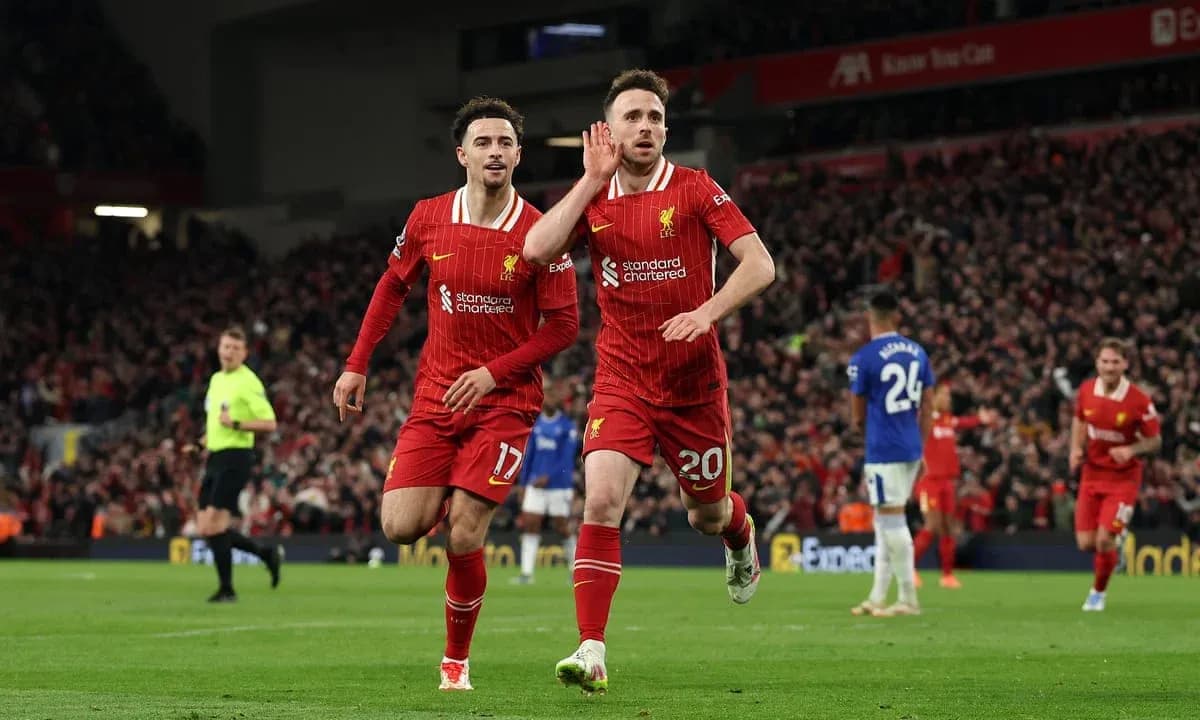
Liverpool Secures 2-1 Win in Derby Against Everton
The Hill Dickinson Stadium had barely settled when this derby began to reveal its true shape. A 2-1 Liverpool win, sealed in regulation under Chris Kavanagh’s watch, felt like the distilled version of both clubs’ seasonal identities. Heading into this game, Everton sat 10th on 47 points, Liverpool 5th on 55, and the table’s numbers framed the story: Everton’s overall goal difference of 1 (40 scored, 39 conceded) against Liverpool’s 11 (54 scored, 43 conceded) – the narrow pragmatists versus the high-variance contenders.
I. The Big Picture – Structures and Season DNA
Liverpool arrived with their now-familiar 4-2-3-1, a shape Arne Slot has leaned on in 30 league matches. G. Mamardashvili anchored the back, shielded by a back four of C. Jones, I. Konate, V. van Dijk and A. Robertson. In front, D. Szoboszlai and R. Gravenberch formed the double pivot, with an attacking line of M. Salah, F. Wirtz and C. Gakpo operating behind A. Isak.
It is a structure that mirrors Liverpool’s season-long profile: overall they average 1.6 goals for and concede 1.3 per game, with a strong attacking split – 1.8 at home, 1.5 on their travels – but an away defence that allows 1.5 goals per match. The 4-2-3-1 is designed to keep the ball high, use Gakpo and Wirtz between the lines, and let Salah drift into the half-spaces, while the double pivot manages transitions.
Everton, by contrast, have largely been a 4-2-3-1 side themselves this season (20 league matches in that shape), but here the lineup card reads more like a flat, workmanlike block than a fluid attacking system. J. Pickford stood behind a back four of J. O’Brien, J. Tarkowski, J. Branthwaite and V. Mykolenko. In midfield, I. Gueye and J. Garner provided the engine, with D. McNeil, K. Dewsbury-Hall and I. Ndiaye supporting lone striker Beto.
Everton’s season numbers tell of a side that lives on small margins: overall they score 1.2 and concede 1.2 per game, with 1.3 goals for and 1.2 against at home. The Hill Dickinson Stadium is not a fortress, but it is structured – 6 home wins, 4 draws, 7 defeats – a place where shape and discipline matter more than volume of chances.
II. Tactical Voids – Absences and Discipline
Both squads carried scars into this fixture. Everton were without J. Grealish, whose 2 goals and 6 assists in the league, plus 40 key passes and a dribbling profile that draws 58 fouls, usually give them a release valve on the left. His absence stripped them of a ball-carrying outlet between lines and a player capable of stalling Liverpool’s counter-press simply by winning free-kicks.
Liverpool’s list was longer and more structural. Alisson’s muscle injury handed the gloves to Mamardashvili. Without W. Endo’s positional discipline at the base of midfield, and with S. Bajcetic, C. Bradley, J. Gomez, H. Ekitike and G. Leoni all missing, Slot’s bench lost both rotation and late-game chaos options. Ekitike’s 11 league goals and 4 assists would normally change the dynamic of the final half-hour; here, Liverpool had to lean more heavily on Salah, Gakpo and Isak to carry the scoring burden.
Disciplinary trends shaped the tone. Everton’s season-long yellow card distribution peaks late: 23.73% of their yellows arrive between 76-90', and a further 16.95% between 91-105'. Their red cards are also heavily back-loaded, with 50.00% shown in the 76-90' window. Liverpool mirror that late intensity: 28.57% of their yellows come in the 76-90' band, and their only league red in extra time (91-105'). This is a fixture primed to fray as legs tire and spaces open.
Within that, individuals matter. Garner, with 9 yellows this season, walks a constant tightrope in the engine room. Szoboszlai, who has 7 yellows and 1 red, plus a missed penalty on his record, brings an edge to Liverpool’s midfield press. The match was always likely to tilt on who could play on the border of aggression without stepping over it.
III. Key Matchups – Hunter vs Shield, Engine Room Battles
The “Hunter vs Shield” duel was written across the left channel. Salah, the league’s joint-top creator in this fixture with 6 assists and 7 goals, attacked the corridor patrolled by Mykolenko and Branthwaite. Salah’s 47 key passes and 41 shots (17 on target) frame him as both finisher and provider; Everton’s home defence, conceding 1.2 goals per game at Hill Dickinson, needed to funnel him wide and force him onto his weaker combinations.
On the opposite flank, Gakpo’s role was subtler but just as decisive. With 6 goals and 5 assists, plus 48 shots and 48 key passes, he is Liverpool’s second creative axis. His ability to drift inside, link with Wirtz and overload Gueye and Garner threatened to pull Everton’s double pivot out of shape, exposing the central defenders to Isak’s movement.
In the “Engine Room”, Garner and Gueye tried to smother Szoboszlai and Gravenberch. Garner’s season numbers – 103 tackles, 9 blocked shots and 51 interceptions – mark him as Everton’s defensive metronome. He is also their best passer from deep, with 1,531 completed passes at 87% accuracy and 46 key passes. His duel with Szoboszlai, who has 5 goals, 4 assists, 61 key passes and 1,938 completed passes at 87% accuracy, was essentially a battle over who would dictate the rhythm.
Without Grealish, Everton’s creative burden shifted towards K. Dewsbury-Hall and D. McNeil, but neither offers the same foul-drawing gravity. That made transitions more fragile: when Everton lost the ball, Liverpool’s counter-press – led by Szoboszlai and Wirtz – could trap them in their own half, forcing long clearances towards Beto.
IV. Statistical Prognosis – Why 2-1 Felt Inevitable
Following this result, the scoreline aligned almost perfectly with the underlying trends. Liverpool’s overall attacking average of 1.6 goals and Everton’s 1.2 suggested a narrow away win if Liverpool’s front line found normal efficiency. Everton’s home defence (1.2 conceded) versus Liverpool’s away attack (1.5 scored) pointed towards the visitors breaching them once or twice; the 2-1 outcome fits that band.
Defensively, Liverpool’s away figure of 1.5 goals against per game left room for Everton to strike, especially from set-pieces where Tarkowski, Branthwaite and O’Brien’s aerial presence can trouble a back line that has occasionally suffered on its travels. Everton’s 11 clean sheets overall underline that they can shut games down, but with Liverpool’s attacking depth and the absence of Grealish’s ball retention, the balance tilted red.
In xG terms, this had the profile of a match where Liverpool’s structured 4-2-3-1 would generate more sustained, high-quality pressure, while Everton relied on lower-volume, higher-impact moments: second balls, crosses, and Garner’s delivery from deep. The disciplinary patterns – both sides prone to late cards – hinted at a stretched final quarter, and that chaos historically favours the side with more individual match-winners.
Ultimately, Liverpool’s superiority in creative zones, the dual threat of Salah and Gakpo, and Szoboszlai’s control of tempo outweighed Everton’s organisation and industry. A 2-1 away win did not just close out a derby; it felt like a precise statistical and tactical expression of who these two teams have been across 33 Premier League matches.