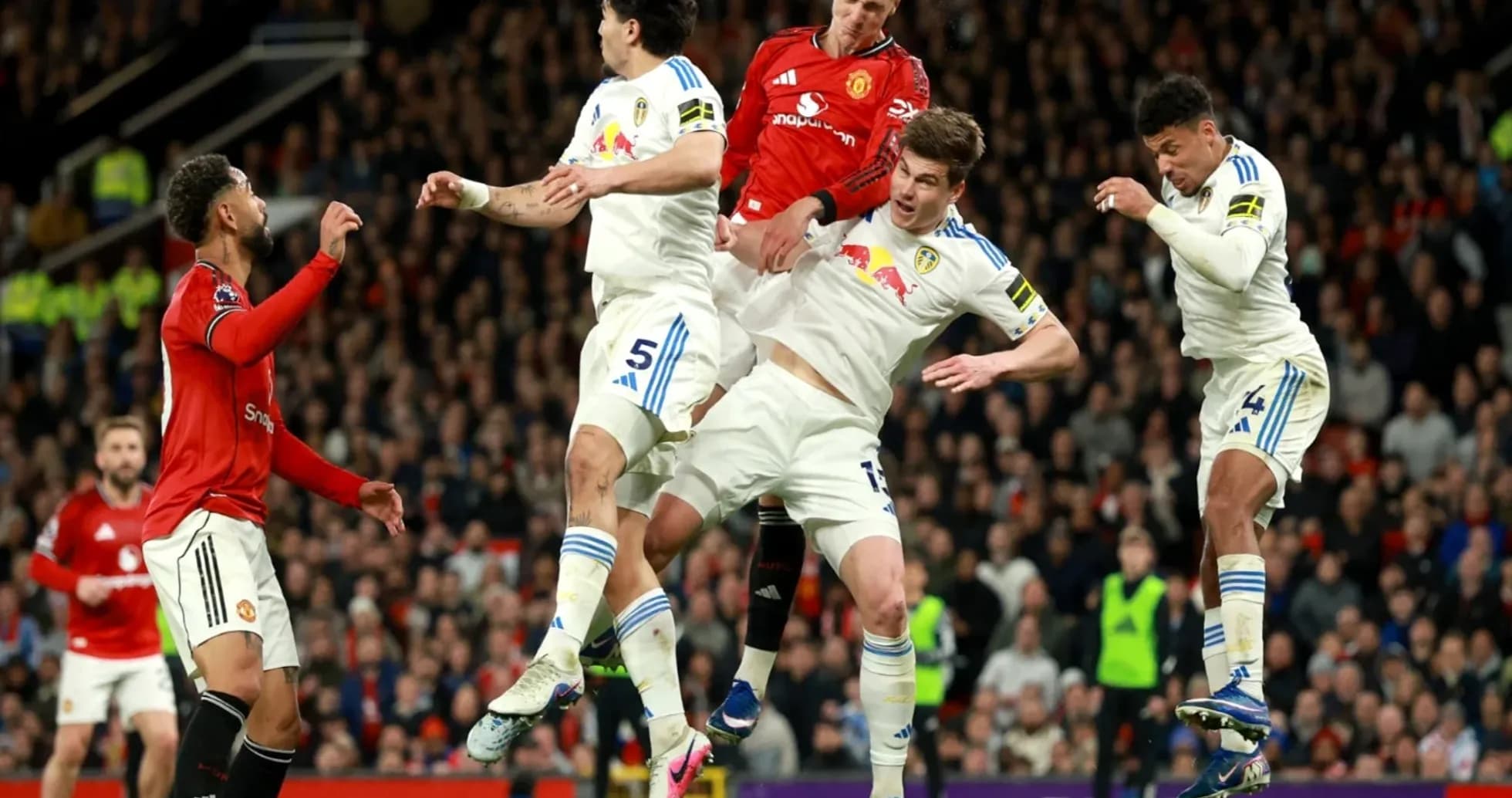
Manchester United vs Leeds: Tactical Analysis of the Premier League Clash
Old Trafford under floodlights, a referee’s whistle cutting through the Mancunian evening, and a scoreline that told of a contest decided early: Manchester United 1–2 Leeds, finished in regular time in Round 32 of the 2025 Premier League season. Following this result, it felt less like an upset of league positions – United came into the night 3rd on 55 points, Leeds 15th on 36 – and more like a tactical ambush that the visitors executed to near-perfection.
I. The Big Picture – Structures and Seasonal DNA
Manchester United lined up in a 4-2-3-1 under Michael Carrick, a shape that has become their secondary skin this season, used 14 times compared to 18 with a 3-4-2-1. The structure at Old Trafford was orthodox on paper: S. Lammens in goal, a back four of N. Mazraoui, L. Yoro, L. Martinez and L. Shaw, Casemiro and M. Ugarte as the double pivot, with A. Diallo, Bruno Fernandes and M. Cunha behind lone striker B. Šeško.
Leeds, under Daniel Farke, leaned into a 3-4-2-1 that mirrored United’s attacking band but gave them an extra centre-back: K. Darlow behind a trio of J. Justin, J. Bijol and P. Struijk, wing-backs J. Bogle and G. Gudmundsson flanking a central pair of E. Ampadu and A. Tanaka, with B. Aaronson and N. Okafor supporting D. Calvert-Lewin.
Heading into this game, United’s seasonal profile at home was that of a high-event contender: 16 home matches, 10 wins, 3 draws, 3 defeats, scoring 31 and conceding 19. That is an average of 1.9 goals for at home against 1.2 conceded, a positive home goal difference of 12 that mirrored their overall league goal difference of 12 (57 scored, 45 conceded). Leeds arrived as a fragile but awkward opponent: on their travels they had played 16, won 2, drawn 7 and lost 7, with 17 goals for and 29 against – an away average of 1.1 scored and 1.8 conceded, and an away goal difference of -12 feeding into an overall goal difference of -10 (39 for, 49 against).
On paper, it was a classic top-three home side against a bottom-half traveller. On the grass, it became something more nuanced.
II. Tactical Voids – Absences and Discipline
Both managers were forced to navigate key absences. For United, the defensive rotation was imposed rather than chosen: P. Dorgu (hamstring injury), M. de Ligt (back injury) and H. Maguire (suspended after a red card) all missed out. The knock-on effect was clear: L. Yoro partnered L. Martinez at the heart of a back four that lacked Maguire’s aerial dominance and de Ligt’s penalty-box authority. Against a penalty-box striker like D. Calvert-Lewin, those absences were more than names on a list; they were structural gaps.
Leeds had their own voids. D. James (muscle injury) removed a direct, vertical outlet in transition, while J. Rodon and A. Stach (both ankle injuries) stripped depth from the defensive and midfield cores. Farke’s answer was to lean on the flexibility of E. Ampadu and the positional intelligence of A. Tanaka to stabilise the middle of the pitch.
Disciplinary profiles added another layer. United’s season-long card map shows a tendency toward late aggression: 21.57% of their yellow cards come in the 76-90 minute range, and they have seen red most often just after half-time – 66.67% of their reds between 46-60 minutes, and another 33.33% in the final quarter-hour. Leeds, meanwhile, distribute their cautions more evenly, but with a peak of 22.64% between 61-75 minutes and a notable 20.75% just before the break. Their only red in the league has come in the 46-60 window.
In a match that United were chasing from a 0-2 half-time deficit, those patterns mattered: a side that often becomes more reckless late on against a team that tends to collect cards as legs tire and blocks become last-ditch interventions.
III. Key Matchups – Hunter vs Shield, Engine Room
The headline duel was always going to be “Hunter vs Shield”: D. Calvert-Lewin, Leeds’ leading scorer with 10 league goals, against a United defence already conceding an overall average of 1.4 goals per game and 1.2 at home.
Calvert-Lewin’s season numbers painted the threat: 56 total shots, 28 on target, 387 duels contested with 149 won, and 10 tackles with 7 blocked shots. He is not just a finisher; he is a reference point who can pin centre-backs and defend his own box. Against a United back line missing Maguire and de Ligt, his ability to occupy both L. Yoro and L. Martinez created space for B. Aaronson and N. Okafor to operate between the lines.
On the other side, United’s attacking “Shield” was supposed to be their collective output rather than a single talisman. Heading into this game they had scored 57 overall, with a striking late-game surge: 25.00% of their goals arriving in the 76-90 minute window, the single highest slice of their minute distribution. That late pressure was expected to test a Leeds defence that concedes an away average of 1.8 per match and has already suffered heavy defeats on their travels (up to 5-0).
In the engine room, the confrontation was as pure as it comes: Bruno Fernandes versus E. Ampadu. Fernandes entered as the league’s leading creator with 17 assists and 8 goals, 1,683 passes at 82% accuracy, and a staggering 106 key passes. He is both tempo and incision. Casemiro, alongside him, brought 71 tackles, 17 blocked shots and 25 interceptions, but also a combustible edge: 9 yellow cards and 1 yellow-red this season.
Ampadu’s role was to be Leeds’ enforcer and distributor, anchoring a midfield that needed to screen Calvert-Lewin’s supply line while still springing transitions. With A. Tanaka providing the shuttle and J. Bogle and G. Gudmundsson offering width, Leeds often created a 3-2 platform in build-up, daring United’s No. 10 to press out of position.
The subplots were rich. B. Šeško, with 9 league goals from 27 appearances, is a penalty-box predator who thrives on service. Yet much of United’s bench threat came from B. Mbeumo, also on 9 league goals and 3 assists, a wide forward with 52 shots (30 on target) and 41 key passes – the kind of profile that can stretch a back three and isolate wide centre-backs like J. Justin or P. Struijk.
IV. Statistical Prognosis – xG, Late Pressure, and Defensive Solidity
While explicit xG values are not provided, the season-long patterns allow a tactical reading of how this 2-1 Leeds win fits the data.
United’s attack is built on volume and late surges. Overall they average 1.8 goals per match, with a clear crescendo: 17.86% of goals between 31-45, another 17.86% in each of the 46-60 and 61-75 windows, and then that 25.00% spike from 76-90. Their concession profile, however, mirrors that late chaos: 28.26% of goals against also arrive in the 76-90 window, the single highest share. United games tend to become stretched and high-risk as they chase margins late on.
Leeds, conversely, are a low-ceiling, high-variance side. Overall they score 1.2 goals per game and concede 1.5, with away figures of 1.1 for and 1.8 against. Their clean sheet tally – 6 overall, 2 away – suggests they can dig in, but more often they are forced into survival mode, reflected in a card distribution that spikes after the hour mark.
In this match, the script flipped early. Leeds’ 2-0 half-time lead allowed them to compress space, defend deeper in a 5-4-1 out of possession, and turn Calvert-Lewin into an outlet rather than a constant penalty-box presence. For United, chasing from behind amplified their worst tendencies: structural risk, emotional intensity, and a late-game phase where they already concede the highest proportion of their goals.
From an expected goals perspective, Leeds’ plan was about shot quality over volume: use B. Aaronson and N. Okafor to exploit the half-spaces around Casemiro and Ugarte, draw United’s centre-backs into uncomfortable zones, and create high-value chances for Calvert-Lewin. United, by contrast, were likely to accumulate xG through sustained pressure, crosses towards Šeško, and Bruno Fernandes’ delivery from zone 14.
The 2-1 scoreline suggests Leeds maximised their moments while United, despite their typical late surge profile, could not fully tilt the match back. United’s impeccable penalty record this season – 4 penalties taken, 4 scored, 100.00% conversion – never came into play, while Leeds’ own penalty history (4 taken, 4 scored, 0 missed this campaign despite D. Calvert-Lewin having 1 career miss in the data) underlined their threat if the game descended into box duels.
In the end, defensive solidity – or the closest thing Leeds have to it – was the decisive factor. A back three that has been part of only 4 league starts in a 3-4-2-1 this season held out against one of the division’s most creative forces. United’s overall defensive average of 1.4 goals conceded per game was breached twice before the interval; Leeds’ away average of 1.8 conceded was kept just below that mark.
Following this result, the narrative is clear: Leeds showed that a disciplined 3-4-2-1, built around Calvert-Lewin’s physicality and Ampadu’s control, can bend but not break even at Old Trafford, while United were reminded that their late surges and attacking talent cannot always compensate for structural fragility and key absences at the back.