Manchester United Women: A Crucial Crossroads Ahead
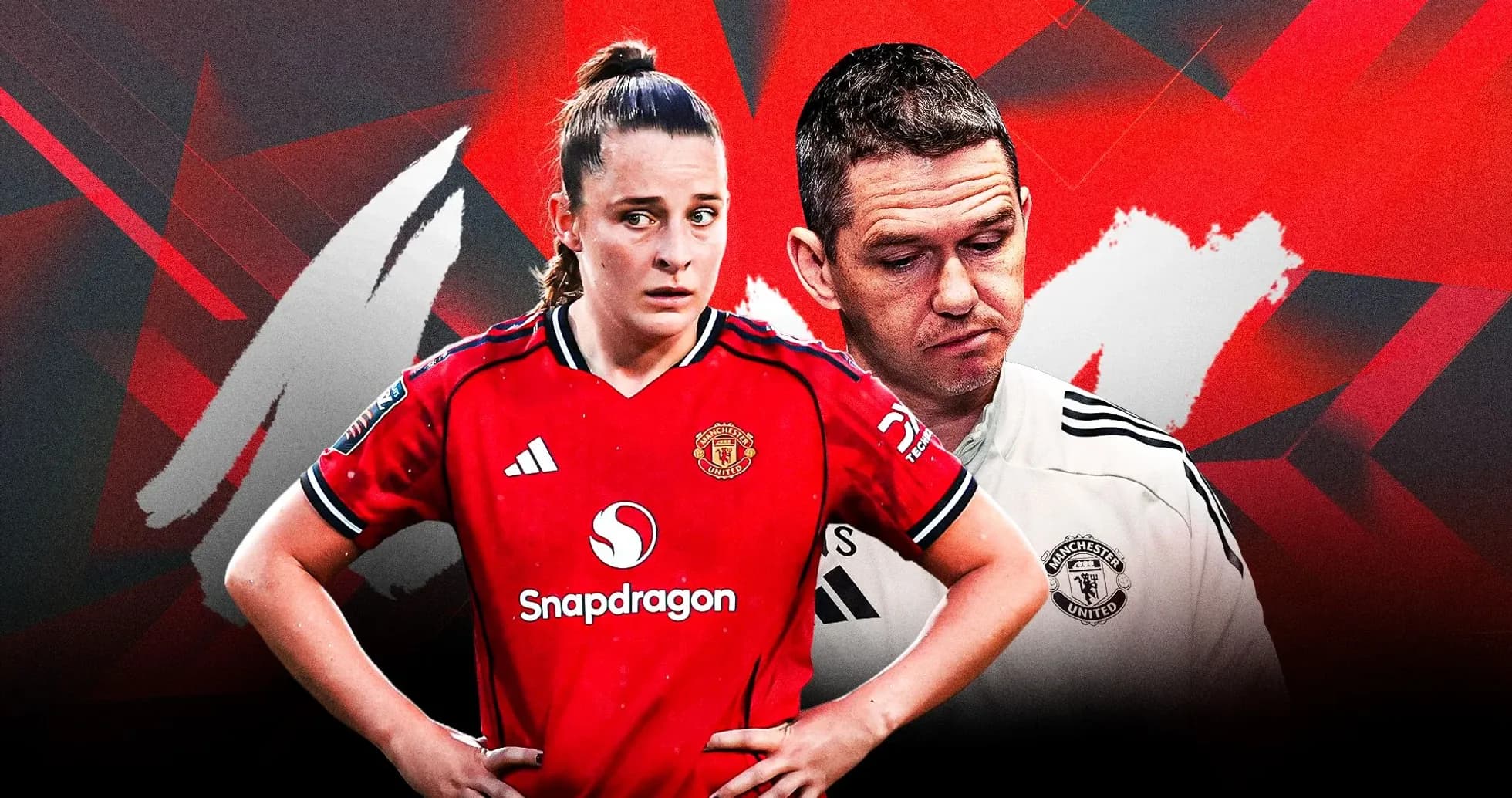
Manchester United Women stand at a crossroads.
A year that included a Champions League quarter-final and some genuinely impressive European performances still ended without any form of continental football for the new campaign. That contradiction captures exactly where this team is: close enough to touch the elite, nowhere near consistent enough to live among them.
A club still catching up
United’s women’s side is only eight years old. That matters. While City, Arsenal and Chelsea have spent the last decade building structures, pathways and depth, United have been playing catch-up at speed.
They have made strides. Champions League qualification, three cup finals, an FA Cup lifted at Wembley – all important markers. But those are moments, not yet a sustained era. The foundations at Leigh Sports Village are simply not as deep as those at clubs who have treated the women’s game as a long-term project for far longer.
To close that gap, United always needed to move aggressively on and off the pitch. The problem? Their rivals have done exactly that, and often with greater clarity and conviction.
Squad depth has been the most glaring issue. It cost them last season, when Marc Skinner’s side tried to juggle four competitions with a group that looked thin the moment injuries and fatigue bit. Everyone knew the squad needed broadening last summer. It didn’t happen. This time, it cannot be dodged.
Recruitment hasn’t been a disaster. Far from it. Julia Zigiotti Olme and Jess Park were smart, impactful additions a year ago. The issue was quantity, not quality. Three signings for a team about to fight on four fronts was always a gamble. It backfired, even with some January reinforcements.
This summer was supposed to be different. So far, the evidence is thin.
Rivals moving, United standing still
Look across the league and the contrast is stark.
Manchester City, fresh from a WSL and FA Cup double, publicly insisted they would not overhaul a title-winning squad. They haven’t. They’ve just improved it. Beth Mead, a proven match-winner at the highest level, adds firepower and experience. Niamh Charles, another England international, solves a long-standing issue at left-back. Keeping Khadija Shaw – the WSL Golden Boot winner – out of Chelsea’s clutches and tied to a new contract might be the most important move of all. Champions strengthen from a position of power. City have done exactly that.
Arsenal have gone the other way: full throttle. Seven years without a league title has sharpened their focus. In the space of two weeks they announced Georgia Stanway, Ona Batlle, Selina Cerci, Geraldine Reuteler and Lisa Baum. Five players, all with the pedigree to tilt a title race. Interest in Barcelona free agent Salma Paralluelo has not gone away either. This is the sort of transfer work that drags a team from “contender” to “favourite”.
Chelsea’s window has been messy, but not weak. Their pursuit of a striker has been public and painful – turned down by Shaw, then Paralluelo, then Felicia Schroder. Yet amid that frustration they have still landed Katie McCabe, one of the league’s most complete wide players, and added Matsukubo, a standout in last season’s NWSL at just 21. Reports in the Netherlands suggest Paris Saint-Germain’s Romee Leuchter is now close, which would finally plug that centre-forward gap.
And United? One arrival.
Andrea Medina, 22, versatile enough to play centre-back or left-back, is a smart addition and a badly needed extra body in defence. She looks a good piece of business. But she is also the only piece of business.
Worse, the noise around United is not about who might come in, but who might go.
Big names, big questions
Melvine Malard is understood to be closing in on a move to Chelsea. The Athletic reports the club are prepared to sell Elisabeth Terland – last season’s top scorer – if an offer meets their valuation, preferring to cash in now rather than lose her for nothing when her deal expires next summer. Terland turned down a new contract in November. That negotiation already feels like a battle United are losing.
She is not alone. Ella Toone is also out of contract next year. When asked about her future last month, the England midfielder did not offer the reassurance United fans craved.
“Obviously it’s now time to talk,” she said. “I just know I have got to make a decision on what’s best for me.”
Those are the words of a player weighing up her options, not one nailed on to stay. In a market where United are already struggling to attract enough top-level talent, the idea of losing key figures – or even just the threat of it – adds another layer of anxiety.
And the pressure is not only coming from above.
The pack behind is closing in
United’s gaze can’t be fixed solely on City, Arsenal and Chelsea. Look down the table and the picture is just as worrying.
London City Lionesses are the clearest warning sign. Backed by billionaire Michele Kang, who also owns Washington Spirit and European giants Lyon, they have made the kind of statement signings that shift power quickly. Two-time Ballon d’Or winner Alexia Putellas in England is a headline that still feels surreal. Mapi Leon, with four Champions League titles, follows her. Mary Earps, a former United and England No.1, adds leadership and pedigree. Nicole Anyomi brings goals from Germany. That is a spine built for disruption.
Tottenham are moving smartly too. They finished just four points and one place behind United last season, drawing with them home and away. They have already brought in five new faces. Shekiera Martinez arrives with 16 goals in 32 league games for a relegation-threatened West Ham side – an impressive return in a struggling team. Kirsty Hanson was outscored only by Shaw and Alessia Russo in the WSL last term. Goalkeeper Selma Panengstuen reportedly turned down Arsenal and PSG to join Spurs. That kind of decision speaks volumes about the project in north London.
Brighton, who caused United problems last season and reached the FA Cup final in May, have also moved decisively. Adding Lia Walti, the experienced former Arsenal midfielder, looks an astute piece of business for a side keen to turn cup promise into league progress.
United are not just at risk of failing to catch the top three. They are in danger of being swallowed by the chasing pack.
Skinner’s reality and a shrinking margin for error
Last summer, as transfer fees in the women’s game hit new heights, Marc Skinner was blunt. United, he said, could not compete financially with the seven-figure deals that took Olivia Smith to Arsenal and Grace Geyoro to London City.
“The reality is we have to try and find our own way to do it,” he admitted.
United did find value. Zigiotti Olme and Park proved that. But they did not find enough of it to assemble a squad capable of going deep on four fronts. Quality without quantity left them exposed.
This year, there will be no European distraction. No midweek trips across the continent, no extra strain on a thin group. City used a year without Champions League football to reset, reload and storm to a first WSL title in a decade. United will hope to follow that blueprint.
There is also optimism that January’s recruits will look more like themselves after a full pre-season. Lea Schuller, prolific at Bayern Munich, arrived with a fearsome reputation but managed just two goals in her first 18 appearances. Six months to settle, a summer to reset, and a clearer role could change that trajectory.
But none of that hides the obvious: this squad still needs major reinforcement.
United require depth to withstand injuries, competition for places to raise standards, and star quality to decide tight games. They need clarity on the futures of players like Terland and Toone. They need to stop reading about other clubs’ ambition and start showing their own.
This is a defining transfer window. A slow start does not guarantee failure, but the silence around Old Trafford and Leigh grows louder with every rival announcement.
The question now is brutally simple: will Manchester United Women seize this moment to step fully into the elite, or watch as the rest of the WSL races past them?