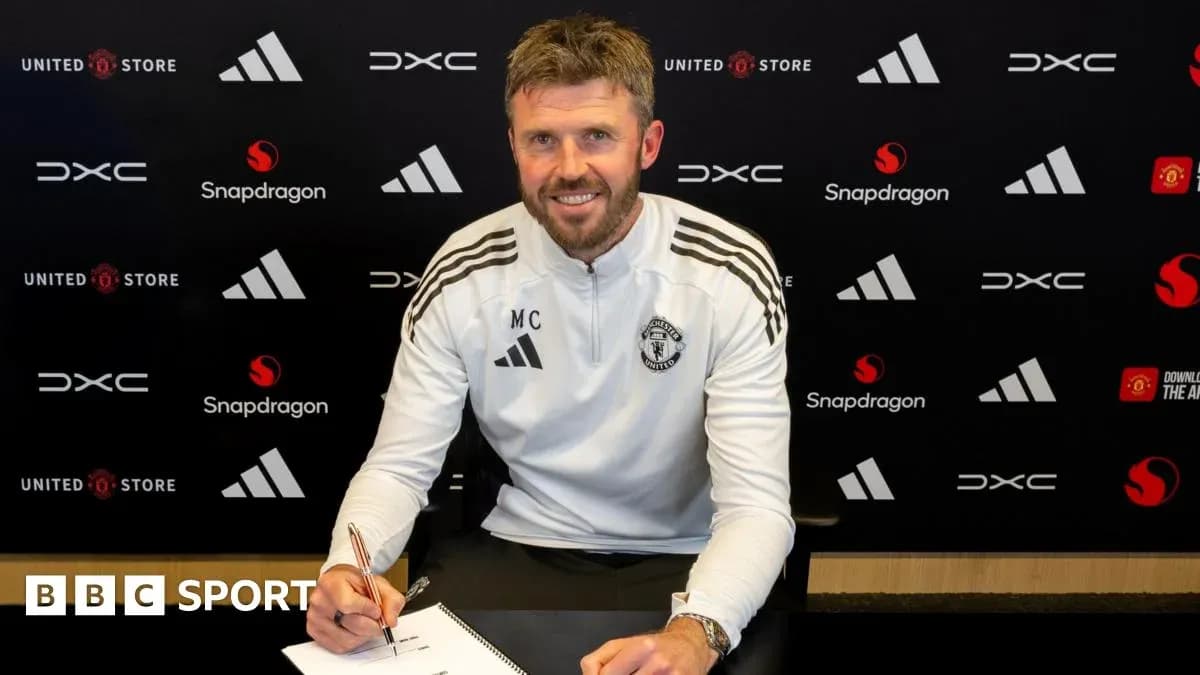
Michael Carrick Confirmed as Manchester United Head Coach
Michael Carrick has waited a long time for this moment. On Sunday he secured Champions League football; on Monday he was handed the keys to Manchester United for real.
The club have confirmed the 44-year-old as their permanent head coach on a two-year contract, a reward for an outstanding audition that has dragged United out of drift and into third place in the Premier League.
Carrick stepped in when Ruben Amorim was sacked in January, with United flat, fragile and going nowhere fast. Since 13 January, no top-flight side has taken more points than the 36 United have banked under his watch. Eleven wins in 16 games, Champions League qualification sealed, and a guaranteed third place after a breathless victory over Nottingham Forest.
For a man who has spent two decades in the shadows at Old Trafford – first as the metronome in midfield, then as the quiet coach in the background – this is a very different kind of responsibility.
“From the moment that I arrived here 20 years ago, I felt the magic of Manchester United. Carrying the responsibility of leading our special football club fills me with immense pride,” Carrick said, as the announcement landed.
“Throughout the past five months, this group of players have shown they can reach the standards of resilience, togetherness and determination that we demand here. Now it's time to move forward together again, with ambition and a clear sense of purpose. Manchester United and our incredible supporters deserve to be challenging for the biggest honours again.”
Those words have been coming, in one form or another, for weeks. Carrick has been asked repeatedly about his future, often straight after another win. He could almost have told reporters to roll the tape from the previous press conference. Now the uncertainty has gone. The real scrutiny starts.
From tidy audition to heavy lifting
On paper, third place in a 40-game season looks tidy. United had no European football to clog the calendar and exited both domestic cups at the first hurdle. The fixture list has been kind; the pressure, comparatively light.
Next season will not be so forgiving. A campaign that could stretch to 60 matches, with Champions League nights back on the agenda, will test the depth and durability of this squad in a way Carrick has not yet faced from the dugout.
He knows it. United know it. Recruitment cannot be a talking point; it has to be a solution.
Central midfield sits at the heart of that problem. Casemiro is leaving. Manuel Ugarte has not hit the level required. Kobbie Mainoo, as gifted as he is, cannot be asked to carry the engine room in every single game across four competitions.
Carrick built his playing reputation on control in that area of the pitch. If United are to resemble his best teams, they need legs, balance and personality in there – not just promise.
Holes to fill, decisions to make
The issues do not stop in midfield. If Patrick Dorgu continues to be pushed into a more advanced role, Luke Shaw cannot be left without serious competition at left-back. Shaw’s injuries and workload have been a running theme of recent seasons; relying on him again without proper cover would be reckless.
The same dilemma looms in goal. Senne Lammens needs a genuine battle for the No.1 shirt if he is to grow, but Radek Vitek has just delivered an outstanding season on loan at Bristol City and wants to keep playing every week. Bring him back and his minutes shrink. Leave him out and Lammens shoulders the load with little internal pressure. These are the trade-offs that will shape Carrick’s first full season.
United’s academy can help, but it cannot carry the project. Eighteen-year-old midfielder Jacob Devaney has caught the eye in the Scottish Premiership at St Mirren, while England Under-20 winger Shea Lacey looks destined for more first-team exposure next term. Both offer freshness, energy, and the kind of internal solutions clubs love to champion.
Yet the spine of a Champions League squad does not come solely from youth-team breakthroughs. Carrick needs his recruitment department to match his clarity with theirs. The margin for error is small.
Calm amid the numbers
Analysts have already started to poke holes in United’s resurgence. Statistical breakdowns argue that United have not been as dominant as their points tally suggests, that certain metrics hint at a team overperforming its underlying numbers.
There is some truth in the idea that results have outstripped performances at times. But that line can also miss the bigger shift.
Carrick has brought calm to Carrington. The training ground, by all accounts, feels steadier. The dressing room looks less agitated, more aligned. On the touchline he rarely flaps, even when games tilt against him. That refusal to panic has seeped into his players.
This is not yet a finished product. It is a team that has learned how to win again, even when it does not fully convince.
The next step
Strip away the emotion and the equation is simple. Third place this year, with no European schedule and early cup exits, is an achievement. Third place next year, with Champions League football and a much heavier workload, would be something else entirely – a genuine step forward.
To have any chance of that, Carrick needs more than a title and a two-year contract. He needs a squad built to endure the grind he once navigated as a player.
The magic he talked about is back within reach. Whether it returns to stay will depend on what Manchester United do for him now.