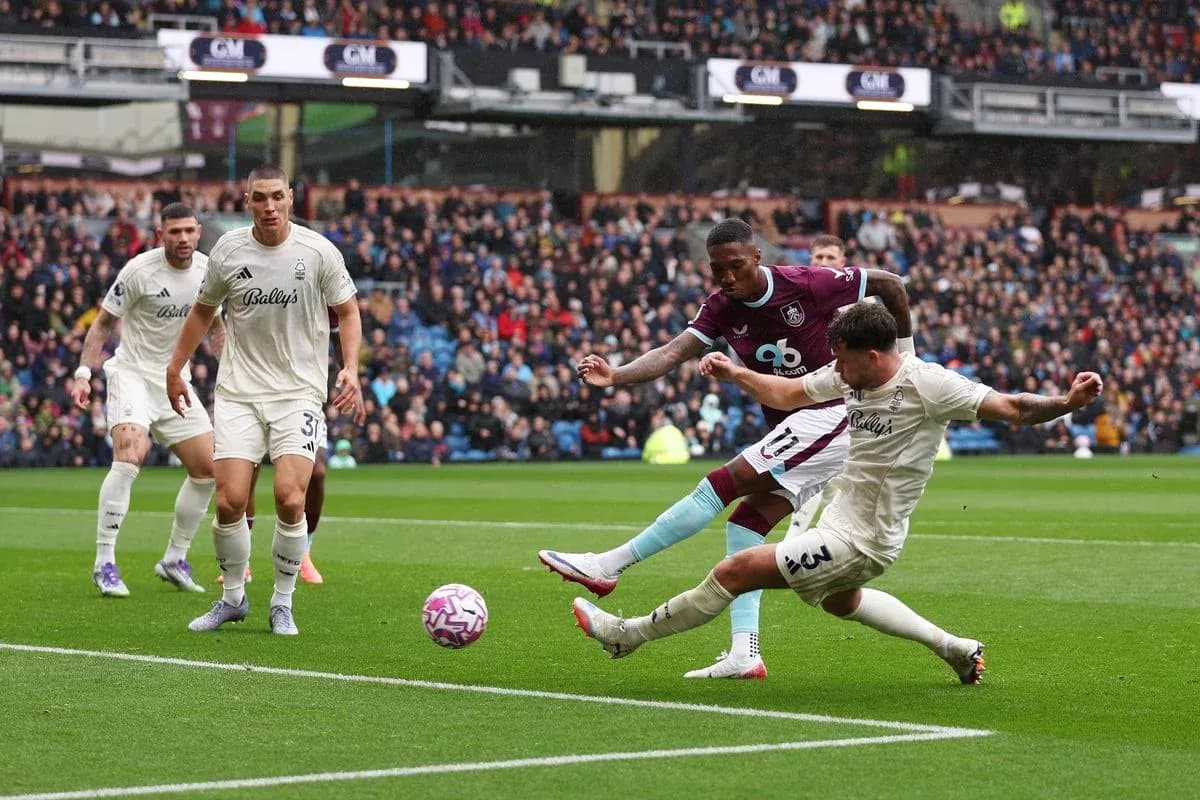
Nottingham Forest vs Burnley: High-Stakes Relegation Battle
City Ground stages a high‑stakes relegation battle in April 2026 as 16th‑placed Nottingham Forest host 19th‑placed Burnley in the Premier League. With Forest on 33 points and Burnley marooned on 20 after 32 matches, the context is stark: the home side are scrapping to stay above the drop zone, while Burnley are running out of road to avoid a swift return to the Championship.
Context and stakes
In the league, Forest’s position (16th, goal difference -12) reflects a season of narrow margins and inconsistency, but they remain just about on course for survival. Their recent form across all phases – “DWDDL” in the table and a longer pattern of streaky runs in the season statistics – suggests a team that oscillates between resilience and fragility.
Burnley, by contrast, arrive in deep trouble. Nineteenth in the league, on 20 points with a goal difference of -30, they have lost 20 of 32 matches and own the division’s second‑worst defensive record (63 conceded). Their form line “LLDLL” underlines a side that has not been able to turn performances into wins at the business end of the season.
With only six matches left after this round, a Forest win would push them towards safety and leave Burnley needing a near‑miracle. Anything less than three points for the visitors would feel like another step towards relegation.
Tactical outlook: Forest
Across all phases, Forest have leaned heavily on a 4‑2‑3‑1 (used 28 times), occasionally flirting with back‑five systems (5‑3‑2, 3‑4‑3, 4‑5‑1). That default shape suits their main creative force: Morgan Gibbs‑White.
Gibbs‑White is Forest’s standout attacking player in the league this season. With 9 goals and 2 assists in 32 appearances, he has carried a significant share of their 32‑goal total. His numbers – 48 shots (24 on target), 44 key passes, and over 1,000 completed passes at 81% accuracy – paint the picture of a high‑usage No.10 who both finishes and creates. He also brings ball‑carrying threat (49 dribble attempts, 24 successful) and draws fouls regularly (38 won), which is crucial for a side that often struggles to break down set defences.
Forest’s main structural problem has been end product. In the league they average just 1.0 goals per game across all phases, and at City Ground it drops to 0.9 (14 goals in 16 home matches). More tellingly, they have failed to score in 9 of those 16 home games. That places a huge onus on Gibbs‑White to find pockets between the lines and on the wide players and lone striker to convert limited chances.
Defensively, Forest concede 1.4 goals per game overall (44 against), with 1.3 per game at home. Eight clean sheets show they can be compact when the game script suits them, but their long‑form record – including a longest losing streak of four – suggests that once they wobble, they can spiral.
Team news may force further caution. At the back, W. Boly is ruled out with a knee injury, while Murillo is listed as questionable. Losing both would strip Forest of aerial presence and composure in build‑up, perhaps nudging the coach towards a more conservative back four and a deeper double pivot. In attack, C. Hudson‑Odoi and C. Wood are also questionable; without them, Forest’s ability to stretch Burnley wide or go more direct late on would be reduced.
One positive: from the spot, Forest have been reliable this season – 2 penalties taken, 2 scored, with no misses. Gibbs‑White has converted his only penalty, so if a tight game is decided from 12 yards, the home side have a trustworthy taker.
Tactical outlook: Burnley
Burnley’s season has been defined by tactical searching. They have used six different formations: 4‑2‑3‑1 (9 times), 3‑4‑2‑1 (8), 5‑4‑1 (7), 4‑3‑3 (3), 4‑4‑2 (2), and 3‑4‑3 (2). That churn reflects a manager trying to find balance between a passing identity and Premier League pragmatism, without much success.
Going forward, their numbers mirror Forest’s: 33 goals in 32 matches (1.0 per game), with 18 away goals at 1.1 per game. They have failed to score in 12 league games overall, but only 4 of those blanks have come away, suggesting they are slightly more dangerous on the counter than when asked to break teams down at Turf Moor.
The real issue is at the back. Burnley concede 2.0 goals per game across all phases, and a grim 2.4 per game away (38 conceded in 16). Their heaviest away defeats (up to 5‑1) underline how quickly matches can get away from them once they fall behind. Clean sheets on the road are non‑existent this season: 0 in 16 away games.
Injuries only deepen the problem. Key defender J. Beyer is out with a hamstring injury, while full‑back C. Roberts also misses out. In midfield, J. Cullen and H. Mejbri are sidelined, and in attack Z. Amdouni – one of their more technically gifted forwards – is ruled out with a knee injury. With so many absentees through the spine, Burnley may again resort to a back five (5‑4‑1) to protect a makeshift defence, conceding territory and possession to Forest and hoping to hit in transition.
Like Forest, Burnley are 2 from 2 on penalties this season, with no misses, but with Amdouni unavailable and others injured, responsibility from the spot could fall to a less established taker.
Head‑to‑head: fine margins, Forest edge
Looking at recent competitive meetings (excluding the cancelled friendly), the last four fixtures tell a story of tight games:
- In September 2025 at Turf Moor, the sides drew 1‑1 in the league.
- In May 2024, Forest won 2‑1 away at Turf Moor in the Premier League.
- In September 2023 at City Ground, they drew 1‑1 in the league.
- In August 2023, Burnley won 1‑0 at City Ground in the League Cup 2nd Round.
Across these last four competitive meetings: 1 win for Nottingham Forest, 1 win for Burnley, and 2 draws. Three of the four were league fixtures; in the league alone Forest shade it with 1 win and 2 draws from three.
Another pattern: every one of those four competitive matches finished with both teams scoring at least once, and three of the four ended 1‑1. The margins between these sides have been consistently narrow.
Key battles
- Gibbs‑White vs Burnley’s double pivot/back line: With Burnley likely to sit deep, limiting space between the lines will be essential. If Gibbs‑White can receive on the half‑turn and combine around the box, Burnley’s fragile away defence could be exposed again.
- Forest’s makeshift defence vs Burnley counters: If Murillo does not make it, Forest’s back line will be reshuffled. Burnley’s best hope lies in fast breaks into those gaps, especially down the channels vacated by Forest’s full‑backs.
- Set pieces and discipline: Burnley’s card profile shows a tendency to pick up yellows and reds late in games. Forest’s ability to draw fouls, especially through Gibbs‑White, could tilt tight moments in their favour via free‑kicks and potential penalties.
The verdict
Data and context both lean towards the hosts. Forest are far from fluent at City Ground, but they are more stable than a Burnley side with 11 away defeats, no clean sheets on the road, and a lengthy injury list in key areas. Recent head‑to‑head meetings suggest another tight contest rather than a rout, and Forest’s own attacking limitations mean this is unlikely to be a free‑scoring spectacle.
Expect Forest to control more of the ball, probe patiently through Gibbs‑White, and test a patched‑up Burnley defence that has struggled all season to cope with sustained pressure. Burnley will scrap and look for moments in transition, but with their season on the line and their squad stretched, the numbers point to a narrow home win – the kind of grind‑it‑out result that could prove decisive in the relegation fight.