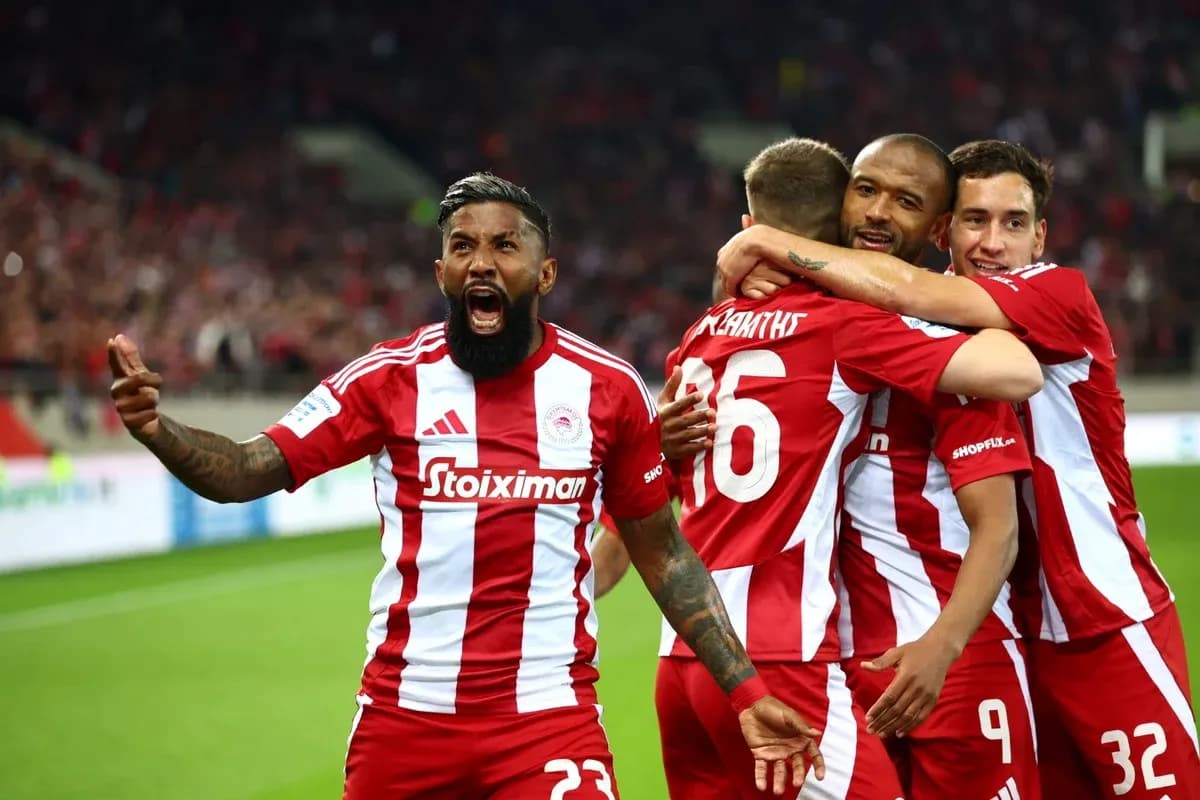
Olympiakos vs AEK Athens: Tactical Breakdown of 4-2-3-1 vs 4-2-2-2
Olympiakos Piraeus’ 4-2-3-1 against AEK Athens FC’s 4-2-2-2 produced a match where territorial control and possession did not translate into genuine threat. Olympiakos dominated the ball with 62% possession and completed 363 of 487 passes (75%), but were held to a single shot on target and an expected_goals figure of just 0.22. AEK, with only 38% of the ball and 190 accurate passes from 306 (62%), played a compact, vertically oriented game, generating slightly higher xG at 0.32 and protecting their early lead with structural discipline rather than deep retreat.
Olympiakos’ build-up revolved around the back four of Rodinei, Panagiotis Retsos, Lorenzo Pirola and Bruno Onyemaechi stepping high, with Santiago Hezze and Dani García as the double pivot. In practice, Hezze often dropped closer to the centre-backs to start play, allowing Rodinei and Onyemaechi to advance. The three behind Ayoub El Kaabi — Gelson Martins right, Mehdi Taremi as a roaming central “10”, Daniel Podence left — occupied advanced positions, but AEK’s 4-2-2-2 block consistently closed the central lanes.
Răzvan Marin and Orbelín Pineda were crucial for AEK out of possession. They screened passes into Taremi and El Kaabi, forcing Olympiakos to circulate wide and accept low-value crosses or speculative shots from distance, reflected in the home side’s split of 2 shots inside the box and 3 from outside. With only 5 total shots and 2 blocked, Olympiakos were largely kept on the perimeter; AEK’s front two, Barnabás Varga and Luka Jović, stayed high enough to discourage overly aggressive central progression from Retsos and Pirola.
AEK’s attacking approach was direct and selective. Despite having just 7 total shots, they produced 3 blocked efforts and matched Olympiakos’ 1 shot on goal, suggesting that when they did reach the final third, they committed numbers and shot from more contested zones. The early goal from Aboubakary Koita at 5' set the game-state: AEK could sit in a mid-block and choose moments to spring forward through Koita and Roberto Pereyra in the half-spaces, supported by full-backs Lazaros Rota and James Penrice when the opportunity was clear.
The disciplinary pattern underlined the tactical tone. AEK’s first yellow card went to Roberto Pereyra at 31' for a foul, a classic tactical intervention to halt an Olympiakos transition. Olympiakos’ Dani García was then booked at 34' for a foul of his own, reflecting the intensity of central duels as the hosts tried to counterpress immediately after turnovers. Penrice’s yellow at 67' again came for a foul, another sign of AEK’s readiness to use controlled aggression to disrupt rhythm rather than drop into passive defending.
Luis Mendilibar’s adjustments were aimed at increasing verticality and creativity, but the underlying structure of the match barely shifted. The first change at 58' saw Christos Mouzakitis (IN) come on for Dani García (OUT), effectively converting the double pivot into a more attack-minded midfield, with Hezze holding alone more often. One minute later, at 59', Chiquinho (IN) replaced Daniel Podence (OUT), adding a different profile between the lines: more combination play and interior passing, less pure 1v1 wing threat.
At 71', Olympiakos doubled down on attacking substitutions. Yusuf Yazıcı (IN) came on for Gelson Martins (OUT), and Clayton (IN) replaced Mehdi Taremi (OUT). These changes pushed the team towards a more fluid, multi-forward structure around El Kaabi, with Yazıcı and Chiquinho both capable of drifting inside and Clayton offering direct runs. However, AEK’s compactness meant that despite the nominal increase in attacking profiles, the shot volume remained low and the quality of chances did not rise significantly.
Marko Nikolic’s response was pragmatic and timed to preserve control of key zones. At 64', Petros Mantalos (IN) came on for Roberto Pereyra (OUT), refreshing the creative and defensive energy in the left half-space. Simultaneously, Mijat Gaćinović (IN) replaced Luka Jović (OUT), slightly rebalancing the front line towards more work without the ball and better link play. Later, at 80', Joao Mario (IN) came on for Aboubakary Koita (OUT), and Zini (IN) replaced Barnabás Varga (OUT), injecting pace and defensive work on the flanks and up front to manage the final phase.
Olympiakos’ final substitution at 83' — Diogo Nascimento (IN) for Santiago Hezze (OUT) — was a last attempt to add progressive passing from deeper midfield, but it further reduced the natural defensive screen in front of the back four. Even so, AEK did not overcommit; they continued to accept a lower share of possession, trusting their structure and timing their pressure to keep Olympiakos’ xG suppressed.
The late VAR intervention at 90+10', cancelling a potential goal by Christos Mouzakitis for Olympiakos, illustrated how fine the margins were for the hosts. Despite territorial dominance, their clearest moment to equalise came not from sustained high-quality chance creation but from a single episode ultimately ruled out. With both goalkeepers registering no recorded saves and both sides finishing with just 1 shot on target, the defensive organisations and shot suppression from both teams were more decisive than any individual goalkeeping performance.
Statistically, the picture is stark: Olympiakos led possession 62–38, but trailed in xG 0.22–0.32 and could not convert their 5 shots into consistent danger. AEK, with 7 shots (3 blocked) and only 2 inside the box, managed the game-state intelligently after Koita’s early strike, using fouls (16 to Olympiakos’ 12) and disciplined spacing to blunt the hosts’ 4-2-3-1. The 1–0 scoreline, low xG on both sides, and absence of recorded saves underline a match defined by AEK’s compact, situationally aggressive defending and Olympiakos’ inability to turn control of the ball into genuine penetration.