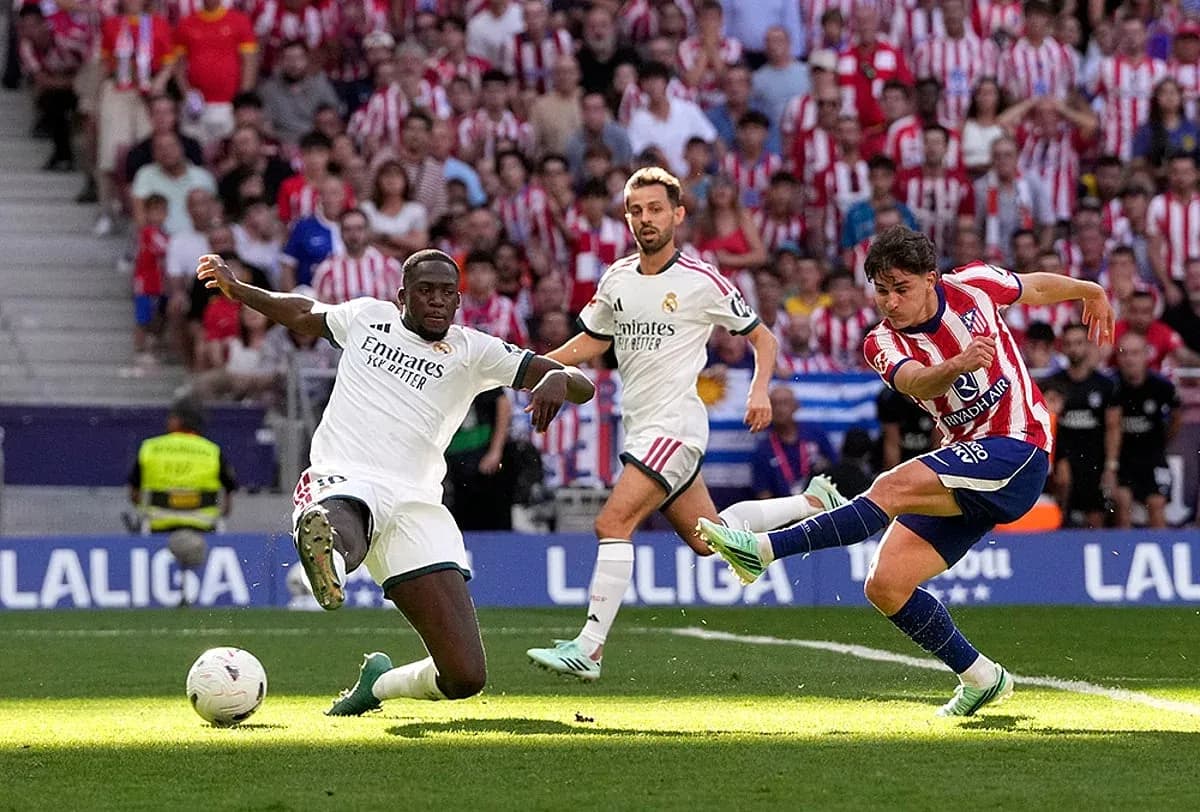
Osasuna vs Atletico Madrid: Tactical Analysis of La Liga Showdown
The evening at Estadio El Sadar closed with the kind of tense, attritional football that defines late-season La Liga. Following this result, Osasuna’s 2-1 home defeat to Atletico Madrid underlined the gap between a rugged mid-table side and a Champions League contender who know how to survive hostile away days.
I. The Big Picture – contrasting seasonal DNA
This was Round 36 of La Liga, and the table told a clear story before a ball was kicked. Osasuna came in 12th with 42 points, their overall goal difference at -4 from 43 goals for and 47 against. At home they have been a different animal: 9 wins from 18, with 30 goals scored and only 22 conceded. El Sadar has been their shield.
Atletico arrived as the more polished machine. Sitting 4th with 66 points and an overall goal difference of 21 (60 scored, 39 conceded), Diego Simeone’s side have built their campaign on fortress home form but still carry enough quality on their travels: 6 away wins from 18, 22 goals scored and 22 conceded away.
The full-time scoreline – Osasuna 1-2 Atletico Madrid (0-1 at half-time) – fitted the seasonal pattern. Osasuna were once again combative and competitive at home, but Atletico’s higher ceiling in both boxes told in the key moments.
Alessio Lisci stayed loyal to Osasuna’s most-used structure, rolling out a 4-2-3-1 that has been their base in 21 league matches. A. Fernandez started in goal behind a back four of V. Rosier, A. Catena, F. Boyomo and J. Galan. The double pivot of J. Moncayola and L. Torro anchored the midfield, with R. Garcia, M. Gomez and R. Moro supporting lone striker A. Budimir.
Simeone, predictably, went with his staple 4-4-2, a shape he has used in 24 league games. J. Musso was protected by a back line of M. Llorente, M. Pubill, D. Hancko and M. Ruggeri. In midfield, T. Almada, R. Mendoza, Koke and O. Vargas formed a flexible band of four behind the front duo of A. Griezmann and A. Lookman.
II. Tactical Voids – absences and discipline
Both squads were marked by important absences that shaped the tactical landscape. Osasuna were without S. Herrera, suspended due to a red card, and V. Munoz, sidelined by a muscle injury. Herrera’s absence removed a combative presence from Lisci’s options, forcing even more responsibility on J. Moncayola and L. Torro to control central spaces and manage transitions.
Atletico’s absentee list was even longer. J. Alvarez (ankle injury), A. Baena (suspension for yellow cards), P. Barrios (muscle injury), J. Cardoso (contusion), J. M. Gimenez (injury), N. Gonzalez (muscle injury), N. Molina (muscle injury) and G. Simeone (hip injury) all missed out. Deprived of several defensive and midfield pieces, Simeone leaned heavily on the adaptability of Koke and the back-four’s positional discipline to keep their structure intact.
Season-long disciplinary profiles hinted at how this contest might fray at the edges. Osasuna’s yellow-card distribution shows a clear late-game spike: 20.45% of their yellows arrive between 76-90 minutes, with another 14.77% from 91-105. Their red cards are also concentrated in high-stress phases – 28.57% between 31-45, 28.57% from 76-90 and 28.57% from 91-105. Atletico’s yellows are more evenly spread but still peak between 31-45 minutes at 21.05%, while their reds are remarkably balanced across 16-30, 31-45, 46-60, 61-75 and 76-90, each at 20.00%. It is no accident that this match was played on the edge; both teams habitually live there.
III. Key Matchups – Hunter vs Shield, and the Engine Room
Hunter vs Shield
The headline duel was always going to be A. Budimir against Atletico’s defensive unit. Budimir has been one of La Liga’s most efficient centre-forwards this season: in total he has 17 league goals from 35 appearances, with 84 total shots and 39 on target. He is not just a finisher but a focal point – 357 duels in total, winning 167, and 6 successful blocks defensively. Against a side that, on their travels, concede 1.2 goals per game and have allowed 22 away goals in total, his ability to occupy both centre-backs and attack crosses was Osasuna’s clearest route back once they fell behind.
The “shield” was a patchwork Atletico back line. Without J. M. Gimenez and N. Molina, Simeone relied on D. Hancko’s timing and M. Pubill’s aggression alongside the defensive intelligence of M. Llorente and M. Ruggeri in wide areas. Atletico’s season numbers underline their resilience: overall they concede 1.1 goals per game, and away they have kept 6 clean sheets from 18. The plan was simple: compress the central channel around Budimir, trust Koke and R. Mendoza to screen, and force Osasuna’s wide players to cross from less dangerous zones.
Engine Room – Playmaker vs Enforcer
In midfield, the game’s rhythm hinged on two contrasting figures. For Atletico, Koke remains the metronome. His presence in a side that averages 1.7 goals per game overall and 2.1 at home has been about more than creativity; he knits together the pressing triggers of the front two and the positional rotations with T. Almada and O. Vargas.
Opposite him, J. Moncayola was Osasuna’s enforcer and distributor rolled into one. Over the season he has 34 appearances, 50 tackles, 6 blocks and 20 interceptions, plus 4 assists and 37 key passes – a profile that blends bite with progression. His duel with Koke determined whether Osasuna could break Atletico’s first pressing line and find R. Garcia and M. Gomez between the lines, or whether they would be forced into longer, less accurate balls toward Budimir.
Behind Moncayola, A. Catena’s presence was just as decisive. Across the campaign he has 38 tackles, and crucially he has blocked 32 shots – a huge number that explains how Osasuna, at home, have kept 5 clean sheets and allowed only 22 goals. But his aggressive style comes at a cost: 11 yellow cards and 1 red make him one of the league’s most carded defenders, and his timing in stepping out to meet Griezmann between the lines was always going to be a knife-edge calculation.
On Atletico’s bench, A. Sørloth loomed as a different kind of “hunter”. With 13 goals in total this season, 54 shots and 34 on target, plus 272 duels contested and 129 won, he offers a more direct, aerially dominant option compared to Griezmann or Lookman. Simeone’s capacity to introduce Sørloth against a tiring Osasuna back four was a built-in tactical threat.
IV. Statistical Prognosis – xG logic and defensive solidity
Even without explicit xG figures, the season data frames how this match was always likely to tilt. Heading into this game, Osasuna’s overall scoring rate stood at 1.2 goals per match, but at home that rose to 1.7, matched against 1.2 goals conceded at El Sadar. Atletico’s overall attacking output was stronger at 1.7 goals per match, and on their travels they still averaged 1.2 goals scored while conceding 1.2.
Overlaying those profiles, a narrow Atletico win or a draw sat firmly within the expected range: Osasuna’s home attack against Atletico’s away defence suggested something like 1-1 in pure xG logic, but Atletico’s higher ceiling in chance quality – via Griezmann, Lookman and potentially Sørloth – nudged the probabilities towards the visitors.
Defensively, Atletico’s 13 clean sheets overall and Osasuna’s 7 show both sides are capable of locking games down when the game state suits them. Yet Osasuna’s disciplinary spikes late on, combined with Atletico’s habit of drawing fouls around the box through mobile forwards, created a scenario where a tight contest could be decided by a single lapse or set piece.
In the end, the 2-1 away win mirrored the season-long trends. Atletico’s structure and individual quality allowed them to edge the key duels – Budimir’s threat was contained just enough, Koke and R. Mendoza wrestled control of the midfield at vital moments, and the makeshift back line held firm under aerial bombardment. For Osasuna, the performance reinforced their identity: fierce at home, reliant on Budimir’s penalty-box craft and Catena’s last-ditch defending, but still a step below the clinical edge of a top-four side when the margins narrow in May.