Osasuna vs Espanyol: Tactical Analysis of a 1-2 Defeat
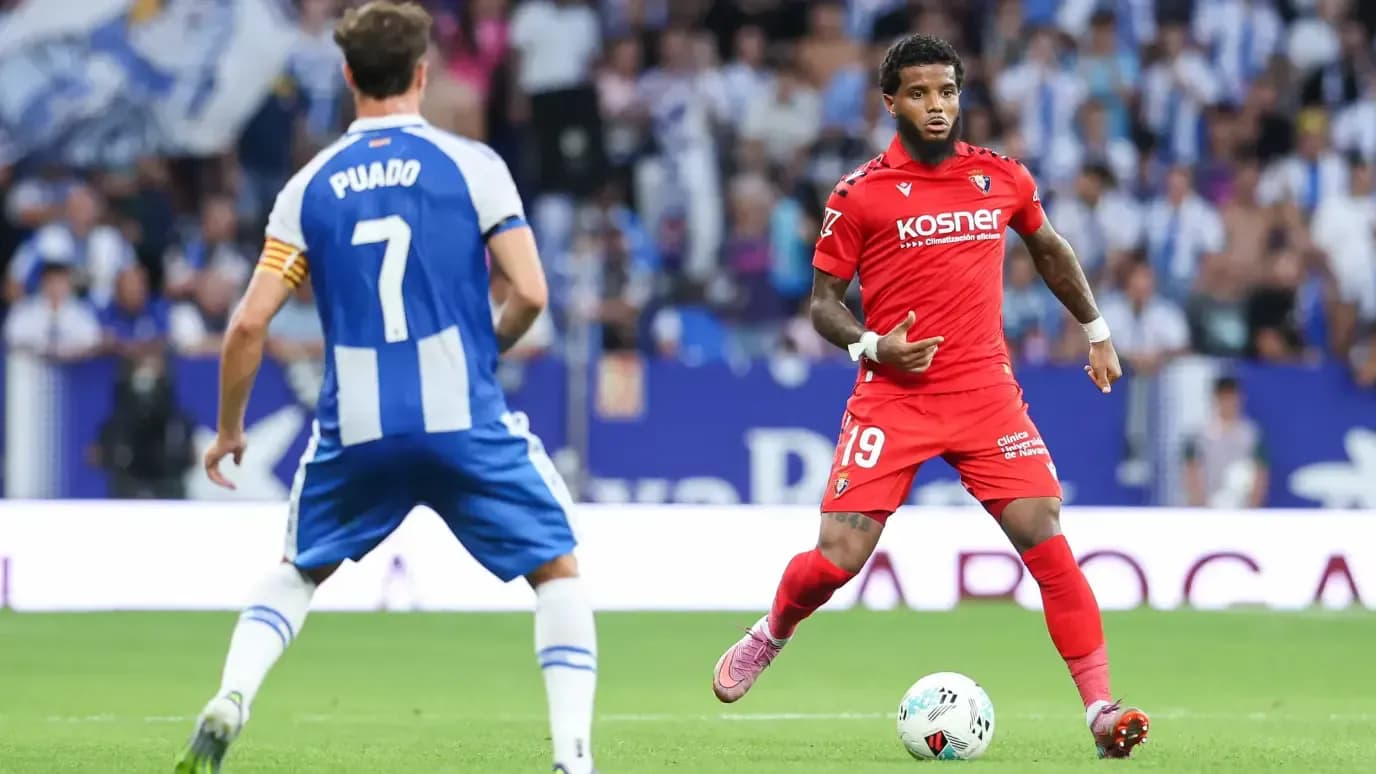
Osasuna’s 1-2 defeat to Espanyol at Estadio El Sadar was a classic case of territorial and statistical dominance being undone by structural fragility in both boxes. Alessio Lisci’s side controlled the rhythm, posted superior metrics across almost every category, and yet Manolo Gonzalez’s Espanyol executed a cleaner, more ruthless game plan built on compact defending, direct transitions, and set-piece efficiency.
Osasuna lined up in a 4-2-3-1 with S. Herrera behind a back four of V. Rosier, A. Catena, F. Boyomo and A. Bretones. The double pivot of L. Torro and J. Moncayola was tasked with building through the thirds, with R. Garcia, A. Oroz and V. Munoz supporting lone striker A. Budimir. Their structure quickly produced territorial control: 68% possession, 515 passes, and 86% passing accuracy (515 passes, 442 accurate). The shape was stable in rest attack, with full-backs pushing high and the three advanced midfielders occupying half-spaces.
Espanyol’s 4-4-2 was unapologetically pragmatic. M. Dmitrovic was protected by a compact line of O. El Hilali, C. Riedel, L. Cabrera and C. Romero, with a narrow midfield four of T. Dolan, U. Gonzalez, Pol Lozano and P. Milla behind the front pairing of Exposito and K. Garcia. Their 32% possession (252 passes, 174 accurate at 69%) was by design: they defended deep, protected the central lane, and accepted long spells without the ball in exchange for clear attacking patterns in transition and on dead balls.
The scoring sequence underlines the tactical trade-offs. On 27', C. Romero opened the scoring for Espanyol, capitalizing on Osasuna’s vulnerability when committing numbers forward. With full-backs high and the double pivot spread to circulate possession, Espanyol found space to exploit, and Romero’s goal gave Gonzalez the perfect platform to double down on a low block and counter-attacks. At half-time the scoreline of 0-1 reflected Espanyol’s efficiency rather than their volume of play.
Osasuna’s structural pressure finally paid off on 49', when V. Munoz equalized, assisted by F. Boyomo. The move epitomized Lisci’s idea: centre-backs stepping into midfield, wide overloads, and second-line runs from the attacking midfielders. Boyomo’s involvement high up the pitch showed how aggressively Osasuna were squeezing Espanyol back, using their back line almost on the halfway line to keep the visitors pinned.
Yet just four minutes later, Espanyol reasserted their edge in transition. On 53', K. Garcia restored the lead, assisted by T. Dolan. Again, Osasuna’s rest defence was exposed: with numbers committed forward after equalizing, their counter-press failed to stop the first pass out, and Dolan’s involvement from the right side of midfield highlighted Espanyol’s plan to break quickly into the channels rather than trying to play through Osasuna’s midfield block. That 1-2 moment became the tactical hinge of the match: Osasuna had to chase; Espanyol could retreat even deeper.
The substitutions from 55' onward were clearly tactical responses. At 55', Espanyol replaced Pol Lozano with C. Pickel (C. Pickel (IN) came on for Pol Lozano (OUT)), adding more defensive energy in midfield to protect the lead. Lisci responded with a triple change on 58': R. Garcia (IN) came on for A. Oroz (OUT), I. Munoz (IN) came on for L. Torro (OUT), and M. Gomez (IN) came on for J. Moncayola (OUT). Functionally, Osasuna injected more verticality and fresh legs between the lines, sacrificing some control in the pivot to increase attacking threat and pressing intensity.
Espanyol’s 64' double change—F. Calero (IN) came on for Exposito (OUT) and R. Fernandez Jaen (IN) came on for K. Garcia (OUT)—tilted their 4-4-2 into an even more defensive posture, with an extra defender and a fresh forward for counter outlets. Osasuna’s response at 67', J. Galan (IN) came on for A. Bretones (OUT), was a like-for-like full-back swap aimed at maintaining width and crossing quality. On 76', A. Roca (IN) came on for T. Dolan (OUT) and R. Sanchez (IN) came on for P. Milla (OUT), further refreshing Espanyol’s wide and defensive resources, while Osasuna’s final attacking tweak came at 78', with K. Barja (IN) coming on for V. Rosier (OUT), effectively turning the right flank into a winger-dominated lane and pushing even more numbers into the final third.
The disciplinary events subtly shaped the match’s tempo. On 11', Pol Lozano received a yellow card for “Foul”, an early signal of Espanyol’s willingness to break rhythm and accept bookings to disrupt Osasuna’s combinations. On 83', Iker Muñoz was booked for “Foul”, reflecting Osasuna’s increasing desperation and higher-risk pressing as they chased the game. Finally, on 90', Antoniu Roca received a yellow card with no additionalInfo, capping Espanyol’s combative defensive display. In total: Osasuna 1 yellow, Espanyol 2 yellows, 3 cards overall.
Statistically, Osasuna’s attacking volume was overwhelming: 24 total shots to Espanyol’s 7, with 9 shots on goal versus 3, and 18 efforts inside the box. Their xG of 1.61 suggests they created enough to merit at least a draw, but finishing and decision-making in the area were suboptimal. Espanyol’s xG of 0.79 underlines just how clinical they were with limited opportunities, turning two of three shots on target into goals.
Goalkeeper performance adds nuance. S. Herrera made only 1 save, with a goals prevented figure of -0.23, indicating he slightly underperformed the quality of shots faced; the defensive line in front of him also allowed Espanyol’s few chances to be high-value. At the other end, M. Dmitrovic recorded 6 saves, also with goals prevented at -0.23, an unusual combination that suggests some of Osasuna’s attempts, while numerous, were not of the highest difficulty, and that the single goal conceded roughly matched the quality of chances allowed.
Espanyol’s defensive index on the day was defined less by pure prevention metrics and more by structural coherence: 13 fouls, 2 yellow cards, and a compact 4-4-2 that forced Osasuna wide and into blocked shooting lanes (Osasuna had 10 blocked shots). Osasuna’s overall form within the match—measured by control, passing, and territorial dominance—was strong, but their defensive index suffered whenever they transitioned from attack to defence, and that imbalance ultimately decided a contest where the scoreboard, not the stat sheet, told the final story: Osasuna 1-2 Espanyol.