Pisa vs Napoli: A Tactical Analysis of Serie A Clash
The Arena Garibaldi - Stadio Romeo Anconetani felt like a stage set for a mismatch, and the scoreline confirmed it. Pisa, already marooned at the bottom of Serie A in 20th place with 18 points and a goal difference of -44, fell 0-3 at home to a Napoli side chasing the title from 2nd with 73 points and a goal difference of 21. Following this result in Round 37, the contrast between the two clubs’ seasonal identities could hardly be sharper: Pisa fragile and blunt, Napoli controlled and ruthless.
Pisa’s season-long story is written in their numbers. Overall, they have scored just 25 goals and conceded 69 across 37 matches; at home, that drops to 9 goals for and 26 against. An average of 0.5 goals scored at home against 1.4 conceded underlines why a defensive 3-5-2 has become necessity rather than choice. Oscar Hiljemark’s selection — A. Semper behind a back three of A. Calabresi, A. Caracciolo and S. Canestrelli, with a five-man midfield led by M. Aebischer and M. Hojholt — was built to survive first and hope for scraps later.
The tactical voids were clear before a ball was kicked. Pisa came into this fixture without a cluster of squad options: R. Bozhinov and F. Loyola suspended by red cards, F. Coppola and M. Tramoni sidelined by muscle injuries, D. Denoon nursing an ankle problem, and Lorran listed as inactive. For a side already short of quality and confidence, that stripped away rotation and limited Hiljemark’s ability to adjust mid-game. The disciplinary profile of this Pisa group only deepens the tension: their season card data shows a late spike in yellow cards, with 25.97% arriving between 76-90 minutes, and a worrying spread of reds in the 16-60 and 91-105 ranges. The emotional strain of chasing games has often tipped into rashness.
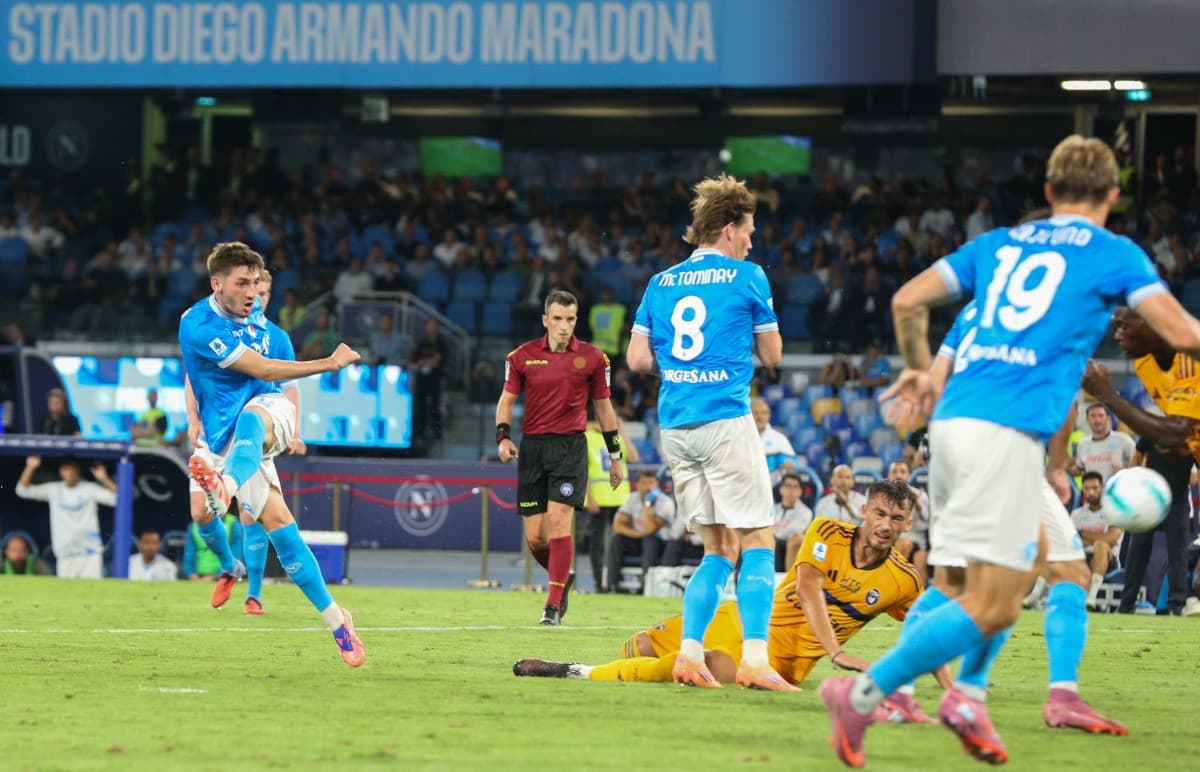
Napoli had absentees of their own — David Neres and R. Lukaku injured, M. Politano suspended for yellow cards — but Antonio Conte’s squad depth and structure allowed a seamless reshuffle. A back three of S. Beukema, A. Rrahmani and A. Buongiorno sat behind a four-man line of G. Di Lorenzo, S. Lobotka, S. McTominay and L. Spinazzola, with E. Elmas and Alisson Santos flanking R. Hojlund in a 3-4-3. Where Pisa’s formation was reactive, Napoli’s mirrored it with aggression: three centre-backs to dominate aerially, wing-backs to pin Pisa’s wide midfielders, and a central axis of Lobotka and McTominay to suffocate transitions.
The “Hunter vs Shield” duel was always going to tilt blue. Napoli’s attack has produced 57 goals overall, with 25 on their travels at an away average of 1.3 per game. Pisa’s defence, by contrast, has been porous: 69 goals conceded overall at an average of 1.9, including 26 at home. In that context, R. Hojlund’s presence as one of Serie A’s top scorers was decisive. Heading into this game he had 11 league goals and 5 assists from 32 appearances, built on 44 shots (23 on target) and 31 key passes. His profile — mobile, direct, willing to duel (303 duels, 108 won) — was perfectly suited to attacking the spaces behind Pisa’s wide centre-backs, especially when their wing-backs were forced back by Spinazzola and Di Lorenzo.
On the other side of the equation, Pisa simply lacked a comparable spearhead. Their season top scorers do not appear among the league’s elite lists, and the raw team data tells the story: just 2 wins overall, 21 matches failed to score, including 12 such blanks at home. Even with creative efforts from Aebischer — who has 33 key passes and 1 assist this campaign — and the running of S. Moreo and F. Stojilkovic, Pisa rarely turn phases of possession into clear chances. Napoli’s defensive record away from home, with only 18 goals conceded at an average of 0.9, meant that once they scored first, the contest tilted into a containment exercise.
The “Engine Room” battle was perhaps the clearest illustration of the gulf. McTominay, one of the league’s standout midfielders with 10 goals and 3 assists, combined physicality and timing to dominate central lanes. His 28 tackles, 13 blocked shots and 21 interceptions this season highlight his dual role as destroyer and late-arriving scorer. Alongside him, Lobotka’s metronomic passing and Napoli’s back three ensured that Pisa’s main ball-playing pivot, Aebischer, was often receiving under pressure with limited forward options. Even when Pisa tried to step higher with M. Hojholt and E. Akinsanmiro, Napoli’s superior structure and pressing angles forced play wide or backwards.
Discipline added another layer to the tactical chessboard. Napoli’s season card profile shows a concentration of yellow cards between 61-75 minutes (30.61%) and a notable spike of red cards in the 76-90 window (100.00% of their reds). Conte’s side play on the edge, particularly when protecting leads late on. Yet against Pisa’s blunt attack, that risk was mitigated; they could maintain intensity without facing a counter-punch. Pisa, by contrast, often become more frantic in the closing stages, as reflected in their late yellow-card surge. Once they trailed 0-2 at half-time and 0-3 by full-time, the game-state pushed them towards the same emotional cliff they have walked all season.
From a statistical prognosis standpoint, this match unfolded almost exactly along expected lines. Napoli’s season-long xG profile (inferred from 1.5 goals scored per game and only 1.0 conceded overall) suggests a side that consistently creates more than they allow, while Pisa’s 0.7 goals scored and 1.9 conceded per match paint them as chronic underperformers at both ends. Add Napoli’s 14 clean sheets overall — 8 of them away — to Pisa’s 21 matches without scoring, and a Napoli win to nil felt the likeliest outcome. The 0-3 scoreline simply gave that logic a brutal, visible form.
In narrative terms, this was not just a defeat for Pisa; it was a confirmation of an entire campaign’s trajectory. The back three anchored by Caracciolo, a defender who has amassed 10 yellow cards and blocked 24 shots this season, once again found itself overwhelmed by a level of attacking quality it could not contain for 90 minutes. Napoli, even without several headline names, showed why they sit near the summit: depth, structure, and a clear hierarchy of roles, from Hojlund the hunter to McTominay the engine and Lobotka the metronome.
Following this result, Pisa’s relegation-bound season feels complete in all but mathematics, while Napoli stride towards the finish line with the authority of a side built for bigger stages. The numbers, the tactics, and the 0-3 on the board all tell the same story.