Premier League's Record Revenues and Losses: A Financial Paradox
The Premier League has never looked richer. It has also rarely looked more reckless.
England’s top flight generated a record £6.8 billion ($9.2 billion) in combined revenue in the 2024/25 season, a commercial machine that every other league in world football studies with envy. Yet behind the gloss sits a stark number: clubs still managed to lose nearly $1 billion.
The sport’s most powerful league is locked in an arms race, and the bill is landing hard.
Record revenues, record losses
On paper, this should be a golden age. Broadcasting deals remain colossal, global sponsorship money keeps flowing, and matchday income continues to rise. But transfer inflation, soaring wages and swelling agent fees are devouring that growth faster than clubs can bank it.
Chelsea stand as the most glaring example. The club posted a Premier League record pre-tax loss of £262 million for the year ending June 30, 2025, a staggering figure even by modern standards. Their aggressive, scattergun recruitment of young talent from across the globe has turned them into the poster club for excess — but not an outlier in direction, only in scale.
Tottenham, fighting relegation despite being the ninth-richest club in the world, also plunged deep into the red. Spurs lost £121 million last season, even as their state-of-the-art stadium pumped out booming revenues and they paraded a Europa League trophy. The numbers underline a brutal truth: success on the pitch, or even the trappings of it, no longer guarantees stability off it.
Some clubs have turned to creative accounting just to keep the balance sheet palatable. Saudi-backed Newcastle sold St James’ Park to another company owned by the club’s shareholders to post a profit. Everton and Aston Villa did the same with their women’s teams, selling them to related entities to generate paper gains.
The pressure finally told in the raw figures. Without such internal asset sales, the league’s collective losses would look even more severe.
Transfer frenzy and wage spiral
“The problem with the Premier League is that clubs are so incentivised to overspend,” football finance expert Kieran Maguire told AFP. “It’s an arms race at the end of the day in terms of competing for players on transfer fees and wages.”
The 2024/25 accounts don’t even capture the full blast of that arms race. Last summer’s transfer window saw Premier League clubs spend a record £3 billion on fees alone, smashing the previous high by £650 million. The spending spree was not a blip; it was a statement.
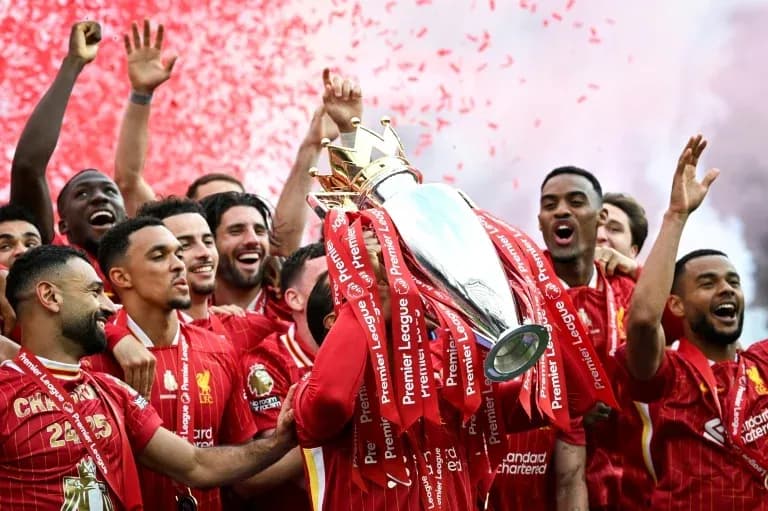
Liverpool led the charge with a £450-million window. The headline deal, a £125-million move for Alexander Isak, set a new record for an English club. Yet for all that outlay, the English champions have not yet seen the kind of tangible return on the pitch that such a fee demands. It is the modern Premier League paradox: spend more, risk more, guarantee nothing.
Wages, always the heaviest line on the cost sheet, climbed again to £4.4 billion, a nine percent rise year-on-year. Revenue only went up seven percent. The gap widens, and with it, the sense that the model is straining.
Agents, too, are taking a bigger slice. Payments to intermediaries hit new highs, inflaming fans who watch money pour out of the game while they face higher ticket prices and rising costs just to follow their club.
In this environment, success is no longer judged purely by trophies. League position, European qualification, and the commercial uplift that comes with being part of the Premier League’s global soap opera all shape how owners and executives define “winning.”
For the second straight year, at least five English clubs will qualify for the Champions League, opening up another lucrative revenue stream. The chase for those spots feeds the cycle: spend to get in, spend to stay in, spend to go deeper.
New rules, same habits?
From next season, new financial rules will attempt to put some kind of harness on this runaway race. Club spending on wages, transfer fees and agent costs will be capped at 85 percent of revenue, with a tighter 70 percent limit for those in UEFA competitions.
On the face of it, that looks like a sharp corrective. In reality, the impact may be muted. Operating costs — which soared to £1.9 billion for Premier League clubs last season — sit outside those limits. Stadium operations, infrastructure, and wider business costs can still expand, and clubs will search for every possible angle within the rules.
Despite the haemorrhaging of money, Premier League clubs remain prized assets. Their scarcity, their global reach, and their starring role in football’s most-watched league keep valuations sky-high.
Jim Ratcliffe’s 27.7 percent purchase of Manchester United for £1.25 billion in 2024 valued the club at around £4.5 billion. Chelsea went for a total package of £4.25 billion in 2022 to a consortium led by Todd Boehly and Clearlake Capital. Manchester City’s transformation into the dominant force in English football followed the takeover backed by the Abu Dhabi royal family. Newcastle’s trajectory changed overnight when the Saudi sovereign wealth fund took control in 2021.
Former Manchester United captain Gary Neville has suggested that Chelsea’s mounting financial problems might be the moment the market pauses for breath, a sign that the boom cannot last forever.
Maguire, though, sees a different calculation at play. For billionaire owners and sovereign wealth funds, the losses are painful in theory, manageable in practice.
“With billionaire owners and sovereign wealth funds in charge of clubs, whilst the losses seem high, for those people they are deemed to be affordable,” he said. “Unless there’s a mindset change from club owners in terms of controlling your core costs, which are player-related in transfer fees and wages, we’re going to continue in this vein for some time.”
The Premier League has built a spectacle that the world cannot stop watching. The question now is how long its biggest players are willing to keep paying this price for the show.