Rayo Vallecano vs Girona: Tactical Analysis of 1-1 Draw
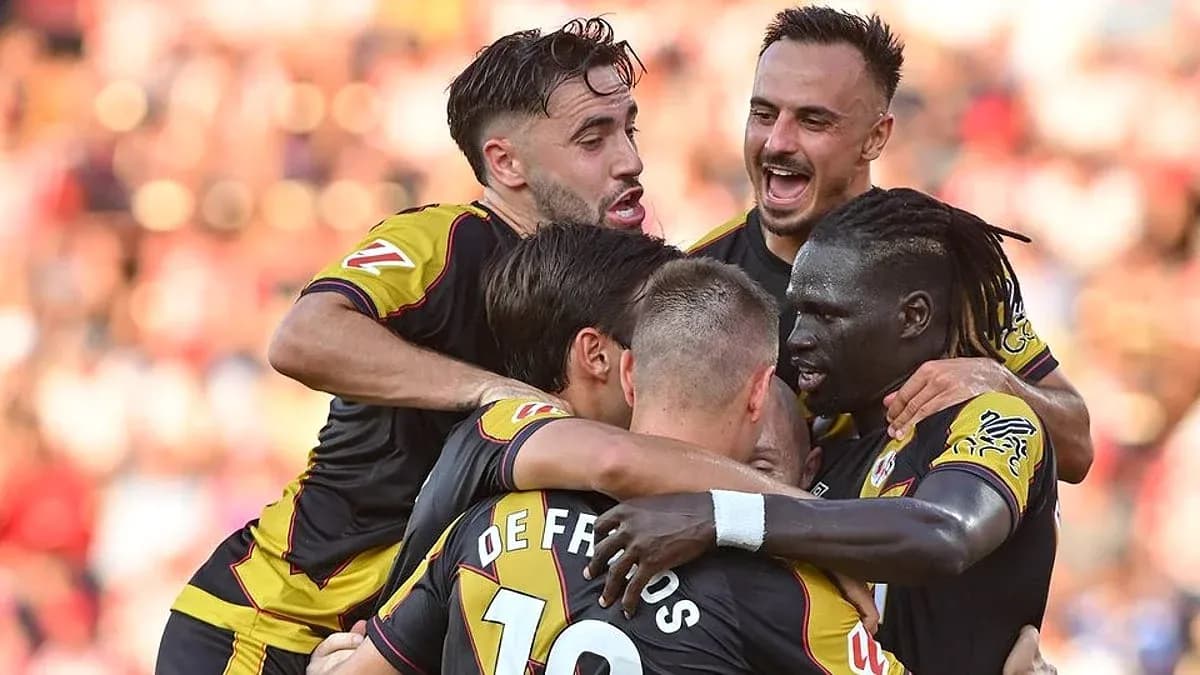
Rayo Vallecano and Girona shared a 1-1 draw at Campo de Futbol de Vallecas in a match where the tactical story was defined by Rayo’s territorial control against Girona’s compact structure and late-game punch. Inigo Perez’s 4-3-3 dominated possession and shot volume, but Michel’s 4-2-3-1 remained efficient and dangerous in moments, particularly after changes on the hour. The game state swung dramatically in the final minutes: Alemao’s 86' breakthrough for Rayo was cancelled out by Cristhian Stuani in the 90', reflecting a balance between Rayo’s sustained pressure and Girona’s strategic use of substitutions and direct attacking patterns.
I. Executive Summary
Rayo’s 4-3-3 was built around a high-possession, high-crossing approach: 59% of the ball, 18 total shots, and 9 corners underline a plan to pin Girona deep and circulate patiently through midfield. Girona, with 41% possession and just 9 shots, accepted a more reactive role, using Axel Witsel and F. Beltran as a double pivot to protect the back four and spring transitions through V. Tsygankov and T. Lemar between the lines. The xG numbers — 1.09 for Rayo and 0.86 for Girona — mirror the final 1-1, suggesting a tactically even contest where Rayo’s volume and Girona’s efficiency effectively cancelled each other out.
II. Scoring Sequence & Disciplinary Log
The match remained goalless at half-time, with Rayo’s pressure not yet converted into clear chances. Discipline was light but significant in its timing and context.
Card log (chronological, with reasons):
- 44' Pedro Díaz (Rayo Vallecano) — Foul
- 90+4' Cristhian Stuani (Girona) — Argument
Total cards: Rayo Vallecano 1, Girona 1, Total 2.
The key turning point sequence began after a VAR intervention: at 56', a potential Girona penalty involving Álex Moreno was reviewed and a “Penalty cancelled” decision went against the visitors, denying Michel’s side a high-value opportunity and reinforcing Rayo’s defensive resilience in their own box.
Substitutions then reshaped the attacking structures. For Rayo at 58', G. Gumbau (IN) came on for P. Diaz (OUT), and Alemao (IN) came on for F. Perez (OUT), adding fresh legs and a more direct reference in the front line. Girona responded on 60' with C. Echeverri (IN) for T. Lemar (OUT) and I. Martin (IN) for A. Ounahi (OUT), subtly shifting their creative and pressing dynamics in the attacking midfield band.
Rayo doubled down on width and energy at 68', with Pacha (IN) for S. Camello (OUT) and C. Martin (IN) for J. de Frutos (OUT), while Girona adjusted defensively at 72' as H. Rincon (IN) replaced A. Martinez (OUT) at right-back. At 85', C. Stuani (IN) came on for F. Beltran (OUT), a decisive attacking substitution that would later define the result.
The deadlock was broken at 86': Alemao (Rayo Vallecano) finished from close range after a delivery by U. Lopez, capping Rayo’s territorial dominance with a deserved 1-0 lead. Two minutes later, Rayo refreshed midfield energy with N. Mendy (IN) for U. Lopez (OUT) at 88', aiming to close out the game.
However, Girona’s structural gamble with Stuani paid off. Despite receiving a yellow card for Argument at 90+4', his earlier involvement was crucial: at 90', C. Stuani (Girona) converted a chance created by V. Tsygankov, levelling the match at 1-1 and punishing Rayo’s inability to manage the final defensive phase.
III. Tactical Breakdown & Personnel
Rayo Vallecano: 4-3-3, territorial control, wing-oriented attack
Inigo Perez’s side set up with A. Batalla in goal behind a back four of A. Ratiu, P. Ciss, F. Lejeune and P. Chavarria. The defensive line held an advanced position, enabling Rayo to compress the pitch and sustain pressure. Batalla made 3 saves; the goals prevented figure of -0.15 suggests he conceded slightly more than the post-shot quality would expect, though the single goal against was largely a function of late structural looseness rather than repeated individual errors.
The midfield trio of Pedro Díaz, O. Valentin and U. Lopez underpinned Rayo’s 59% possession. Their passing numbers — 486 total passes, 405 accurate (83%) — show a clear plan: circulate, probe, and use the full-backs plus wide forwards to overload the flanks. Diaz’s yellow for Foul at 44' came from his role as the main controller and breaker of transitions in the middle third.
Up front, J. de Frutos and F. Perez flanked S. Camello, looking to stretch Girona’s back four and attack the half-spaces. Despite 18 total shots and 9 inside the box, Rayo initially lacked incision. The introduction of Alemao and C. Martin sharpened the attack: Alemao’s physical presence and penalty-box instincts were exactly what the structure had been missing, evidenced by his 86' goal from U. Lopez’s service.
Girona: 4-2-3-1, compact block, targeted transitions
Michel’s 4-2-3-1, with P. Gazzaniga in goal, was oriented around defensive stability and selective risk. Gazzaniga produced 4 saves, with goals prevented at -0.15, indicating he slightly underperformed against shot quality but still kept Girona in the match during Rayo’s dominant spells. The back four of A. Martinez, A. Frances, Vitor Reis and Álex Moreno sat relatively narrow, forcing Rayo wide and trusting aerial and box defending.
The Witsel–Beltran double pivot was crucial. They limited central progression and protected the space in front of the centre-backs, accepting Rayo’s crosses as a calculated risk. Ahead of them, Tsygankov, Lemar and J. Roca supported A. Ounahi, trying to exploit transitions when Rayo’s full-backs pushed high. Girona’s 343 passes (271 accurate, 79%) reflect a more direct, lower-volume approach, with quick vertical outlets rather than extended possession phases.
Michel’s substitutions were tactically coherent. C. Echeverri and I. Martin added fresh creativity and ball-carrying in the attacking midfield zones, while H. Rincon’s introduction at right-back aimed to cope with Rayo’s growing wing pressure. The key adjustment was C. Stuani for Beltran at 85', effectively shifting the structure towards a 4-4-2 in possession with a classic target man. This gave Girona a more direct reference to attack crosses and second balls, culminating in the 90' equaliser: Tsygankov’s delivery and Stuani’s finish illustrated a late-game pattern that Rayo struggled to handle.
IV. The Statistical Verdict
The numbers reinforce the tactical narrative. Rayo’s 59% possession, 18 shots to Girona’s 9, and 9 corners to 5 show a side that controlled territory and volume. Their xG of 1.09 against Girona’s 0.86 indicates a slight edge in chance quality, but not an overwhelming one — aligning with a 1-1 result where both teams created enough to justify their goals.
Rayo’s passing structure — 486 passes, 405 accurate (83%) — was more elaborate and possession-oriented than Girona’s 343 passes, 271 accurate (79%). Yet Girona’s efficiency in key moments, particularly after shifting to a more direct approach with Stuani, narrowed the margin. Defensively, both goalkeepers posted negative goals prevented (-0.15 each), suggesting that finishing quality and defensive organisation, rather than outstanding shot-stopping, shaped the scoreline.
Discipline remained controlled (Rayo Vallecano 1 yellow, Girona 1 yellow, total 2), and the single VAR intervention — a Penalty cancelled for Girona at 56' — prevented the match from tilting decisively towards the visitors. In synthesis, Rayo’s overall form in this match was that of a proactive, possession-heavy side lacking late-game control, while Girona’s defensive index and game-management, especially through substitutions, earned them a valuable away point.