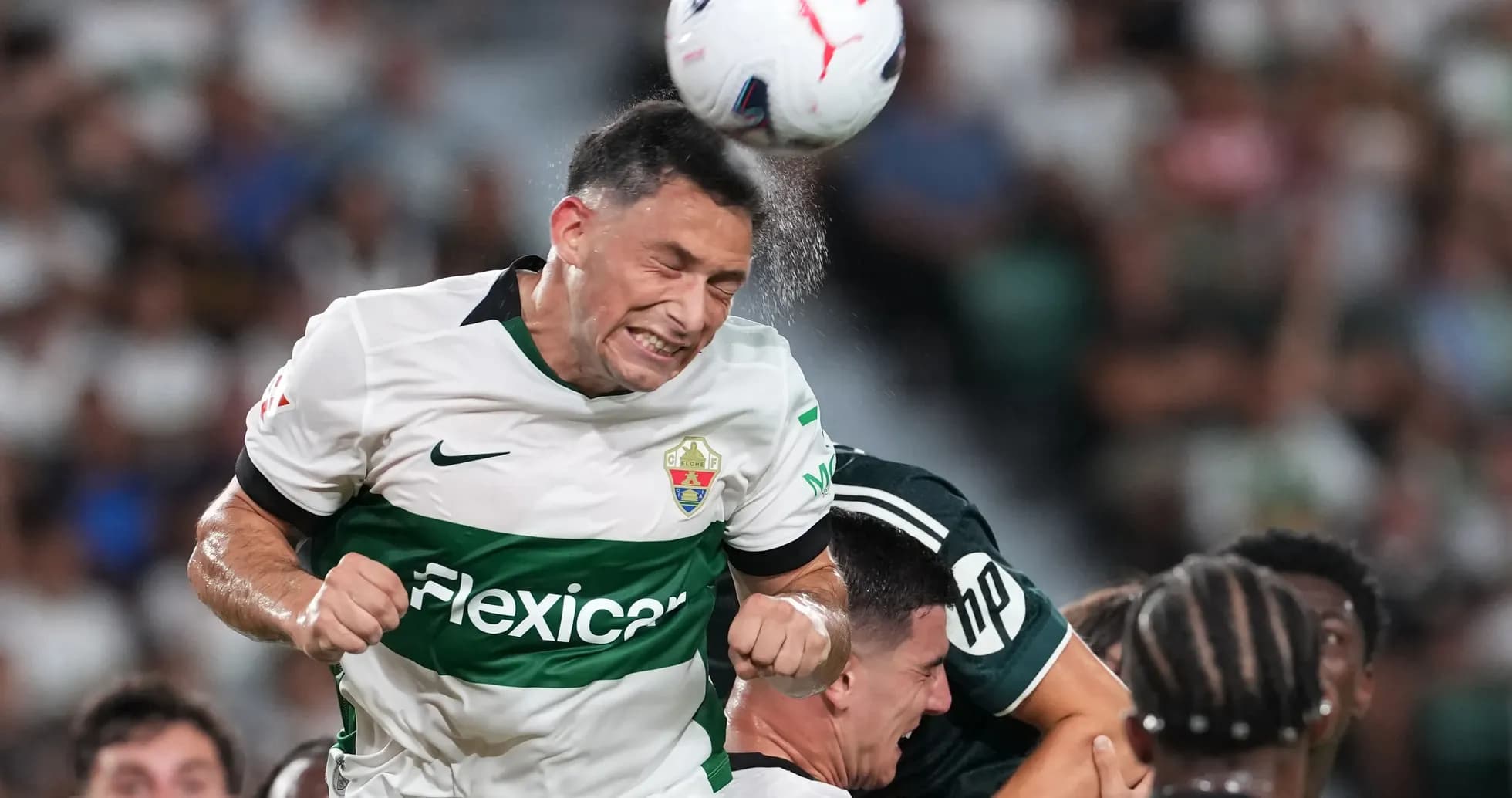
Real Betis Exploits Space in 2-1 Victory Over Elche
Real Betis’ 2-1 win over Elche at Estadio La Cartuja de Sevilla was defined less by territorial control and more by how efficiently Manuel Pellegrini’s side exploited space and transitions against a team that actually had more of the ball. Elche’s 55% possession and 542 passes to Betis’ 438 framed a match where the visitors tried to dictate with a 3-5-2, but the hosts’ 4-3-3 structure, verticality and superior shot volume (16–8 total shots, 11–4 inside the box) delivered the decisive edge.
Out of possession, Betis accepted a mid-block rather than a high press, with the front three of Antony, Cucho Hernandez and A. Ezzalzouli orienting themselves on Elche’s back three and the double pivot outlets. S. Amrabat anchored centrally, screening the passing lane into M. Aguado and A. Febas, while P. Fornals and G. Lo Celso stepped out selectively to press the ball-carrier once the pass into midfield was played. This allowed Betis to compress space between their lines and funnel Elche into the wide channels, where H. Bellerin and J. Firpo could engage aggressively knowing they had cover from V. Gomez and Diego Llorente.
With the ball, Betis were far more direct. Their 45% possession was used to progress quickly, especially down the flanks. The front three stretched Elche’s back line horizontally: Ezzalzouli held width on the left, Antony on the right, with Cucho Hernandez constantly darting into the channels between centre-back and wing-back. Fornals, nominally an interior midfielder, often advanced into the right half-space, creating a 4-2-3-1 in possession and overloading the zone around Elche’s right-sided centre-back. That positional pattern underpinned both Betis goals: early vertical passes into Cucho and later Fornals’ late arrivals into the box mirrored the statistical story of 11 shots inside the area and an xG of 1.5.
Elche’s 3-5-2 under Eder Sarabia was built to control tempo through the central trio of G. Villar, M. Aguado and A. Febas, with wing-backs H. Fort and G. Valera tasked with providing width. Their 470 accurate passes (87%) to Betis’ 382 (also 87%) show they succeeded in circulating possession, but their xG of 0.44 and only 2 shots on target reveal a structural problem: lots of sterile control, little penalty-box penetration. Betis’ compact 4-3-3 narrowed the central channels, forcing Elche to progress wide and then cross or cut back against a well-set back four.
Turning Point
The turning point was disciplinary and tactical. At 49', Léo Pétrot’s Red Card for Foul forced Elche to abandon their balanced 3-5-2. Down to ten, Sarabia had to reshuffle the back line and sacrifice attacking presence to restore defensive stability. The subsequent substitutions – V. Chust (IN) came on for G. Diangana (OUT) at 57', A. Rodriguez (IN) for Andre Silva (OUT) and Tete Morente (IN) for H. Fort (OUT) both at 64' – reflected a move toward a deeper, more conservative block. Elche dropped into a back five when defending, with wing-backs pinned deeper and the midfield line less aggressive in pressing. That reduced their ability to counter after regains and effectively surrendered the initiative to Betis.
Pellegrini’s in-game management responded in kind. At 63', Isco (IN) came on for G. Lo Celso (OUT), adding a more possession-oriented playmaker between the lines against a tiring, numerically reduced opponent. Shortly after, Natan (IN) replaced J. Firpo (OUT) at 66', giving fresh legs and more defensive security on the left side as Betis anticipated Elche’s need to go more direct. Later, R. Riquelme (IN) for A. Ezzalzouli (OUT) and S. Altimira (IN) for P. Fornals (OUT), both at 83', were clearly aimed at game management: maintaining counter-threat through Riquelme while adding Altimira’s work rate and defensive coverage in midfield to protect the lead.
Disciplinary Profile
The disciplinary profile underscores how the match state tilted tactical choices. Elche finished with 1 Red Card and 2 Yellow Cards (Aleix Febas for Foul at 76', Gonzalo Villar for Argument at 78'), while Betis collected 3 Yellow Cards (Diego Llorente for Foul at 80', Natan for Foul at 85', Cucho Hernández for Time wasting at 90+3'). Once ahead and facing ten men, Betis naturally adopted a more conservative posture, inviting some pressure and accepting tactical fouls to break rhythm, as reflected in their 16 Fouls to Elche’s 13.
Goalkeeper dynamics also shaped the tactical risk profiles. A. Valles for Betis faced only 2 shots on goal and made 1 save, with goals prevented at -1.17 indicating that the one conceded effort was of relatively low probability and that he marginally underperformed against xG on target. That reality emboldened Betis to keep their defensive line slightly higher, trusting their structure more than their keeper’s shot-stopping. On the other side, M. Dituro made 3 saves from 7 shots on goal, also with goals prevented at -1.17, suggesting Betis’ finishing outstripped the average expectation. Elche, aware of Betis’ threat once they broke lines, increasingly dropped their block deeper after going down to ten, trying to limit the quality of chances rather than pressing high.
Statistical Verdict
Statistically, the verdict is clear: Elche’s higher possession and identical pass accuracy did not translate into dangerous territory. Betis’ superior shot volume, especially inside the box, and higher xG align with the 2-1 scoreline and the visual pattern of a side more incisive in the final third. The card imbalance – Elche’s early Red Card versus Betis’ late, largely game-state-driven Yellows – explains why the match tilted decisively after the break. Overall, Betis’ tactical pragmatism, efficient use of transitions and well-timed substitutions overcame Elche’s structural possession game and numerical setback, aligning performance data tightly with the final result.