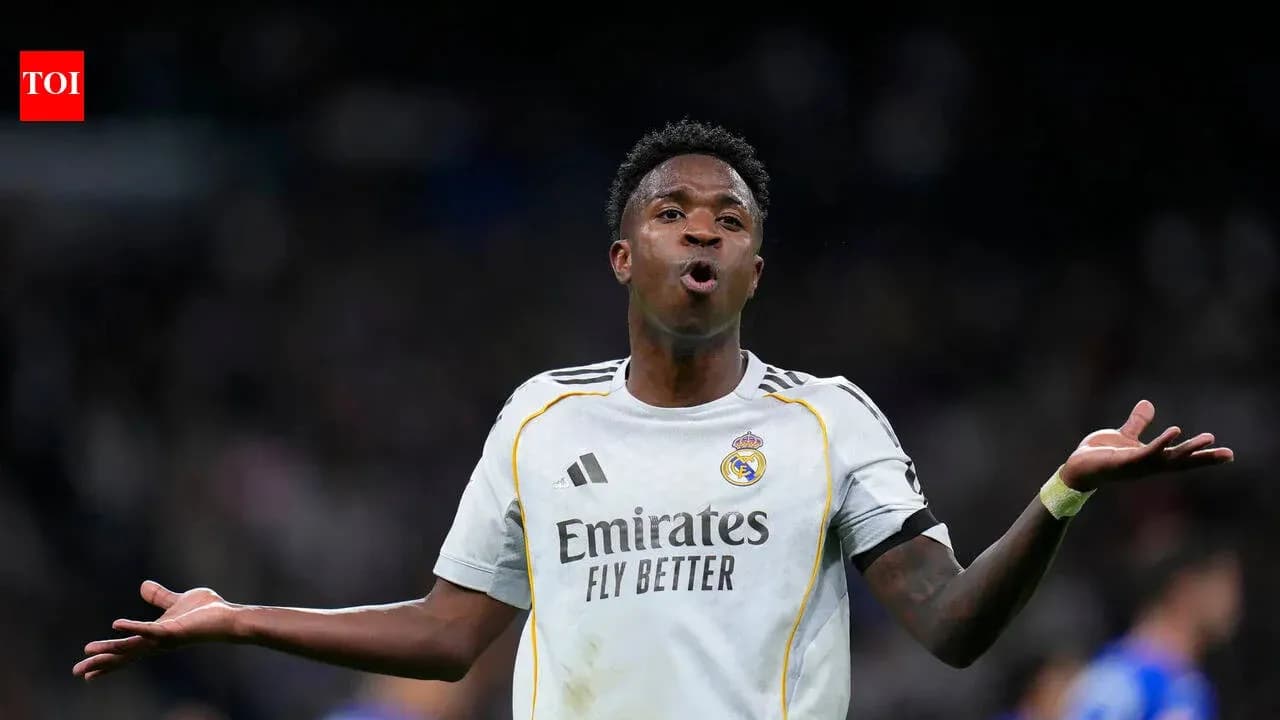
Real Madrid Faces Crisis as Vinícius Júnior Transfer Storm Brews
The week before El Clásico is supposed to be about fine‑tuning, not firefighting. At Valdebebas, it has turned into something closer to crisis management.
Real Madrid, already shaken by a violent training-ground clash that sent Federico Valverde to hospital, now face the prospect of their most electric forward being prised away. Vinícius Júnior, the symbol of their post‑Galáctico rebuild, is suddenly at the centre of a transfer storm.
Dressing-room flashpoint before Barcelona
The alarm bells started with Valverde and Aurélien Tchouaméni. What began as a physical training match reportedly spilled over into the dressing room, ending with the Uruguay captain suffering a head injury serious enough to require hospital treatment.
Madrid’s medical statement was stark: “cranioencephalic trauma,” a form of concussion. The protocol is clear. Valverde has been advised to rest for 10 to 14 days, which rules him out of Sunday’s El Clásico, a match Madrid can scarcely afford to approach under-strength with Barcelona already 11 points clear at the top of La Liga.
Valverde later tried to play down the incident, saying he had “accidentally hit a table,” calling it a “small cut” on his forehead. The images of him leaving for tests told a different story: this was not a routine knock.
Spanish reports have not stopped there. Tension, they say, runs deeper. An alleged feud involving full-back Álvaro Carreras and centre-back Antonio Rüdiger has been cited as another crack in a dressing room that, on the surface, still chases trophies but behind closed doors looks increasingly volatile.
Vinícius and the contract stand-off
Into that fractured backdrop drops the Vinícius situation. TEAMtalk report that the Brazilian, whose contract runs for just over another 12 months, is now drawing serious interest from the Premier League, with Manchester City watching closest.
Talks over a new deal stalled in 2025. Both player and club agreed to revisit negotiations this summer, yet several major issues remain unresolved. Madrid, according to the same report, were blunt last year: if no agreement is reached this summer, a sale becomes a real option. Letting a player of Vinícius’ value drift towards free agency is not on the table.
Inside the Bernabéu, the preferred outcome is still clear: renewal, not farewell. But contingency planning has already begun. When a player of this stature enters the final stretch of his contract, the market starts circling.
Manchester City smell opportunity
City sense precisely that. TEAMtalk describe the Premier League champions as seeing a “rare market opportunity” — a prime‑age Vinícius potentially available, something that almost never happens at this level.
Their interest is framed by uncertainty over Jérémy Doku’s long-term role. January arrival Antoine Semenyo, according to the report, would not block a move for Vinícius either. If the Brazilian moves, he moves as a centrepiece, not a luxury.
They are not alone. Arsenal are said to be actively searching for a left‑sided attacker and are monitoring the situation. Chelsea, long‑time admirers of the 25‑year‑old, are also in the frame, though the lack of European football at Stamford Bridge could weigh heavily in any decision.
Liverpool and Manchester United have been alerted. Bayern Munich and Paris Saint‑Germain are keeping an eye on developments from the continent. Saudi Pro League clubs lurk as a financially powerful alternative should negotiations between Vinícius and Madrid collapse completely.
The list of suitors underlines his status. This is not a player clubs “consider”. This is a player they build around.
Old wounds with City, fresh intrigue now
A move to Manchester would come with its own emotional baggage. The rivalry between Madrid and City has grown bitter, and Vinícius has been right in the middle of it.
In 2024, Madrid believed he had done enough to win the Ballon d’Or. The award went to Rodri. The club’s response was dramatic: a full boycott of the ceremony in Paris. Months later, when the sides met in the Champions League, City supporters unfurled a banner of Rodri holding the Ballon d’Or, emblazoned with the message: “Stop Crying Your Heart Out”.
Vinícius saw it. He said so afterwards. “I saw it, I saw the banner,” he said. “Whenever the opposing fans do things like that, they give me more strength to have a great game, and here I have done it.”
Those memories would not simply fade if he pulled on a City shirt. They would follow him into every press conference, every away end, every Champions League night.
Producing under pressure
On the pitch, he has not shrunk. Despite the noise around his future, Vinícius is still delivering numbers that most forwards would envy: 21 goals and 14 assists in all competitions this season, including four goals in his last three league games.
He has not quite hit the outrageous heights of 2024, when he stood among the leading Ballon d’Or contenders, but he remains one of the most decisive attackers in the game. When Madrid need a spark, they still look for the No. 7.
Off the pitch, the picture has been far darker. His time in Spain has been repeatedly scarred by racist abuse from sections of La Liga crowds, a stain that has forced Spanish football into uncomfortable conversations it can no longer avoid. Each incident has added emotional weight to his stay, and any decision about his future will inevitably carry that context.
El Clásico under a cloud
All of this unfolds as Madrid prepare for the final El Clásico of the campaign, chasing a Barcelona side already 11 points clear. The fixture that usually defines a title race now feels like a referendum on Madrid’s direction.
A dressing room under strain. A key midfielder out with concussion after a training bust‑up. Their brightest attacking star with one foot in a contract stand‑off and the other being tugged by England’s elite.
Sunday at the Bernabéu will be about more than points. It will be a test of whether Madrid can still project the authority of a club that keeps its best players, controls its own narrative, and turns weeks like this into fuel rather than fracture.