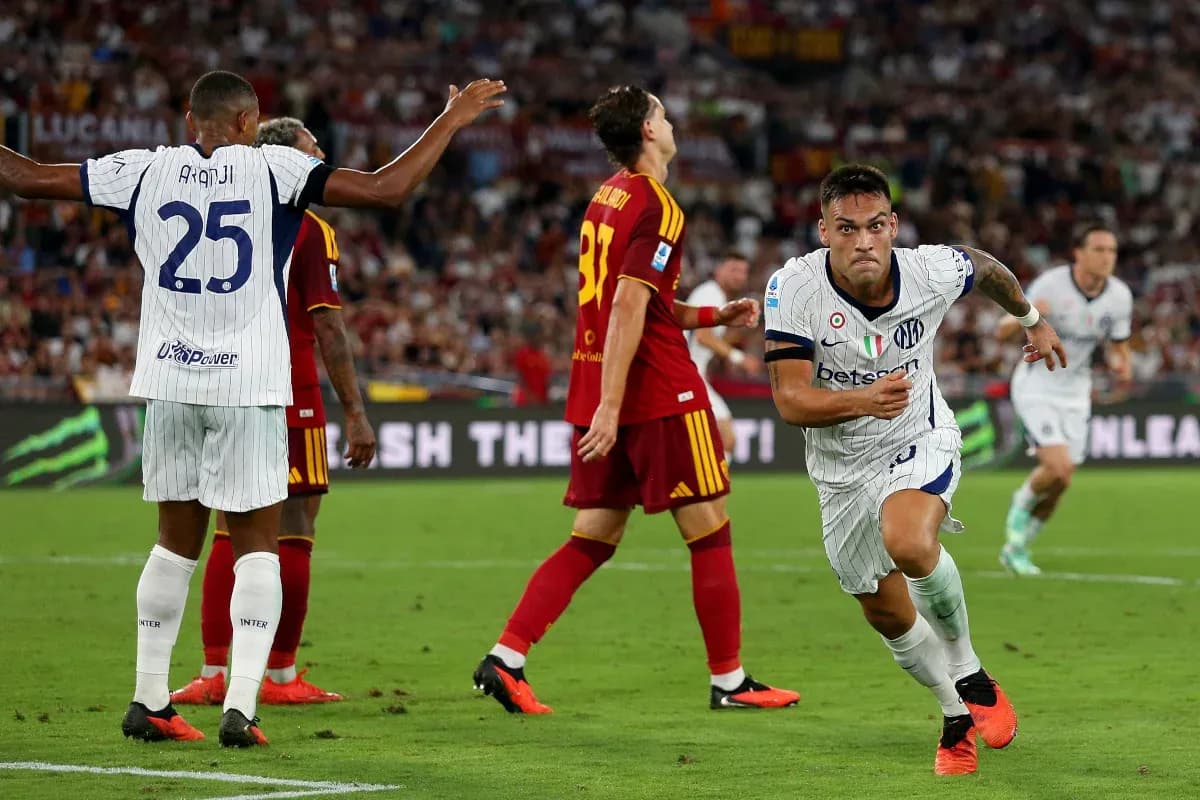
Roma and Inter Battle to 2-2 Draw in Serie A Clash
The Stadio Olimpico had the feel of a summit meeting. First against second in Serie A, AS Roma and Inter arriving level on 13 points after five matches, both unbeaten, both carrying the swagger of sides that had spent the early season bending games to their will. Ninety minutes later, the scoreboard told a story of balance – Roma 2, Inter 2 – but the tactical layers beneath the draw revealed two coaches trying to impose very different kinds of control.
Roma came into the game as league leaders, their overall record a commanding four wins and one draw, with 14 goals scored and only 3 conceded. That goal difference of +11 had been built on ruthless efficiency: at home they were averaging 2.7 goals scored and 1.0 conceded, away an even sharper 3.0 scored and 0.0 conceded. Inter, chasing from second, had been more expansive and more open: 15 goals for and 8 against overall, a goal difference of +7, driven by a devastating 4.0 goals per game at home but tempered by a more cautious 1.5 on their travels, where they were conceding 1.0 per match.
The lineups underlined the clash of ideas. Piero Gasperini Gian kept Roma in their now-familiar 3-4-2-1, a structure that has underpinned four of their five league outings. M. Svilar sat behind a back three of G. Mancini, L. Balerdi and Mario Hermoso, with the wing‑back band of Wesley Franca and N. Molina bracketing the double pivot of B. Cristante and M. Kone. Ahead of them, P. Dybala and M. Soule floated between the lines, feeding the league’s most ruthless finisher to date, D. Malen, spearheading the attack.
Cristian Chivu responded with a 3-1-4-2, a subtle twist on Inter’s usual 3-5-2. J. Martinez was protected by a trio of Y. Bisseck, M. Akanji and A. Bastoni. P. Zielinski sat deepest in midfield, with a high-energy four of F. Dimarco, C. Jones, N. Barella and A. Diouf stretching the pitch horizontally. Up front, the familiar double act of L. Martinez and M. Thuram offered contrasting but complementary threats: Lautaro’s penalty-box craft and Thuram’s power and channel running.
The tactical voids on both sides were significant. Roma were without M. Bah, missing with a knee injury, trimming Gasperini’s options for rotation in the wide and midfield lanes. Inter’s absences were more structural: H. Calhanoglu’s muscle injury removed their primary deep playmaker and set‑piece specialist; D. Spence and J. Stones were also ruled out, reducing flexibility in the back line and at wing‑back. Chivu’s solution was to lean on Zielinski as the first receiver and to push Diouf and Barella higher as carriers and press triggers.
Discipline was always likely to shape the tempo. Roma’s season-long card profile shows a pronounced spike in yellow cards between 61 and 75 minutes, where 37.50% of their cautions arrive, and a further 25.00% between 76 and 90. Inter, by contrast, concentrate half of their yellow cards in the 46‑60 minute window. It produced a predictable rhythm: a cautious, chess-like first half that Roma controlled, then a second half in which Inter’s aggression and Roma’s increasingly desperate defensive interventions raised the emotional temperature.
Roma’s first-half superiority flowed through the “engine room” axis of Cristante, Kone and Dybala. Cristante’s metronomic passing and positional discipline allowed Kone to step out to press and carry, while Dybala, Serie A’s leading assist provider with 4 so far this season, found pockets between Inter’s lines. His 23 key passes in five league games speak to a player who constantly bends defensive structures, and at the Olimpico he repeatedly dragged Bastoni and Diouf into uncomfortable zones, opening lanes for Soule and Malen.
Soule, already with 2 goals and 1 assist this campaign, played as the elastic thread between midfield and attack, drifting wide to combine with Wesley Franca and cutting inside to overload the half-spaces. That movement created the stage for Malen, whose season numbers – 6 goals from 16 shots, 10 on target, across 348 minutes – mark him as the division’s most clinical forward. His duels and dribbles (17 duels won, 10 successful dribbles) are not just adornments; they are how Roma turn direct balls into sustained pressure. Inter’s back three, particularly Akanji, were forced into repeated one‑v‑one engagements they would rather have avoided.
If Malen was the hunter in yellow and red, Lautaro Martinez was the blue and black counterpart. With 4 goals already, 16 shots and 6 on target, Lautaro remains Inter’s reference point in the box, but this match also showcased the importance of his supporting cast. Thuram, with 2 goals and 2 assists this season, and Diouf, on 3 assists, form the connective tissue of Chivu’s transition game. Diouf’s 91% pass accuracy and 13 key passes underline how he has become the conduit between Inter’s build‑up and their front line. When Inter rallied after the break, it was often Diouf threading balls into Thuram’s feet or into the space behind Roma’s wide centre‑backs.
Behind them, the “shield” battle was relentless. Hermoso and Mancini, both among the league’s standout defenders so far, had to manage Inter’s twin strikers while still stepping out to contest Diouf and Barella. Hermoso’s season to date – 13 tackles, 16 interceptions, 2 blocked shots and 2 yellow cards – tells of a defender who defends on the front foot. Against Inter, that aggression occasionally left channels for Thuram to attack, but it also prevented Inter from camping around Roma’s box for long spells.
On the other side, Akanji embodied Inter’s defensive personality. With 9 tackles, 8 interceptions, 2 blocked shots and 2 yellow cards in the league, plus a red card on his disciplinary record this season, he plays on the edge. His duels won and 94% passing accuracy usually make him a secure outlet in the first phase, but with Dybala and Malen rotating in his zone, even he was drawn into riskier decisions than Chivu would have liked.
From a statistical prognosis, the draw felt like the meeting point of two different strengths. Roma’s defensive record – only 3 goals conceded overall before this game, with 3 clean sheets and no failures to score – collided with Inter’s attacking volume, built on 3.0 goals per game overall and a front line stacked with in‑form scorers and creators. Neither side had taken nor missed a penalty all season, so the margins were always likely to be found in open play patterns and set‑piece details rather than from the spot.
In the end, a 2-2 scoreline at the Olimpico preserves the symmetry at the top of Serie A. Roma retain the aura of a side that can suffocate opponents with structure and then kill them with the precision of Dybala and Malen. Inter leave knowing that even without Calhanoglu, their 3-1-4-2 can generate enough chaos and quality through Diouf, Thuram and Lautaro to trouble any defensive unit in the league. If this was an early-season preview of a title race, the tactical story is clear: Roma’s control versus Inter’s relentlessness, and a battle that looks destined to run deep into the season.