Socceroos Draw: A Nation Stops for World Cup History
They once said Australia stopped for a horse race. On Friday, it stopped for a stalemate.
Nil-nil. Paraguay held. Nerves shredded. And still, enough to push the Socceroos into the World Cup knockout rounds for a second straight tournament. A scoreline that looked flat on paper, but in living rooms, pubs and public squares across the country, it carried the weight of history.
A nation clocks off for kickoff
This was a first: a Socceroos World Cup match played entirely within Australian working hours. No 3am alarms. No bleary-eyed commutes. Just a country quietly – and not so quietly – putting the tools down.
In Sydney’s inner west, the Golden Barley filled early. Laptops open, emails half-written, pints sweating on tables. Small business owner Jamie Hayman and his brother, Rick, were among those who decided work could wait.
Rick, who runs a local construction company, tapped away at admin between glances at the screen, surrounded by staff in gold and green. He has followed the Socceroos “forever” and has felt the shift.
“It unites the community,” he said. “Pubs get filled up, there’s all the talk around town, it’s really good to see.”
In front of the television, four old friends had claimed the front row from opening time. Nick, Guinness in hand, wore an authentic 1974 Socceroos jersey – a threadbare tribute to the year Australia first reached a World Cup. This is not a bandwagon for him; it is a lifetime.
He and his partner Robyn admitted they miss the old ritual: the brutal alarm, the cold kitchen floor, the flicker of a TV in the dark.
“We were just saying this morning, we used to wake up in the middle of the night, it used to be really good,” he said, laughing. “It’s a unique experience. A family experience.”
Daylight football is convenient. It is not quite as romantic. But it brought a different kind of spectacle.
Rain, fear and a dog’s howl
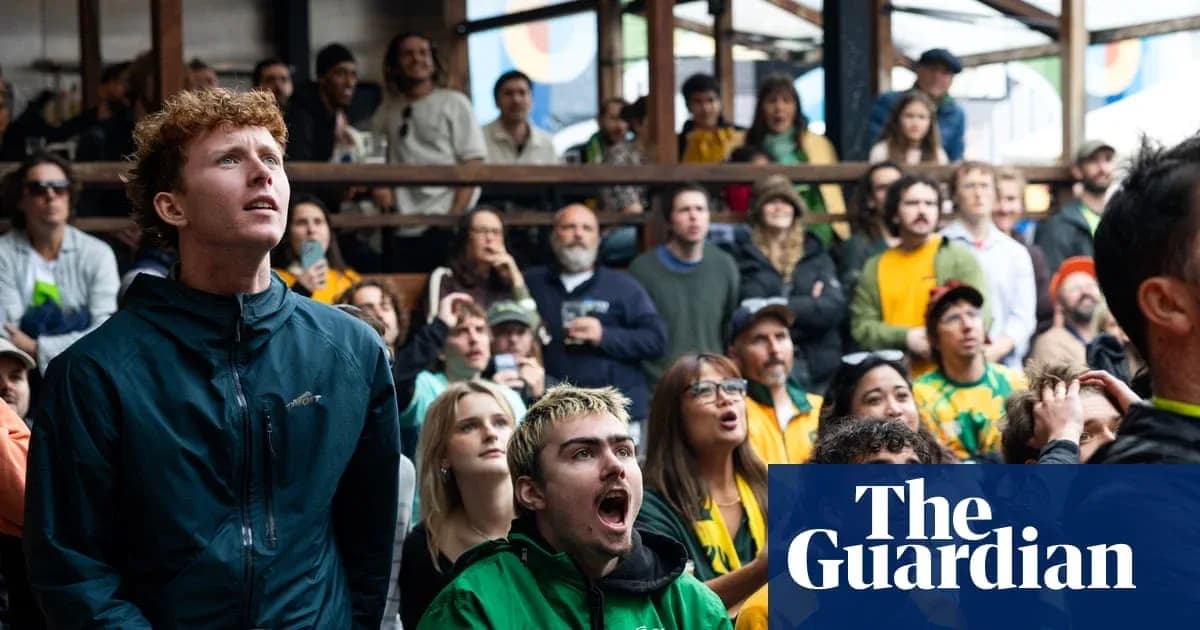
Down the road at the Vic on the Park, the crowd jammed itself into every corner. Hundreds of fans, shoulders pressed, eyes fixed. The mood swung between joy and dread with every misplaced pass.
When the rain arrived in the first half, jackets and Socceroos scarves became makeshift umbrellas. Ponchos were ripped from bags and dragged over heads. No one moved from their spot.
After 80 goalless minutes, the tension needed a release. A few defiant “Aussie, Aussie, Aussie” chants broke out. From the front bar, a dog howled along, as if it understood what was at stake.
As the clock crept towards full-time and the nil-nil that would be enough, the noise rose. A bald man with a stick-on Australian flag tattoo on his head wrapped his arms around his mates. For him, for many, survival in the tournament felt as good as a win.
Some had planned this day for months, booking leave the moment the schedule dropped. Others improvised. Sophie and her son Orson, in year 11, were there too, having watched Australia lose 2-0 to the USA at the same pub the previous Saturday morning.
This time, Orson skipped the last day of term. Sophie worked quietly off her phone, but her eyes stayed on the screen.
“This is of national importance,” she said. “I really want Oscar to hear a goal in the pub, just to hear us lift.”
Oscar dreams of becoming a football coach. He sees something changing.
“Football’s growing,” he said. “It’s been brilliant, so cool to see so many people supposed to be working coming to support their country.”
Federation Square turns into a cauldron
In Melbourne, Federation Square transformed into a gold-and-green amphitheatre. Victoria Police estimated a crowd of 7,500, many of them there hours before kickoff. By 10am, the square was at capacity.
With time to kill, the nervous energy spilled into games of flip bottle. Each successful landing drew cheers that felt far too emotional for a piece of plastic and a bit of water. Around them, teenagers bragged about “wagging” school or winning parental permission to skip class. This was their World Cup memory.
When the national anthem rang out, seven flares burst into orange light. It made for a striking scene, but also a swift intervention: a 16-year-old arrested, police said.
The crowd surged and swayed. Every so often, some unseen shove sent a ripple through the mass, bodies stumbling forward. Once people steadied themselves, thousands turned as one towards the culprit and let fly with a single, sharp verdict: “wanker”. Three teenagers received penalty notices for riotous behaviour and were moved on.
On the edge of it all stood Craig Foster, former Socceroo and now one of the game’s most prominent voices in Australia. He watched a disciplined, controlled performance and called it a “near perfect game”.
“The squad depth has been demonstrated,” he said. “They’ve done exactly what was required … Australia is managing well, learning very quickly, and it’s a beautiful day anytime the Socceroos get through to knockout rounds.
“We are here. We’re still in this tournament, and we’re fighting all the way. There’s nothing better in life.”
For some, that fight came with bruises. Teenager Ali Abolhasani and his friend ended up on the ground along the barricade, shoes gone in the crush.
Asked how he felt, he didn’t hesitate. “Amazing.”
“I can’t wait to come back next week,” he said. “We did an all-nighter, we couldn’t sleep because we knew we’d make it … We’ll do it again.”
Capital fever, modest screens
In Canberra, the scale was smaller but the emotion just as sharp. More than 500 fans gathered in Garema Place, huddled around a modest two-screen setup that struggled to match the occasion.
World Cup fever, though, had clearly taken hold.
ACT senator David Pocock stepped into the crowd, seeing up close the mix of faces and backgrounds that mirrored the national team itself.
“The Socceroos, as it’s been talked about this week in parliament, represents what is so great about Australia,” he said. “We do have so many people from diverse backgrounds coming together, and you see the way that that resonates across the country.”
From inner-west pubs to a heaving Federation Square, from a rain-soaked Vic on the Park to a cramped fan zone in the capital, the picture was the same: a country pausing its day to ride out 90 tense minutes and celebrate a goalless draw as if it were a last-minute winner.
No goals. No glory moment for the highlights reel. Just a result that keeps Australia alive, and a reminder that the Socceroos no longer play in the shadows of the night.
Next week, they go again. And so will the nation.