Sweden’s Journey to the World Cup: From Struggles to Success
Sweden should have been nowhere near this World Cup. Two points from six group games, one winless spiral, and a manager sacked after defeat to Kosovo – this was a campaign heading for the dustbin.
Instead, they are in North America with a new coach, a new identity, and a striker who has dragged a broken qualifying bid back to life almost on his own.
All of it under Graham Potter, back in the country where his coaching story truly began.
From chaos to Potter-ball, Swedish edition
The collapse under Jon Dahl Tomasson was brutal. Four games, one point, and a 1-0 loss to Kosovo in October 2025 that ended his reign and left Sweden staring at the unthinkable: missing out on an expanded World Cup.
Potter walked into the mess with history and goodwill already banked. At Östersund he had been a cult figure, the English coach who turned a fourth-tier side into Allsvenskan winners and Europa League giant-killers, even beating Arsenal. Sweden knew him. He knew Sweden.
He also knew he had to strip things back.
Out went the flirtation with expansive ideals. In came something far more familiar to Swedish supporters: a stubborn, disciplined defensive block and quick, ruthless counterattacks. Potter had said he preferred a back four. When the pressure spiked in the Nations League playoff route, he parked that preference.
Sweden lined up in a 5-3-2. Tight, compact, almost conservative. Almost.
Because in front of that structure waited Viktor Gyökeres.
Gyökeres, the man of the moment
The semi-final against Ukraine in Spain felt like a litmus test for Potter’s reboot. It turned into a one-man showcase. Gyökeres scored all three in a 3-1 win, a hat-trick that carried Sweden to the brink of a tournament they had no right to reach on the basis of their group campaign.
The final against Poland was different. Nervier. Scrappier. Poland were the better side for long stretches, forcing Sweden deep, forcing them to suffer. The kind of night where one mistake, one lapse, can undo months of work.
But the pressure didn’t crack them. It bent them.
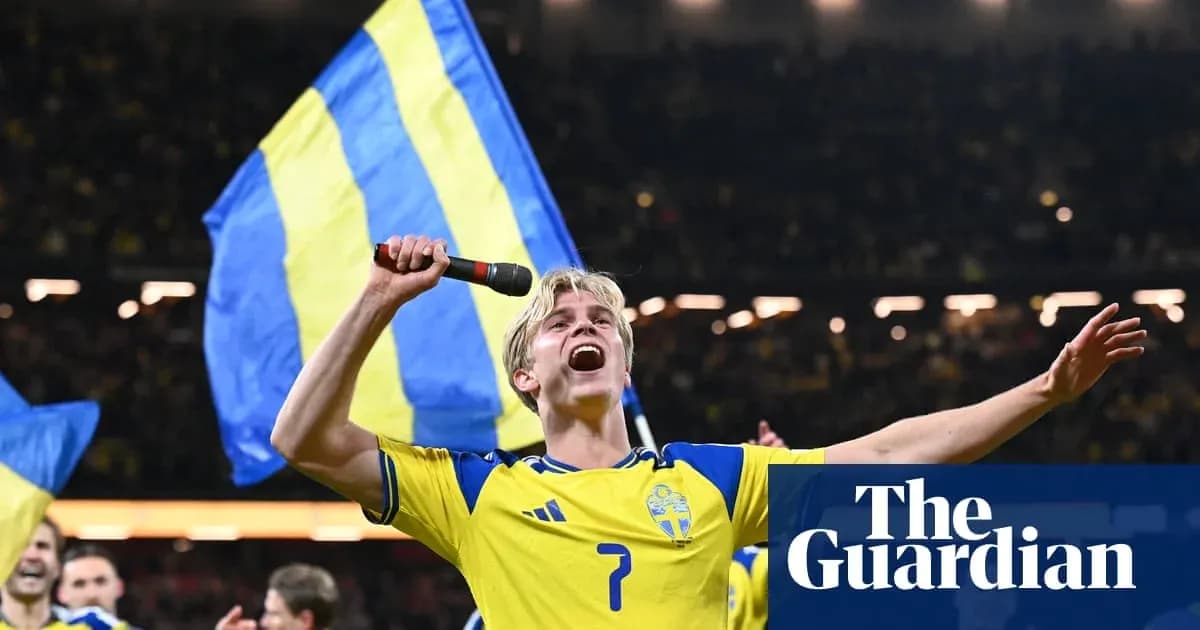
Sweden scored three, conceded two, and clung on. Then, in the 88th minute, Gyökeres struck again, the decisive goal in a 3-2 thriller that detonated the Swedish bench and delivered Potter his defining moment in national colours.
He called it the best night of his football life, an “out-of-body experience”. Watching his staff sprint past him as the ball hit the net, he admitted he almost questioned whether he was really there.
Sweden were. Against all logic, they were going to the World Cup.
They had taken the Nations League lifeline and turned it into a resurrection.
A flawed contender, but a dangerous one
Strip away the romance and the story still has sharp edges. Sweden arrive in North America having finished their group campaign with just two points from six matches. This is not a side rolling into the tournament on a wave of dominance.
They also arrive without their captain and most influential all-round presence: Dejan Kulusevski. His absence cannot be glossed over. He knits attacks together, carries the ball, links midfield and forwards, and sets the tone off the pitch. Sweden will miss all of that.
Then there is Alexander Isak. On paper, a superstar. In reality, a concern. He became the most expensive transfer in Premier League history when he swapped Newcastle for Liverpool for £125m, but his first season at Anfield has been a grind. Form and fitness both raise questions.
He did score in a 3-1 defeat to Norway on 1 June after coming off the bench, a reminder of his talent. The rest of that performance, though, was worryingly one-sided. Sweden were second best. Potter will know he cannot lean on reputation; he needs the sharp, decisive Isak of old, not a passenger.
That is why Gyökeres is now the undisputed talisman. The Arsenal forward also took time to adjust at his new club, but he arrives at the World Cup as the man who delivered when it mattered most. Four of Sweden’s six playoff goals were his. His Bane-inspired celebration from The Dark Knight Rises has gone viral back home, copied in living rooms and local pitches across the country.
He is no longer just a striker. He is the face of this run.
Sweden’s group – Tunisia, Netherlands, Japan – offers opportunity and peril in equal measure. There is a clear path to the knockouts, but no margin for drift. One bad half against the Dutch. One lapse of concentration against Japan’s relentless pressing. One moment of complacency against Tunisia. Any of those could send them home early.
Potter, rebuilt in yellow and blue
For Potter, this job arrived at exactly the right time. After Chelsea and West Ham, his reputation in England had taken heavy damage. The man once lauded as a progressive, intelligent coach needed a reset.
He all but asked for it.
In October 2025, he told Fotbollskanalen that coaching Sweden would be an “incredible opportunity”, stressing his affection for the country and its football. It sounded less like a polite answer and more like a plea. Days later, the Swedish FA answered.
The early results were not spectacular. No wins in his first two games. But the federation saw something they liked – the clarity, the connection, the language skills, the sense of fit. By March he had a contract through to 2030.
Now he stands on a World Cup touchline with a team built around resilience, defined by Gyökeres, and stripped of its captain. A test of coaching craft if ever there was one.
Lagerbielke, Nygren and the new supporting cast
Beyond the headliners, Sweden bring a squad with a few intriguing subplots.
Benjamin Nygren at Celtic is one name that has attracted attention, but the player who may quietly shape this campaign is Gustaf Lagerbielke. Now at Braga, the centre-back produced a towering performance in the playoff final against Poland: a thumping header at one end, a disciplined, controlled display to keep Robert Lewandowski quiet at the other.
As if that were not enough, he is a baron and 254th in line to the Swedish throne. A defender with a title, a story and, potentially, a big move on the horizon. A strong World Cup could push him into one of Europe’s top five leagues.
These are the margins Sweden must exploit. With Kulusevski absent and Isak still searching for rhythm, the supporting cast cannot simply blend into the background.
Karlström, the anchor Sweden cannot do without
If Sweden are to wrestle control away from the slick technicians of the Netherlands and the tireless, intricate Japan, they will need someone to win ugly in the middle and keep the ball moving when the storm hits.
That job belongs to Jesper Karlström.
Now captain of Udinese, Karlström is a late bloomer. His path took him through Djurgården and then Lech Poznan, and it was not smooth. He has spoken openly about his struggles with gambling addiction during his time at Djurgården, and how support from the club and his family helped him pull away from it.
On the pitch he is everything you want from a deep-lying midfielder: firm in the tackle, smart in his positioning, tidy and composed in possession. At 30, he offers calm in a midfield that may also feature younger talents such as Yasin Ayari and Lucas Bergvall.
In a tournament where one rash decision can unravel an entire game plan, Karlström’s presence could be the difference between control and chaos.
The stands: beer, banter and Blågult
Sweden will not be alone. They rarely are.
Blågult fans travel in numbers and make themselves heard. They sing, they joke, they mingle with opposition supporters. The soundtrack is often “Kanna på”, a raucous ode to beer pitchers that “keep on arriving” and a tongue-in-cheek promise that “We are coming with 100,000 men”.
North America will not see a Viking invasion, but it will see a wave of yellow and blue. The atmosphere around Sweden’s games tends to be loud, good-natured and fuelled by more than a few drinks.
A complicated American backdrop
There is another layer to Sweden’s presence in the United States, a more political one.
In 2017, Donald Trump famously told a rally: “Look what happened in Sweden last night,” while talking about immigration and terrorism. Nothing significant had actually happened the night before. He later said he was referring to a Fox News report, which did little to clarify matters.
Swedish newspaper Aftonbladet responded by listing what had actually occurred that day: Owe Thörnqvist, a famous singer, had technical problems in rehearsals. A man set himself on fire in central Stockholm. Roads in northern Sweden closed because of harsh weather.
That episode lodged itself in the Swedish-American conversation. It will linger in the background as Swedish fans descend on US cities, draped in blue and yellow, singing about beer pitchers and chasing another improbable run.
So here they are: a team that stumbled, then survived; a coach rebuilding both a national side and his own career; a striker who turned a failing campaign into a World Cup ticket with one ruthless burst of form.
They are flawed. They are patched together. They are dangerous.
The question now is simple: was that playoff miracle the peak of this story, or just the opening chapter of something even more improbable on American soil?