Villarreal vs Sevilla: Tactical Analysis of 2-3 Defeat
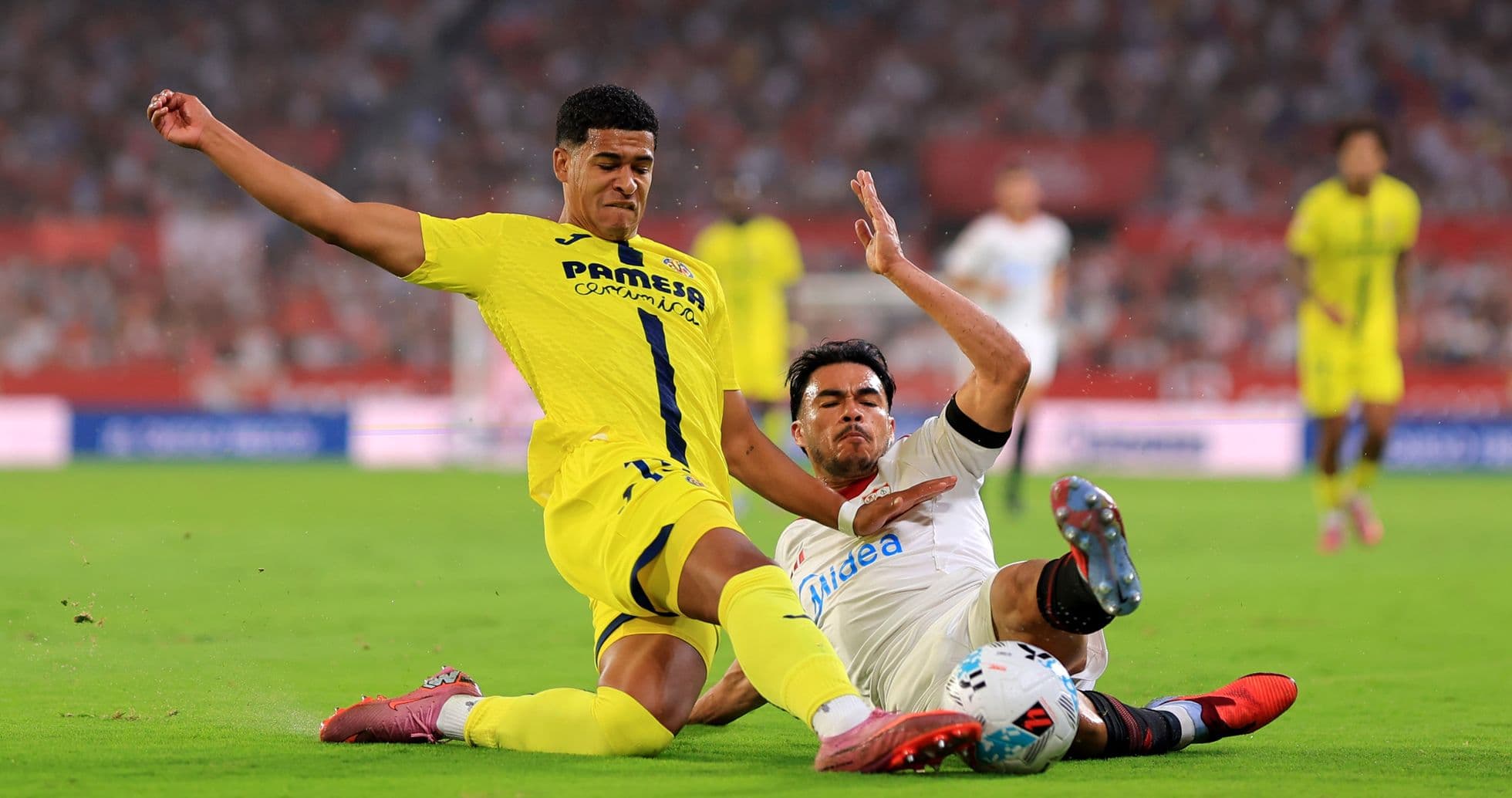
Villarreal’s 2-3 home defeat to Sevilla at Estadio de la Ceramica unfolded as a tactical inversion: Marcelino’s side dominated the structure and the ball, while Luis Garcia Plaza’s Sevilla controlled the scoreboard through efficiency, compactness, and set patterns in transition. Across 90 minutes, the contrast between Villarreal’s 4-4-2 and Sevilla’s 5-3-2 defined not just territory and possession, but the way risk and reward were distributed.
I. Executive Summary
Villarreal started with an aggressive 4-4-2, looking to use width and combinations between Gerard Moreno and Georges Mikautadze to stretch Sevilla’s back five. Sevilla, in a 5-3-2, accepted a low-possession game (37% to Villarreal’s 63%) but built their plan around a disciplined block, direct progression, and targeted exploitation of spaces around Villarreal’s full-backs and between the centre-backs. Despite Villarreal’s control and a 2-0 lead inside 20 minutes, Sevilla’s more balanced shot profile (13 total shots to 6, 7 inside the box) and superior penalty-box presence turned the match, aligning with a marginal xG edge (0.88 to Villarreal’s 0.81) that reflected their sharper finishing zones.
II. Scoring Sequence & Disciplinary Log
The match’s tactical story is inseparable from its goals and discipline.
Goals (verified against the final score: Villarreal 2-3 Sevilla, HT 2-2):
- 13' Gerard Moreno (Villarreal) — assisted by Georges Mikautadze
- 20' Georges Mikautadze (Villarreal) — assisted by Alberto Moleiro
- 36' Oso (Sevilla) — assisted by Lucien Agoume
- 45' Kike Salas (Sevilla) — assisted by Rodrigo Vargas
- 72' Alejo Veliz Adams (Sevilla) — assisted by Djibril Sow
Disciplinary log (card totals: Villarreal 2, Sevilla 1, Total 3):
- 81' Ayoze Pérez (Villarreal) — Foul
- 90+2' Renato Veiga (Villarreal) — Foul
- 90+3' José Ángel Carmona (Sevilla) — Time wasting
All three cards reflected game-state pressure: Villarreal chasing, Sevilla protecting.
III. Tactical Breakdown & Personnel
Villarreal’s 4-4-2 was built on ball dominance and structured possession. With 554 passes, 499 accurate (90%), they circulated effectively, particularly through Dani Parejo and Pape Gueye before the hour mark, and then through Santi Comesana after his introduction. The full-backs Alfonso Pedraza and A. Freeman pushed high, supported by narrow wingers N. Pepe and Moleiro, creating a 2-4-4 in sustained attack. This gave Villarreal control but also exposed them to Sevilla’s counters, especially once the first line of pressure was broken.
Gerard Moreno and Mikautadze complemented each other well: Moreno dropping to link, Mikautadze running beyond. Both goals came from this dynamic. However, as Sevilla settled into their block, Villarreal’s shot volume remained low: just 6 total shots, 4 on target, and only 4 inside the box. The structure produced territory but not sustained penalty-box occupation. Their xG of 0.81 underlined the lack of repeated high-quality chances.
Defensively, Villarreal’s back four struggled with Sevilla’s dual threats: wing-back surges and central overloads. Renato Veiga and P. Navarro were repeatedly asked to defend large spaces behind advanced full-backs. The yellow card for Veiga at 90+2' — Foul — was emblematic of late, stretched defending as Villarreal committed numbers forward. In goal, A. Tenas registered 2 saves, but with goals prevented at -0.22, the data suggests he conceded slightly more than an average keeper might from the shots faced, reinforcing the sense that Sevilla’s finishing, while efficient, also found him marginally below par in shot-stopping terms.
Sevilla’s 5-3-2 under Luis Garcia Plaza was compact and pragmatic. With just 325 passes, 276 accurate (85%), they were selective in possession. The back five of Oso, G. Suazo, Kike Salas, Cesar Azpilicueta, and José Ángel Carmona formed a tight block, with wing-backs narrowing to reduce central lanes and then springing wide in transition. The midfield three — Rodrigo Vargas, Agoume, and Sow — focused on screening Villarreal’s central progression and launching vertical passes when Villarreal’s shape stretched.
Crucially, Sevilla generated 13 shots (5 on target), with 7 inside the box, showing their capacity to turn limited possession into dangerous entries. Their xG of 0.88, marginally higher than Villarreal’s, aligned with this shot map: fewer speculative efforts, more from central, close-range zones. Up front, Adams and Neal Maupay (before his substitution) alternated between pinning centre-backs and drifting into channels, creating the runs that Oso and Kike Salas exploited for the first-half goals.
In goal, Odisseas Vlachodimos made just 1 save, with goals prevented also at -0.22, indicating that while he was not heavily tested, he conceded twice from relatively modest xG. Sevilla’s defensive success was therefore more collective and structural than goalkeeper-driven: the block limited Villarreal’s volume rather than relying on Vlachodimos’ heroics.
Substitutions were pivotal in the game’s tactical evolution. For Villarreal, the double change on 60' — Thomas Partey (IN) came on for Pape Gueye (OUT), and Tajon Buchanan (IN) came on for Nicolas Pepe (OUT) — aimed to inject vertical passing and direct wide threat. Later, Santi Comesana (IN) came on for Dani Parejo (OUT) and Ayoze Pérez (IN) came on for Georges Mikautadze (OUT) at 70', shifting Villarreal towards more box presence and late runs rather than structured build-up. However, this also loosened their midfield control, contributing to the spaces Sow and Adams exploited for the 72' winner.
Sevilla’s changes were more about energy and game-state management. J. Sanchez (IN) came on for Rodrigo Vargas (OUT) at 68' to refresh midfield legs, then Nemanja Gudelj (IN) came on for Sow (OUT) and Castrin (IN) came on for Adams (OUT) at 86', reinforcing central stability and aerial presence to protect the 3-2 lead. Carmona’s yellow at 90+3' — Time wasting — reflected a side fully committed to preserving structure and result rather than seeking further transitions.
IV. The Statistical Verdict
The statistical profile supports the tactical reading: Villarreal controlled the ball (63% possession), completed more passes, and maintained a high passing accuracy, but converted this into only 6 shots and 0.81 xG. Their 6 corners to Sevilla’s 4 further underline territorial advantage that did not translate into sustained threat. Defensively, 11 fouls and 2 yellow cards show a side increasingly reactive as they chased the game.
Sevilla, with 37% possession and 325 passes, maximised their offensive actions: 13 shots, 7 inside the box, 5 on target, and 3 goals from 0.88 xG. Their 9 fouls and single yellow card point to a controlled aggression within their compact 5-3-2. The near-identical goals prevented figures (-0.22 for both keepers) indicate that this match was not decided by goalkeeping excellence or errors, but by shot quality, spacing, and the capacity to exploit transitional moments. Villarreal’s overall form in possession was strong, but Sevilla’s defensive index and efficiency in key zones ultimately dictated the 2-3 scoreline at Estadio de la Ceramica.