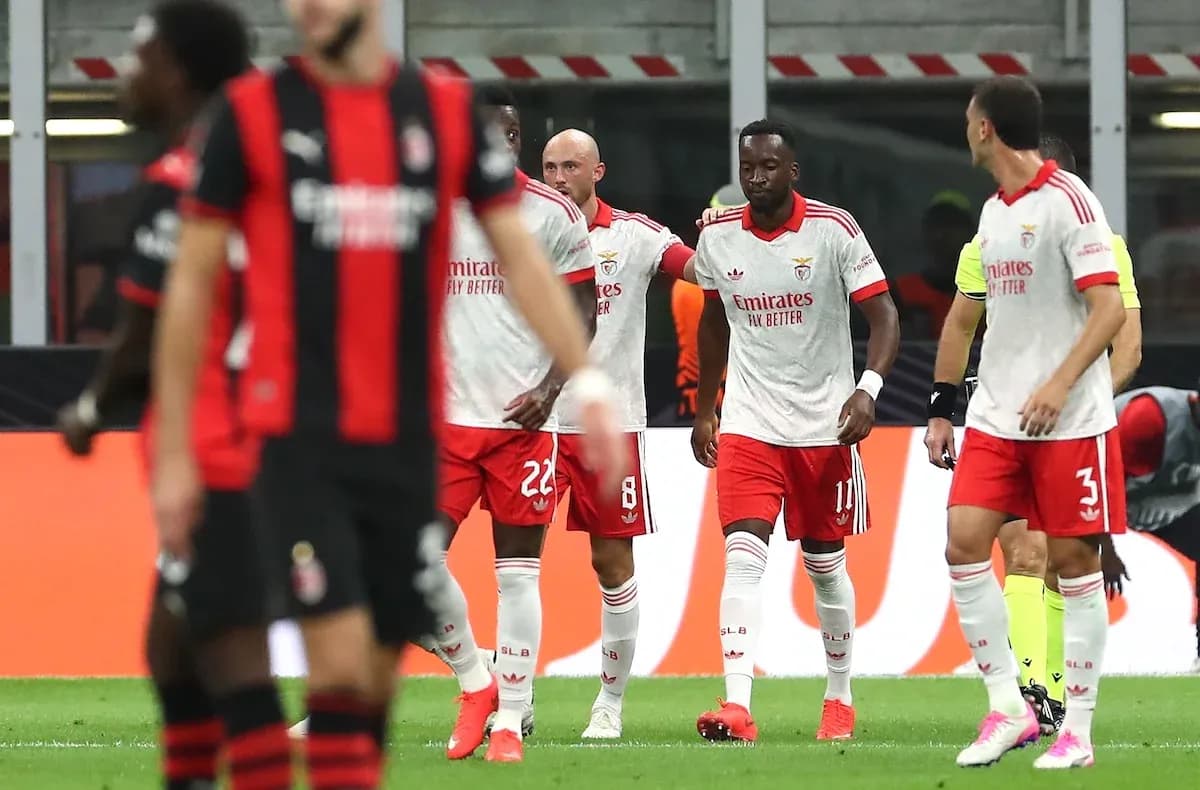
AC Milan vs Benfica: UEFA Europa League Clash in Milan
On 16 September 2026, European nights return to Milan as AC Milan welcome Benfica in the UEFA Europa League League Stage. Under the lights in Milan, two historic clubs with very different recent European rhythms meet at the start of a long continental journey: for Milan, a chance to reassert themselves after a blank slate in the standings; for Benfica, an opportunity to ride the momentum of an already prolific campaign and plant an early flag near the top of the table.
Season Context
AC Milan enter the League Stage ranked 23rd in the overall table, still on zero points with 0 goals scored and 0 conceded from 0 matches. Officially they sit in the “Play Offs” zone, but with no games yet played their European story in 2026 is unwritten — this opener will define whether they look upwards with ambition or over their shoulders with anxiety.
Benfica arrive in a far stronger position, listed 4th in the League Round group with 0 points but backed by a formidable underlying record elsewhere: 0 matches played in this specific standings snapshot, yet a goal difference of 0 and a recent form line of WWDWW at league level. The Portuguese side know that a strong start in Milan could turn a promising statistical profile into a commanding place near the summit.
Form & Momentum
For AC Milan, the numbers offer no comfort or concern yet: 0 matches played, 0 goals for and 0 against in the Europa League standings. With no form string recorded, they step into this game as a mystery package, relying on the energy of a fresh campaign rather than any established rhythm.
Benfica, by contrast, bring clear momentum. Their Europa League league record shows LWWDWW across 6 fixtures, a run that includes 4 wins and just 1 defeat (4 wins, 1 draw, 1 loss in 6 matches). They have been explosive in attack, scoring 19 goals in those 6 games for an average of 3.2 per match, while keeping things reasonably tight at the back with only 6 conceded (1.0 per game). That blend of firepower and control underpins their status as one of the competition’s early pace-setters.
Head-to-Head Patterns
Recent history between these clubs on neutral ground tilts slightly towards Benfica. The most relevant modern meeting in the data came on 28 July 2019, when Benfica edged AC Milan 1-0 in the International Champions Cup (International Champions Cup, season 2019, July 2019) at Gillette Stadium in Foxborough, Massachusetts. That tight encounter underlined how fine the margins can be when these two giants cross paths, even in a pre-season environment. With no additional competitive head-to-heads listed beyond that single fixture, the narrative is less about long-term dominance and more about Benfica’s ability to manage a close game against Milan when they last met.
Tactical Preview
AC Milan’s tactical identity in this Europa League campaign is still theoretical rather than proven, with no recorded fixtures or formations in the competition statistics. However, the squad list hints at a blend of experience and youthful dynamism. In midfield, the presence of Luka Modrić and R. Loftus-Cheek alongside Y. Musah and A. Jashari suggests a structure capable of mixing control and vertical running. Wide and attacking options such as C. Pulišić, S. Chukwueze, A. Saelemaekers and Gonçalo Ramos give Milan the tools to switch between a narrow, possession-based shape and a more direct, transition-focused approach. With 0 goals for and against in the standings, their defensive resilience and attacking cohesion will be tested for the first time at this level in 2026 against one of the competition’s sharpest attacks.
Benfica arrive with a much clearer tactical blueprint. Their team statistics show 6 Europa League fixtures already, with a heavy attacking bias: 19 goals scored (14 at home, 5 away) and only 6 conceded. They have alternated primarily between a 4-2-3-1 (used in 3 matches) and a 4-1-3-2 (used in 2), systems that both rely on an aggressive front line and high support from the midfield. The depth of their attacking talent is striking: V. Pavlidis has 5 goals and 1 assist in the competition, while Rafa adds 2 goals and 1 assist, and A. Schjelderup and D. Lukebakio each contribute both goals and assists. Even defenders such as C. Lenglet and Tomás Araújo have chipped in with goals, underlining the threat from set pieces and late runs from deep. Their penalty record is perfect so far, scoring all 4 spot-kicks taken, which adds another layer of danger in tight matches.
Out of possession, Benfica’s record of 6 goals conceded in 6 games (1.0 per match) suggests a side that can be exposed but usually compensates with offensive output. They have managed just 1 clean sheet, pointing to opportunities for Milan’s forwards if the Italians can transition quickly and exploit the space left by Benfica’s adventurous full-backs like A. Bah. Discipline-wise, Benfica spread their yellow cards across the match, indicating a willingness to foul tactically without tipping into chaos, and the absence of red cards in the data hints at a side that plays on the edge but rarely oversteps.
Statistical Snapshot
- Competition: UEFA Europa League, season 2026 — 16 September 2026.
- Venue: null, Milan.
- Prediction: Benfica — Winner : Benfica.
- Win Probabilities: Home 0% / Draw 50% / Away 50%.
- Model: AC Milan 0 — Benfica 0.
Betting Verdict
The prediction model leans towards Benfica as the winner, but the raw probability split of 0% home, 50% draw and 50% away should be read in the context of incomplete data rather than as a literal dismissal of Milan’s chances. Market odds tell a different story: home prices for AC Milan range roughly from 2.05 to 2.14, implying an approximate winning probability around 46–49%, while away odds on Benfica sit between about 3.20 and 3.49, suggesting roughly 28–31%. Draw odds between 3.40 and 3.62 translate to around 27–29%. In other words, bookmakers see Milan as a slight favourite at home, even if Benfica bring the stronger Europa League form line (LWWDWW with 19 goals in 6 matches). The most coherent betting angle is that Benfica’s attacking quality and proven rhythm make them a live underdog; backing Benfica with some safety — for example via draw-no-bet or double chance — aligns better with their statistical edge than a straight upset call against a home side that remains an unknown quantity in this season’s competition.