AC Milan vs Lecce: Serie A Clash Highlights
Under the San Siro lights, this was billed as a meeting between two very different Serie A projects. AC Milan, reshaped under Ruben Amorim, came into the night as a structured, possession-minded side already carrying the imprint of their new coach. Lecce, under Eusebio Di Francesco, arrived as a more volatile proposition: capable of bright attacking spells, but with a defensive record that has repeatedly betrayed them.
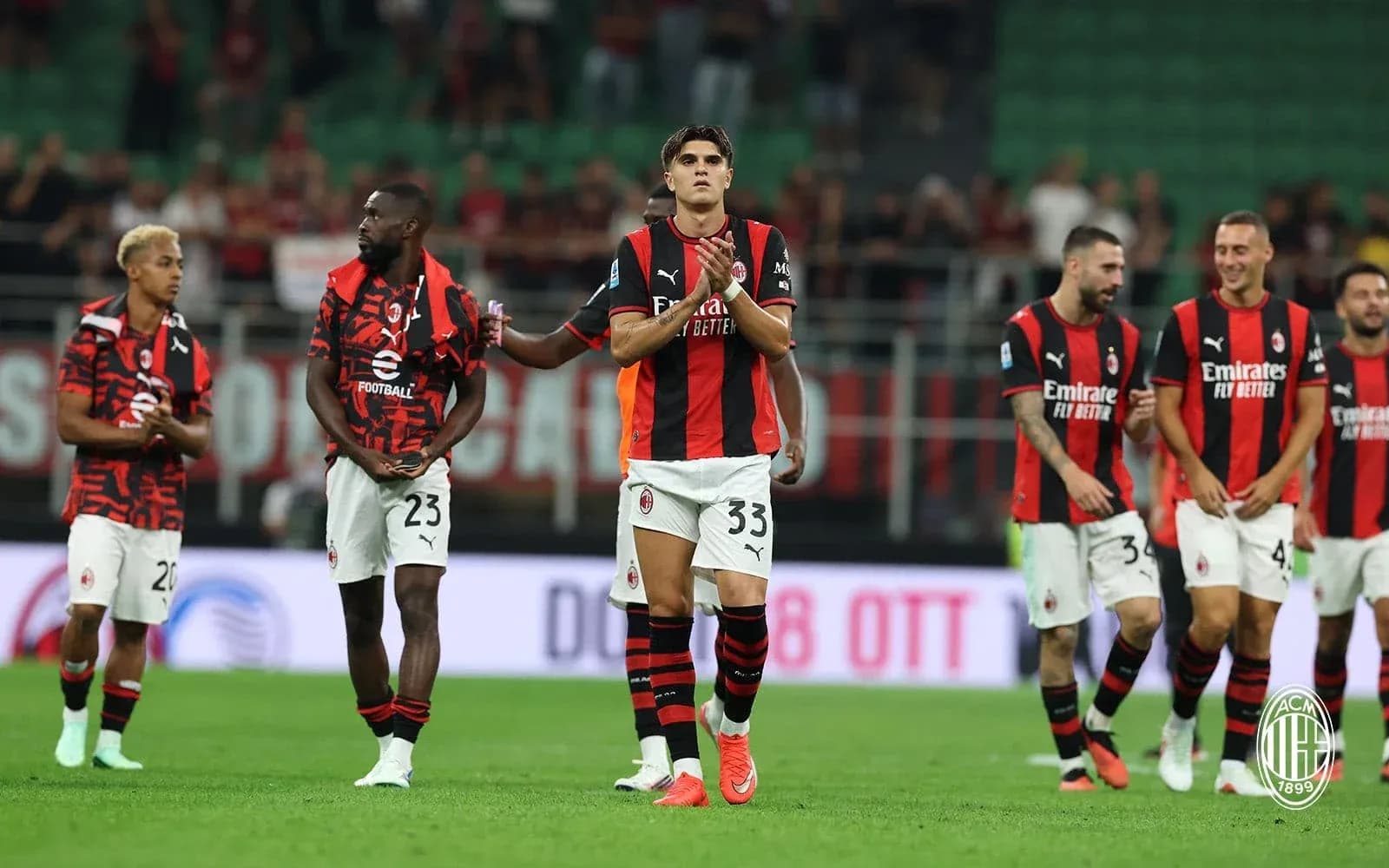
By full time, the scoreboard – 3-0 to Milan – reflected the broader seasonal trends rather than an upset. Following this result, Milan’s overall campaign picture remains impressive: in total this season they have scored 10 goals and conceded 4, giving them a goal difference of +6, fully aligned with their 11 points and 5th place standing. Lecce, for their part, remain a mid-table side with a fragile base: in total they have scored 5 and conceded 10, for a goal difference of -5 and 6 points, leaving them 12th.
AC Milan's Tactical Setup
Amorim stayed faithful to his structural blueprint: a 3-4-2-1 that turns the San Siro pitch into a grid of pre-defined roles. M. Maignan anchored the build-up, protected by a back three of S. Pavlovic, K. De Winter and M. Gila. Ahead of them, the wing corridors belonged to P. Estupinan on the left and S. Chukwueze on the right, with L. Modric and A. Rabiot forming the double pivot that controlled tempo and progression. Between the lines, C. Pulisic and A. Saelemaekers floated as dual creators behind the spearhead G. Ramos.
The numbers heading into this game already hinted at a side that thrives on structure. At home, Milan had played 2 league matches, winning both, scoring 5 and conceding 0. Their home attacking average stood at 2.5 goals per game, with a defensive average of 0.0. Overall, they had not lost in 5 league fixtures (3 wins, 2 draws), and in total they had yet to fail to score in any match. Even their disciplinary profile is controlled: all of their yellow cards this season are spread evenly across the second half, with 25.00% of bookings in each of the 46-60, 61-75, 76-90 and 91-105 minute windows, but no red cards at all.
Lecce's Tactical Setup
Lecce set up in a 4-3-3, a shape that in theory can stretch Milan’s back three but in practice demands impeccable defensive distances and aggressive midfield work. W. Falcone started in goal behind a back four of D. Veiga, K. Gaspar, J. Siebert and A. Gallo. The midfield trio of Y. Maleh, I. Ilic and S. Pierotti were tasked with both screening and sparking transitions, while the front three of J. Monteiro, N. Stulic and L. Coulibaly had to threaten in behind and occupy Milan’s wide centre-backs.
Here, Lecce’s season-long contradictions came into focus. On their travels, they had played 3 times, winning 1 and losing 2, scoring just 2 goals and conceding 4. Their away attacking average stood at 0.7 goals per game, while they allowed 1.3. In total this campaign, they had already failed to score in 3 of 5 matches, and their defensive structure had been exposed in heavy defeats: a 0-4 home loss and a 3-0 defeat away. The San Siro would prove another harsh classroom.
Absences and Tactical Void
The absences only deepened Lecce’s tactical voids. M. Berisha was unavailable through lacking match fitness, O. Gandelman inactive, W. Geubbels sidelined by an ankle injury and Tiago Gabriel out injured. None of these names appeared in the matchday squad, trimming Di Francesco’s options for rotation and late-game adjustments. Milan, by contrast, had a deep bench: from defensive cover like F. Tomori and M. Gabbia to midfield variety in R. Loftus-Cheek, Y. Musah and A. Jashari, and attacking sparks such as D. Moreira, F. Camarda and O. Hutchinson.
Disciplinary Subplot
The disciplinary subplot was always likely to run through D. Veiga and S. Pavlovic. Veiga came into the fixture as one of Serie A’s most carded players, with 3 yellow cards and a red to his name in just 5 appearances. His duel numbers – 57 contests, 27 won – underline how often he is dragged into individual battles, and 8 fouls committed show the cost of that aggression. Pavlovic, on Milan’s side, combined front-foot defending with control: 13 tackles, 2 successful blocks and 2 yellow cards in 5 matches, plus 374 passes at 92% accuracy. His presence meant Milan could hold a high line without losing composure.
Key Matchups
The key matchups defined the narrative. In the “Hunter vs Shield” duel, Milan’s attacking ensemble – buoyed by league top scorer Diego Moreira on the bench with 3 goals in just 127 minutes – went up against a Lecce defence that, in total, had conceded 10 goals in 5 games. With Milan averaging 2.0 goals per match overall and Lecce allowing 2.0, the statistical midpoint already pointed toward a multi-goal home performance.
In the “Engine Room” battle, Rabiot and Modric faced Ilic and Maleh. Rabiot arrived as one of the league’s most productive midfielders, with 2 goals and 2 assists in 306 minutes, 209 passes at 88% accuracy, and 4 key passes. Chukwueze, also high on the assists chart with 2, had already created 10 key passes and attempted 14 dribbles, succeeding 8 times. Against a Lecce midfield that has been functional but not dominant – Ilic’s 141 passes at 89% accuracy and 2 assists mark him as a clever connector rather than a destroyer – the balance of control was always likely to tilt red and black.
Even without explicit xG figures, the statistical prognosis before a ball was kicked was clear. Milan’s home scoring rate of 2.5 goals per game, their perfect clean-sheet record at San Siro, and Lecce’s meagre away attacking output of 0.7 goals per game combined to sketch a likely pattern: Milan to dictate, create and convert; Lecce to rely on isolated moments from Coulibaly, whose 2 goals and 1 assist in 450 minutes make him their primary threat.
The 3-0 full-time scoreline therefore felt less like a surprise and more like a confirmation. Milan’s system, depth and discipline are propelling them toward the top of Serie A, while Lecce’s bravery in attack continues to be undermined by structural frailty and disciplinary risk at the back. On this evidence, the San Siro remains a fortress, and Lecce’s evolution into a stable mid-table side still requires a sturdier defensive foundation.