Anderlecht's Tactical Masterclass in 3–1 Comeback Win Over Hammarby
Anderlecht’s 3–1 comeback win over Hammarby FF at Lotto Park was built on structural control and sheer volume of attacking actions rather than sterile possession. In a UEFA Europa League 2nd Qualifying Round tie that flipped after the interval, Vitor Bruno’s 4‑4‑2 gradually overwhelmed Kalle Karlsson’s 4‑2‑3‑1. Anderlecht produced 21 total shots to Hammarby’s 6 and forced 10 corners while conceding none, turning sustained territorial pressure into three second‑half goals. Hammarby’s early strike gave them a platform to sit deeper, but their inability to progress or relieve pressure left them defending their own box for long spells, and the bench impact on the home side decisively shifted the tactical balance.
The match opened with Hammarby’s game plan clearly focused on vertical shock. From their 4‑2‑3‑1, the double pivot of T. Tekie and M. Karlsson tried to play early into the front four, and that directness paid off immediately with P. Abraham’s goal on 2 minutes. Structurally, Hammarby were content to drop into a compact mid‑block thereafter, with the wide midfielders O. Johansson and V. Lind narrowing to protect the half‑spaces and allow the full‑backs H. Skoglund and N. Persson to hold the line rather than aggressively press.
Anderlecht’s 4‑4‑2, with D. Sikan and J. Onia Seke as the highest reference points, initially struggled to turn possession into clean central entries. The wide midfielders L. Ambros and K. Nga started relatively wide, which left E. Llansana and M. Kana outnumbered by Hammarby’s double pivot plus the dropping No. 10 V. Lind. As a result, much of Anderlecht’s first‑half attacking volume came from early crosses and second balls, reflected in their 12 shots off goal and 3 blocked shots: they were taking attempts, but often from suboptimal positions and under pressure.
Defensively, Anderlecht’s back four of L. Augustinsson, G. Biancone, L. Petrot and A. Maamar held a fairly high line, trusting C. Coosemans (Anderlecht) behind them. Hammarby’s 6 total shots and only 3 on goal show that, beyond the early breakthrough, they rarely accessed the central channel in settled play. The home side’s 12 fouls were the cost of aggressive counter‑pressing and back‑pressing from the midfield line, aiming to prevent Abraham and the supporting three from turning in transition.
The entire tactical picture changed around half‑time. Vitor Bruno’s double substitution at 46 minutes — M. N’Diaye (IN) came on for L. Augustinsson (OUT) and M. Cvetkovic (IN) came on for K. Nga (OUT) — rebalanced the side. With N’Diaye at left‑back, Anderlecht gained more physicality and forward thrust on that flank, while Cvetkovic’s introduction higher up gave them a more direct, penalty‑box‑oriented presence. Immediately, the full‑backs, especially A. Maamar on the right, were encouraged to push higher, turning the 4‑4‑2 into something closer to a 2‑4‑4 in sustained possession.
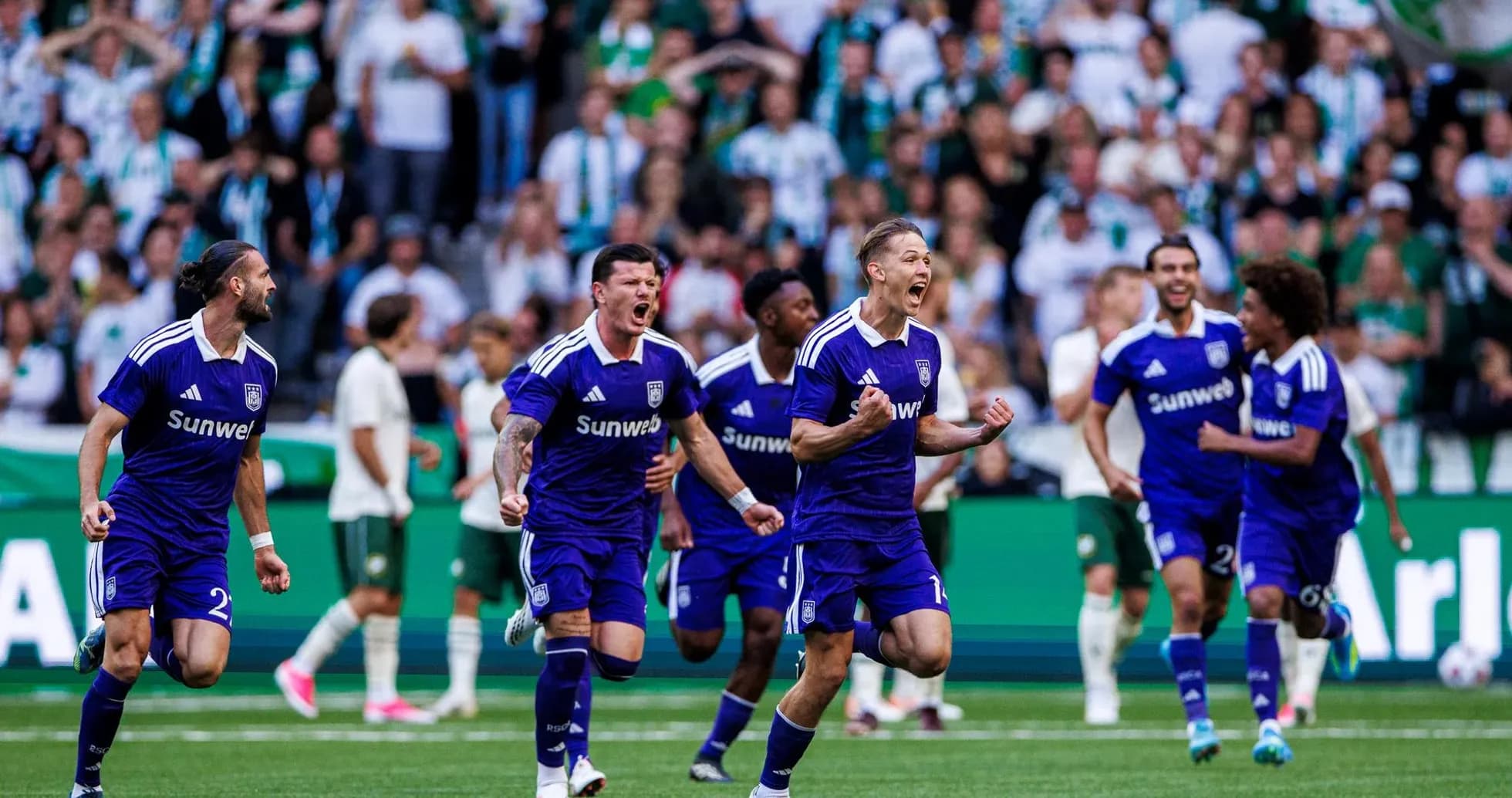
The equaliser at 47 minutes encapsulated the new dynamic: D. Sikan finished a move assisted by A. Maamar, underlining the importance of full‑back width once the wide midfielders started to drift inside. With Hammarby pinned and unable to counter, Anderlecht’s central midfielders could now hold more advanced starting positions, compressing the pitch and feeding continuous waves of attacks. The 10‑0 corner count is a direct indicator of this territorial siege.
Hammarby’s response was to freshen the attacking line rather than alter the structure. On 66 minutes, A. Boudri (IN) came on for P. Abraham (OUT) and N. Besara (IN) came on for M. Madjed (OUT), later followed by I. Fofana (IN) for V. Lind (OUT) and E. Kabore (IN) for O. Johansson (OUT) at 76 minutes, and finally F. Adjei (IN) for V. Eriksson (OUT) at 87 minutes. These changes rotated personnel but maintained the 4‑2‑3‑1 shell. Without an additional midfielder or a third centre‑back, Hammarby continued to suffer under the weight of Anderlecht’s pressure and could not generate sustained sequences to move their block higher.
The decisive phase came from the Anderlecht bench. After his booking for “Roughing” at 65 minutes, Cvetkovic became the focal point of the attack and then delivered the 81‑minute goal that put Anderlecht 2–1 ahead, arriving as an extra finisher in the box. Shortly before that, J. Onia Seke’s yellow card for “Unsportsmanlike conduct” at 66 minutes and his substitution — A. Bertaccini (IN) came on for J. Onia Seke (OUT) at 68 minutes — reflected the increased emotional and physical intensity as Anderlecht chased the winner.
The final blow came from deeper in the squad: T. Degreef (IN) came on for D. Sikan (OUT) at 84 minutes and then scored in the 89th minute, again capitalising on Hammarby’s inability to clear their lines. A late change, Z. Keita (IN) came on for L. Ambros (OUT) at 90+2 minutes, was simply about locking down energy and legs to see out the result.
In goal, C. Coosemans (Anderlecht) made 2 saves from Hammarby’s 3 shots on goal, conceding only the early strike and then largely managing a quiet second half behind a dominant block. At the other end, W. Hahn (Hammarby FF) registered 3 saves but faced 6 shots on goal and relentless pressure from 21 total shots. The shot profile — Anderlecht with more than three times as many attempts — underlines how one‑sided the territory became after the break.
Discipline also tracked the tactical story. Hammarby collected 3 yellow cards: P. Abraham for “Foul” at 27 minutes, V. Eriksson for “Handling” at 55 minutes, and M. Karlsson for “Holding” at 73 minutes, all consistent with a side under stress, forced into last‑ditch interventions. Anderlecht’s 2 bookings — Cvetkovic for “Roughing” at 65 minutes and J. Onia Seke for “Unsportsmanlike conduct” at 66 minutes — came as they pushed aggressively to overturn the deficit.
With no possession or passing data available, the clearest tactical indicators are volume and field tilt: 21–6 in total shots, 10–0 in corners, and a 3–1 final score after trailing 0–1 at half‑time. Anderlecht’s structural tweaks, more adventurous full‑backs, and impactful substitutions turned an early setback into a controlled, territorially dominant win, while Hammarby’s static 4‑2‑3‑1 and lack of an alternative defensive scheme left them absorbing pressure they ultimately could not withstand.