Argentina’s Tactical Evolution Overcomes England in Semi-Final
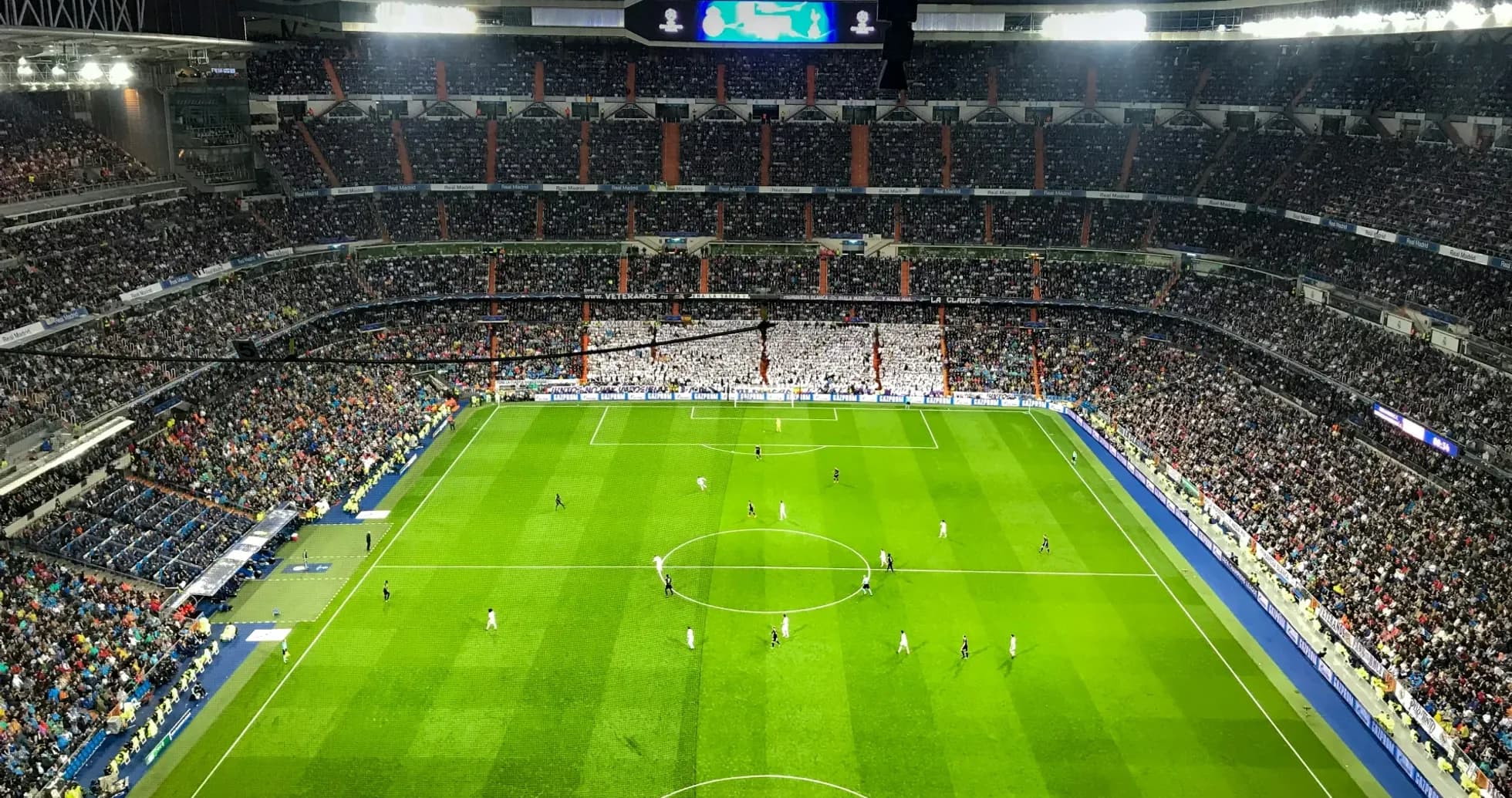
England’s 2-1 defeat to Argentina at Mercedes-Benz Stadium was a study in contrasting game models: England’s compact, low-possession 4-2-3-1 built around vertical transitions, against Argentina’s patient, high-possession 4-4-2 that gradually squeezed the game into England’s half and finally overturned the deficit late on.
Thomas Tuchel’s England set up in a clear 4-2-3-1: Jordan Pickford (England) behind a back four of Reece James, John Stones, Marc Guéhi and Djed Spence; Declan Rice and Elliot Anderson as the double pivot; Morgan Rogers and Anthony Gordon flanking Jude Bellingham behind Harry Kane. The structure was conservative without the ball, with the wingers dropping to form a 4-4-1-1 block and Bellingham screening Argentina’s deepest midfielder.
Lionel Scaloni’s Argentina used a 4-4-2 that often morphed into a 4-3-3 in possession. Emiliano Martínez (Argentina) was protected by Nahuel Molina, Cristian Romero, Lisandro Martínez and Nicolás Tagliafico. Leandro Paredes anchored midfield, with Enzo Fernández and Alexis Mac Allister as advanced interiors and Giuliano Simeone stretching the right. Lionel Messi and Julián Álvarez started as a flexible front two, with Messi free to drop between the lines and to the right half-space.
The statistical profile underlines Argentina’s territorial control: 64% possession, 590 passes with 537 accurate (91%), and 15 total shots (5 on goal). England, by contrast, had 36% possession, 324 passes with 272 accurate (84%), and only 5 shots (2 on goal). This was not an even territorial contest; it was England trying to compress the pitch and survive long spells without the ball.
Defensively, England’s plan initially worked. The double pivot stayed narrow to deny central access, forcing Argentina into wide circulation and crosses. England’s back four dealt reasonably well with first balls, and with only 6 Argentina corners to defend, set-piece volume remained manageable. England conceded 15 fouls to Argentina’s 11, reflecting the strain of late defensive work and tactical fouling to slow Argentine combinations.
In goal, Jordan Pickford (England) made 3 saves and, crucially, his goals prevented value of 0.02 indicates he performed in line with expectation rather than overperforming. He was beaten twice from Argentina’s 5 shots on target, a conversion rate that reflects the quality of Argentina’s late chances rather than any collapse in goalkeeping standards. Emiliano Martínez (Argentina) faced just 2 shots on goal, making 1 save, with the same 0.02 goals prevented; England simply did not generate enough volume or high-quality looks to truly test him.
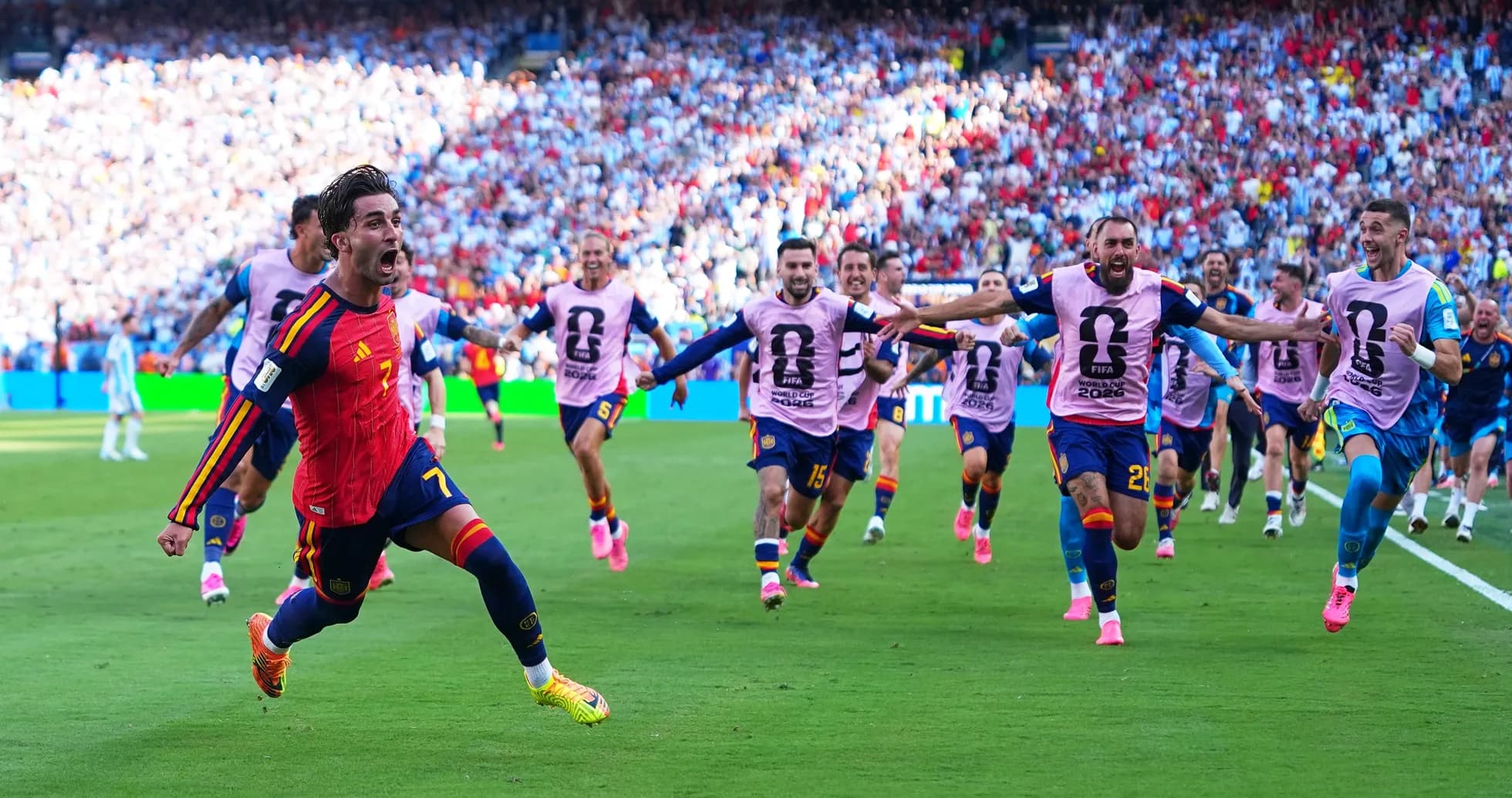
England’s attacking idea hinged on rapid verticality once they recovered the ball. With only 2 shots inside the box from 5 total attempts and an xG of 0.53, they struggled to sustain pressure. The one moment where the plan clicked came on the 55th minute opener: Anthony Gordon’s movement from the left, combined with Morgan Rogers’ support, exploited the space behind Argentina’s advancing full-backs. It was emblematic of England’s best route: win the ball, find Bellingham or Rice quickly, then release the wide forward into space before Argentina could counter-press.
However, once ahead, England’s inability to progress the ball under pressure became decisive. With only 1 corner and 1 offside, they rarely pinned Argentina back high or threatened with repeated final-third entries. Kane was often isolated, dropping deep to connect play, which further reduced penalty-box presence. The late substitutions — Ezri Konsa for Gordon at 72’, Dan Burn for Reece James and Nico O’Reilly for Rice at 82’, then Ivan Toney for Stones and Marcus Rashford for Spence at 90’ — signalled a shift towards more physicality and direct options, but they arrived as Argentina were already camped in England’s half.
Argentina’s tactical evolution was the key storyline. Early on, their 4-4-2 was quite flat, with Paredes the sole deep organizer. As England’s block held, Scaloni adjusted via a wave of substitutions around 64–72 minutes: Nicolás González for Paredes, Nicolás Otamendi for Lisandro Martínez, Gonzalo Montiel for Molina, Rodrigo De Paul for Simeone. This injected fresh legs and more aggressive, front-foot profiles. De Paul’s introduction, in particular, added vertical passing and late runs that overloaded England’s tiring midfield.
The shot map profile — 7 shots inside the box, 8 from outside — shows how Argentina gradually worked their way closer to goal. Their xG of 1.84 against 2 actual goals suggests they created enough to justify the comeback. Messi’s role intensified as the game wore on: he became the central reference in the right half-space, combining with Enzo Fernández and Mac Allister to pull England’s midfield apart. The two late goals, both assisted by Messi, were the culmination of this positional dominance and the constant recycling of possession around England’s box.
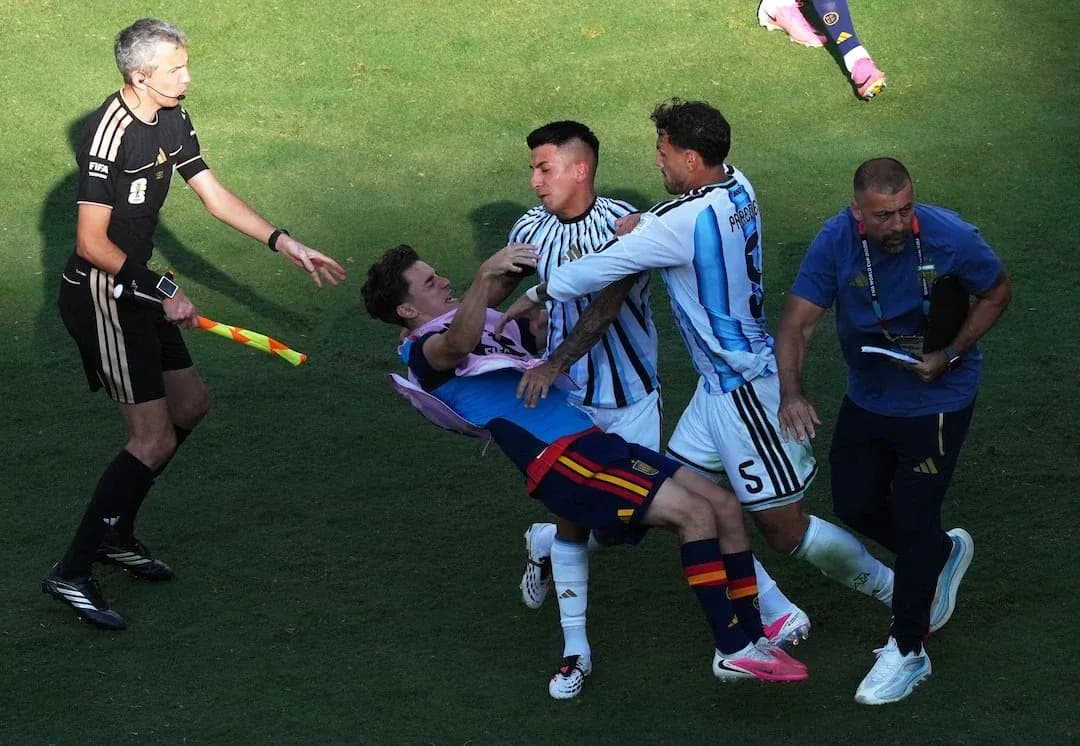
Discipline also reflected the tactical tone. Elliot Anderson’s yellow card for “Foul” at 37’ captured England’s need to disrupt Argentina’s rhythm early. Argentina’s back line felt similar strain: Lisandro Martínez and Cristian Romero both booked for “Foul” (42’ and 51’), by-products of England’s few but sharp transitions when Bellingham or Gordon broke lines. Rodrigo De Paul’s late yellow for “Argument” at 90+4’ came once the game state had flipped, illustrating Argentina’s emotional investment in defending the lead they had worked so hard to engineer.
In summary, this semi-final was defined by Argentina’s control and structural flexibility against England’s low-possession, transition-heavy model. England’s compact 4-2-3-1 delivered a platform and a lead, but with limited passing volume and chance creation, they could not relieve pressure or manage the final 20 minutes. Argentina, with superior possession, passing accuracy, and shot volume, eventually converted their territorial dominance into a late, deserved turnaround.