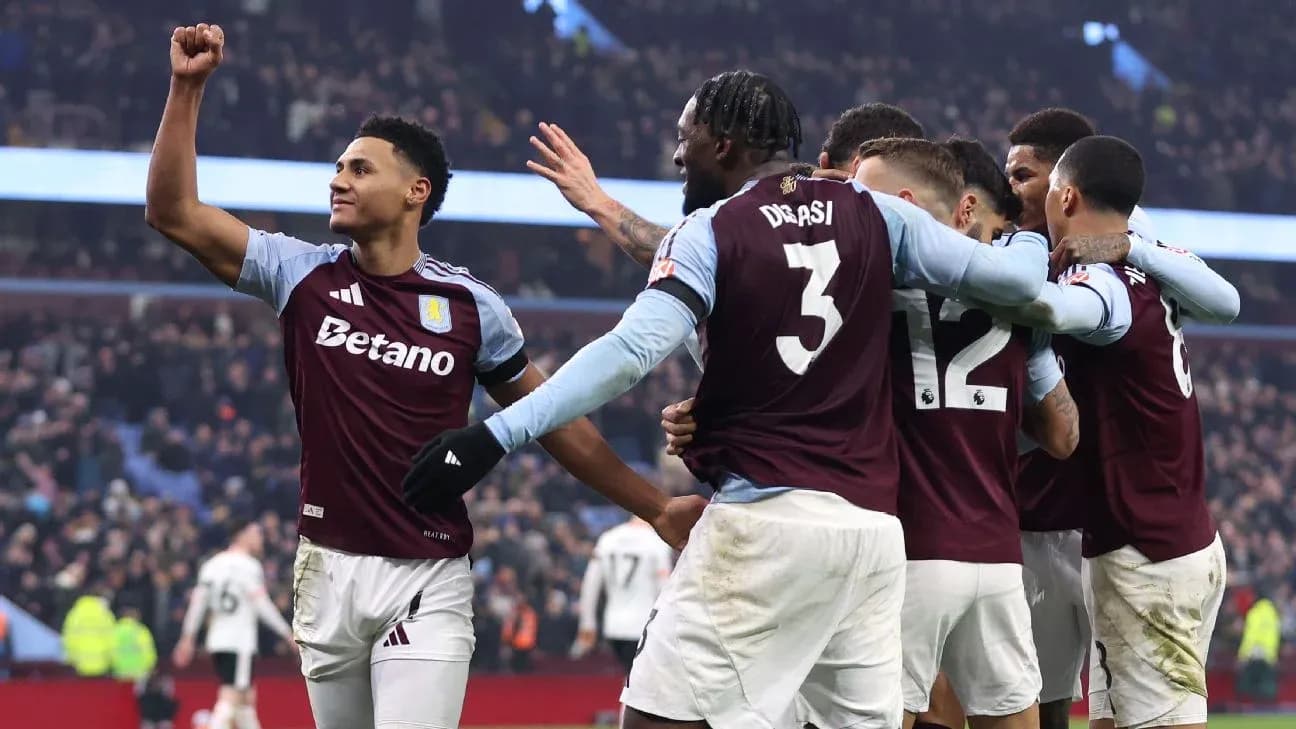
Aston Villa vs Liverpool: Premier League Showdown at Villa Park
Under the lights at Villa Park in Birmingham on 15 May 2026, Aston Villa and Liverpool walk out knowing this is a night that will shape their Premier League story. Both sit locked on 59 points, both officially in the “Promotion - Champions League (League phase)” places, and both aware that any slip now could open the door for rivals. With key names like O. Watkins, M. Rogers, Mohamed Salah, H. Ekitike and D. Szoboszlai carrying so much of their sides’ creative burden, this feels less like a routine league fixture and more like a play-off for prestige and European positioning.
Season Context
Aston Villa arrive in the top four race as a dangerous but inconsistent contender. They have taken 59 points from 36 matches, scoring 50 and conceding 46, a narrow positive goal difference that reflects a team capable of cutting opponents open but also being exposed. Seventeen wins from those 36 games underline their threat, yet 11 defeats show why they are still fighting to secure their Champions League status rather than cruising over the line.
Liverpool mirror Villa on 59 points from 36 games but carry a stronger attacking profile with 60 goals scored and 48 conceded. The 12-goal positive differential hints at more firepower and slightly more control in games, even if their defensive record is similar in raw numbers. Seventeen wins, eight draws and 11 losses leave them in fourth place, and like Villa they are in the Champions League bracket, but without room for complacency heading into this high‑stakes trip to Birmingham.
Form & Momentum
Aston Villa’s recent league form line of “DLLWD” tells of a side stumbling at the wrong time. Two defeats in that run contribute to a goals-conceded figure of 46 across 36 games (1.28 per match), suggesting that when the structure wobbles, they can be punished. Yet 50 goals in those 36 matches (1.39 per game) show that their attacking edge, led by O. Watkins with 12 league goals and 2 assists, means they are rarely out of a contest for long.
Liverpool travel with the more convincing recent record, their form string reading “DLWWW”. Three straight wins in that sequence align with a season tally of 60 goals from 36 matches (1.67 per game), underlining why their attack is rated higher in the model comparison. Conceding 48 (1.33 per match) keeps them far from watertight, but when players like H. Ekitike (11 goals and 4 assists) and D. Szoboszlai (6 goals and 5 assists) are in rhythm, they can simply outscore problems.
Head-to-Head Patterns
Recent meetings have tilted towards Liverpool while still offering drama. On 1 November 2025 at Anfield, Liverpool beat Aston Villa 2-0 in the Premier League (Premier League, season 2025, November 2025), a controlled home performance that reinforced their upper hand on Merseyside. At Villa Park on 19 February 2025, the sides shared a 2-2 draw (Premier League, season 2024, February 2025), a reminder that Villa can trade blows with Liverpool in Birmingham when their attack clicks. Earlier, on 9 November 2024, Liverpool again shut Villa out 2-0 at Anfield (Premier League, season 2024, November 2024), underlining a recurring pattern of Liverpool’s defence holding firm when they dictate the tempo.
Tactical Preview
Aston Villa’s statistical profile and lineups data point strongly towards a 4-2-3-1 base shape (used 32 times), occasionally shifting into 4-4-2. That structure is built to maximise the influence of O. Watkins as the central attacker, supported by creative midfielders like M. Rogers, who has 9 goals and 5 assists from midfield. With 50 goals scored and 46 conceded in 36 league matches, Villa look like a side geared towards front-foot football (1.39 goals scored per game) but one that must protect a back line that can be stretched. The absence of B. Kamara through a knee injury and the uncertainty over A. Onana, both listed as not fully available for this specific fixture, weaken the midfield shield that protects their defenders.
In wide and half-space areas, the onus will fall on M. Rogers to link play between the lines. His 1,036 completed passes and 43 key passes in league action show how often he is the conduit for Villa’s attacks. Behind him, the double pivot will need to balance progression with protection; conceding 46 in 36 suggests that when Villa over-commit, they are vulnerable in transition. The absence of Alysson in attack slightly trims depth, placing even more responsibility on O. Watkins’ movement and finishing.
Liverpool are also heavily tied to a 4-2-3-1 system (32 uses), with occasional switches into 4-2-2-2 and 4-3-3. Their 60 goals in 36 games (1.67 per match) reflect a multi‑layered attacking unit. H. Ekitike’s 11 goals and 4 assists make him a central figure at the tip of the structure, while C. Gakpo (7 goals, 5 assists) and D. Szoboszlai (6 goals, 5 assists, plus 2,090 completed passes at 87% accuracy) provide threat and control from deeper and wider positions. The likely absence of M. Salah, listed as missing with a thigh injury for this fixture, removes one of their most reliable final‑third weapons, but the creative burden can be shared by F. Chiesa and F. Wirtz if the latter is passed fit.
Without W. Endo and with I. Konaté and F. Wirtz questionable, Liverpool’s spine is not at full strength. That could matter against a Villa side that scores regularly at home (28 home goals in the standings data). However, Liverpool’s defensive structure, which has still produced 10 clean sheets across home and away contexts in the broader statistics, combined with their superior attacking numbers, explains why the predictive models lean their way. Expect Liverpool’s double pivot and advanced midfield trio to press Villa’s build-up, aiming to turn midfield turnovers into quick strikes against a defence that concedes 1.28 per game.
Statistical Snapshot
- Competition: Premier League, season 2025 — 15 May 2026.
- Venue: Villa Park, Birmingham.
- Prediction: Win or draw — Double chance : draw or Liverpool.
- Win Probabilities: Home 10% / Draw 45% / Away 45%.
- Model: Aston Villa 36.0% — Liverpool 64.0%.
Betting Verdict
The data and recent momentum both support the prediction of “Double chance : draw or Liverpool”, with Liverpool given a 64.0% edge in the model and stronger recent form (“DLWWW”). With major absences on both sides but particularly the loss of M. Salah and W. Endo for Liverpool and B. Kamara for Villa, this could become a midfield‑heavy battle where Liverpool’s deeper creative pool (Szoboszlai, Gakpo, Ekitike) still gives them the upper hand. Market prices around 2.85–3.02 for the home win and roughly 2.16–2.33 for the away win reflect a relatively balanced contest, but the combination of Liverpool’s head‑to‑head edge at Anfield and their superior attacking output (60 goals vs Villa’s 50) justifies siding with Liverpool on the double‑chance rather than chasing Villa at longer odds. A tight, high‑stakes encounter at Villa Park, with Liverpool favoured to avoid defeat.