Atletico Madrid's Tactical Masterclass Against Real Madrid
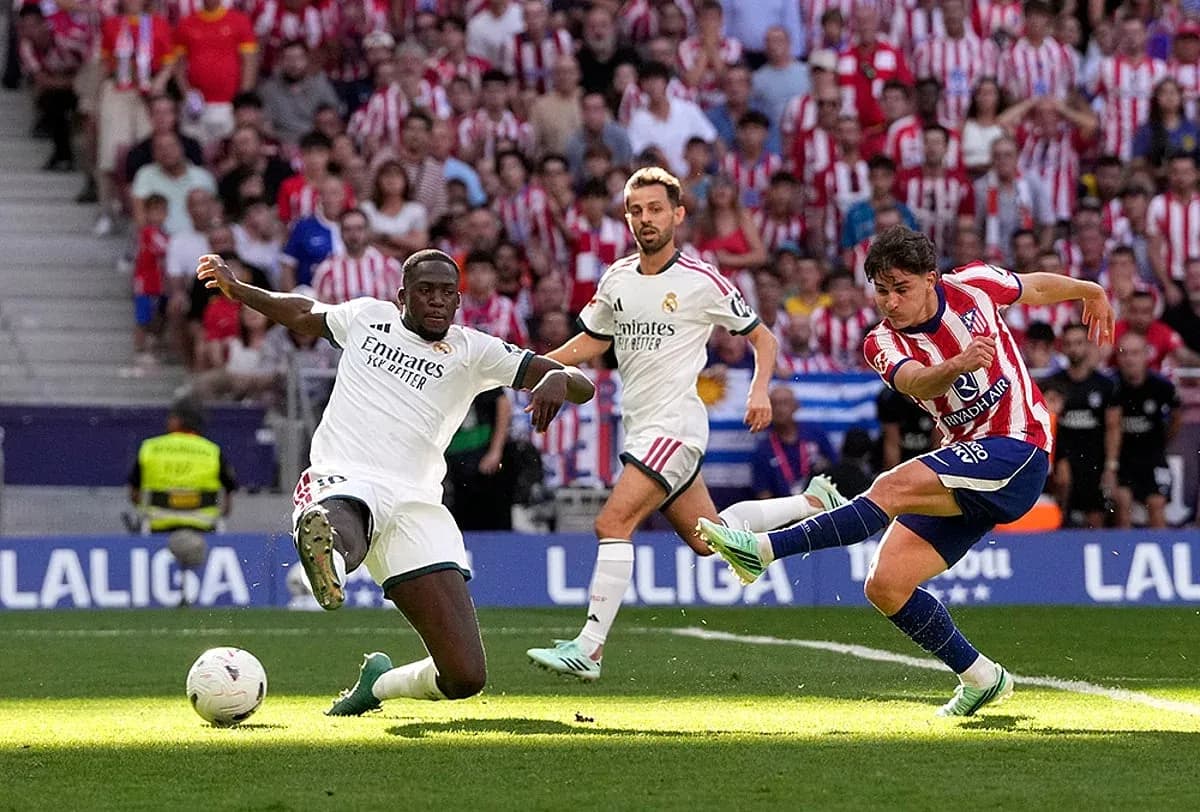
Under the late-afternoon lights of the Riyadh Air Metropolitano, Atletico Madrid’s 2–1 win over Real Madrid felt less like an upset and more like a tactical manifesto. Round 7 of La Liga ended with Diego Simeone’s side consolidating second place on 16 points, while Josè Mourinho’s Real Madrid, still on 15, were dragged into a bruising reminder that this title race will be decided in the margins.
I. The Big Picture – Two Identities, One Battlefield
Heading into this game, the numbers already hinted at a clash of philosophies. Atletico Madrid’s season has been defined by control and late-game cruelty. Overall they had scored 16 goals and conceded 7, a goal difference of 9, built on a home attack averaging 2.5 goals per match and a defence allowing just 0.8 at the Metropolitano. Their scoring profile is ruthless in the closing stages: 37.50% of their goals come between 76–90 minutes, with another 25.00% arriving between 46–60. This is a team that grows into games and finishes them with a knife in hand.
Real Madrid travelled across the city as the division’s chaos merchants. Overall they had 18 goals for and 8 against, a goal difference of 10, with a blistering home attack (4.0 goals per game) but a more fragile away output of 1.5 goals and 1.5 conceded. Like Atletico, they explode late: 37.50% of their goals also arrive in the 76–90 window. The derby was always likely to be decided in that shared red zone of the match.
II. Tactical Voids – Absences That Bent the Game
Both sides were forced into structural compromises. Atletico Madrid were without P. Barrios and A. Sorloth, both sidelined by muscle injuries. Barrios’ absence removed a young, energetic rotation option in midfield, while the loss of Sorloth trimmed Simeone’s capacity to go direct with a classic target man late on. The solution was to lean fully into mobility and pressing: a 4-4-2 built around J. David and Lee Kang-In up front, with Álex Baena and G. Simeone providing legs and aggression from the flanks.
Real Madrid’s missing pieces cut deeper into their defensive and attacking spine. Eder Militao (hamstring) and F. Mendy (hip) were both out, forcing Mourinho to lean on the relatively young axis of I. Konaté and D. Huijsen at centre-back, with Marc Cucurella at left-back. Rodrygo’s knee injury removed a vertical runner and secondary scorer, pushing even more creative and scoring responsibility onto Kylian Mbappé, Vinícius Júnior and J. Bellingham.
Disciplinary trends also hovered over the fixture. Atletico’s season card map shows a spike of 30.77% of their yellows between 31–45 minutes and a solitary but decisive red in the 76–90 window. Real Madrid, meanwhile, carry a red mark of their own: D. Huijsen has already been sent off this season, and the team’s yellows cluster heavily between 46–75 minutes (50.00% combined in those two ranges). It framed a derby where the middle third of the game was always likely to turn nasty.
III. Key Matchups – Hunter vs Shield, Engine vs Engine
The headline duel was always going to be Kylian Mbappé versus the Atletico block. Mbappé arrived with 7 goals and 2 assists in 7 appearances, averaging 32 shots with 22 on target and a 7.96 rating. He is not just a finisher; 11 key passes and 39 dribble attempts (23 successful) underline a forward who bends entire defensive systems around him. Yet Real Madrid’s penalty record betrayed a crack in their ruthlessness: 2 penalties taken, only 1 scored and 1 missed. Even their superstar has shown human fallibility from the spot.
Atletico’s response was collective, but it had clear protagonists. J. Oblak remains the anchor, shielded by a back four of Marc Pubill, C. Romero, D. Hancko and Álex Grimaldo. On the bench, Robin Le Normand loomed as a specialist enforcer, a defender who has already both scored and been sent off this season. In midfield, J. Cardoso and Marcos Llorente formed the hinge, while G. Simeone and Álex Baena carried the dual responsibility of pressing and creativity.
Baena has quietly become one of La Liga’s most decisive midfielders: 4 goals and 1 assist in 7 appearances, with 14 key passes and 13 shots (7 on target). He is both creator and finisher, and his defensive work – 9 interceptions and 1 blocked shot – makes him vital in transition. On the opposite side, G. Simeone embodies Simeone-the-coach’s ideals: 2 goals, 2 assists, 15 tackles, 6 interceptions and 71 duels contested, winning 34. He is a hybrid winger-forward who defends like a full-back and attacks like a second striker.
Up front, J. David added another sharp edge. With 3 goals and 1 assist in just 160 league minutes, 10 shots and 6 on target, he represents efficiency rather than volume. His movement between Konaté and Huijsen, especially when Atletico broke after half-time, was always going to be decisive.
In the engine room, the duel between Real Madrid’s double pivot and Atletico’s midfield line shaped the rhythm. A. Tchouaméni and F. Valverde offered power, range and ball progression, while further ahead J. Bellingham’s all-court influence – 3 goals, 2 assists, 17 key passes, 12 tackles and 83 duels with 51 won – meant Atletico had to defend zones rather than just players. Bellingham’s ability to arrive late in the box intersected dangerously with Atletico’s vulnerability: 42.86% of their goals conceded come in the 76–90 minute period.
On the flanks, Vinícius Júnior against Marc Pubill and Marcos Llorente was a battle of chaos versus control. Vinícius came into the game with 3 assists, 1 goal, 29 dribble attempts (12 successful) and 23 fouls drawn. His capacity to win penalties – he has already won one this season – tested an Atletico side that, while disciplined, clusters yellow cards around the end of the first half.
IV. Statistical Verdict – Margins, Moments, and a Derby Decided
The underlying seasonal profiles suggested a knife-edge encounter. Atletico’s overall scoring average of 2.3 goals per match versus Real Madrid’s 2.6 pointed to an open game, but the defensive numbers tilted the scales. Atletico concede just 1.0 goal per game overall, with 3 clean sheets, and have yet to lose at home. Real Madrid, by contrast, concede 1.5 on their travels and have not kept an away clean sheet.
Layered on top of that, Real Madrid’s penalty vulnerability – 1 miss out of 2 – and a back line missing Militao and Mendy left them exposed to precisely the kind of late surges Atletico specialise in. Both teams peak offensively between 76–90 minutes, but Atletico also concede heavily there, while Real Madrid’s defensive soft spots are earlier (30.00% of goals conceded between 16–30 and another 30.00% between 46–60). Simeone’s plan to accelerate after the break and then double down in the final quarter found those seams.
Following this result, the numbers and the narrative converge: Atletico Madrid’s 4-4-2, powered by the work of Baena, G. Simeone and David, has the resilience and late-game punch to sustain a title challenge. Real Madrid, for all the brilliance of Mbappé, Bellingham and Vinícius, will need to tighten their away defending and sharpen their penalty edge if they are to turn their attacking fireworks into trophies in nights like these.