FC Porto Triumphs 4-1 Over Napoli in UEFA Champions League Clash
Under the floodlights of Estádio do Dragão, this League Stage clash in the UEFA Champions League delivered a storyline that cut against both teams’ seasonal profiles. FC Porto, ranked 26th in the standings with 3 points and a goal difference of -1 heading into this game, had lived a campaign of narrow margins and missed opportunities. Napoli, one place below them in 27th, also on 3 points but with a far worse goal difference of -5, arrived in Porto carrying scars from a porous defence and a fractured squad.
By full time, the scoreboard read 4-1 to FC Porto, a result that felt like a release of all the tension built up over their opening three defeats. The half-time score of 1-1 hinted at balance; the second half broke that illusion entirely.
I. Structural Identities and Season Context
Porto’s season in Europe had been defined by fragility rather than collapse. Overall they had scored 6 and conceded 7 in 4 matches, with that -1 goal difference reflecting a side that stayed in games but rarely controlled them. At home, they had played 3, winning 1 and losing 2, with 4 goals for and 4 against: an average of 1.3 goals scored and 1.3 conceded at the Dragão. The raw numbers painted a team that hovered on a knife-edge.
Napoli’s story was more extreme. Across their 4 fixtures they had scored 6 and shipped 11, the -5 goal difference the mark of a side whose attacking flashes could not hide defensive disarray. At home they had been wild but watchable, scoring 4 and conceding 4 in 2 matches, while on their travels they had been exposed: 2 away matches, 2 defeats, 2 goals for and 7 against, an away defensive average of 3.5 goals conceded per game.
Into that statistical tension stepped two coaches with very different blueprints. Francesco Farioli stayed faithful to Porto’s 4-3-3, a shape they had used in all 4 Champions League outings. Massimiliano Allegri, in contrast, leaned into pragmatism with a 3-5-1-1, one of three systems Napoli had already tried in this campaign. It was a choice that betrayed both caution and necessity.
II. Tactical Voids and Absence as a Storyline
The team sheets were as revealing as any chalkboard. Porto were missing a cluster of defenders and squad options: C. Smalling (knee injury), V. Sousa (leg injury) and William Gomes (ankle injury) were all unavailable, while Gabriel Mec and D. Prpic were off the roster. O. Pietuszewski was listed as questionable with a muscle injury yet still named among the substitutes, a calculated risk from Farioli to preserve attacking depth.
Napoli’s absences were even more brutal, and they shaped the entire tactical picture. A. Buongiorno and B. Badiashile were out, stripping depth and authority from the back line. G. Di Lorenzo and M. Olivera were also sidelined, robbing Allegri of his first-choice full-backs or wing-backs. Further forward, David Neres and L. Spinazzola were unavailable, removing wide threats that could have stretched Porto’s back four. In midfield, S. Lobotka’s ankle injury deprived Napoli of their natural metronome.
Even the creative heartbeat came with an asterisk: K. De Bruyne was officially questionable with an ankle injury but started, a gamble that underlined how stretched Napoli were. Alisson Santos, C. Favasuli, L. Marianucci and others remained off the roster or injured, forcing Allegri into a narrower, more conservative 3-5-1-1 built on what was left rather than what he would have chosen.
Disciplinary patterns only deepened the sense of risk for Napoli. Across the campaign, their yellow cards had been scattered but with spikes between 31-45 minutes (25.00%), 46-60 (25.00%) and 76-90 (25.00%). More tellingly, their only red card had come late, between 76-90 minutes, a 100.00% concentration that spoke of fatigue and desperation in closing phases. Porto, by contrast, had collected most of their yellows between 46-60 (40.00%), then spread the rest across the final half hour and stoppage time, but without a single red.
In a match that would demand emotional control as much as tactical clarity, Napoli’s late-game discipline profile was a flashing warning light.
III. Key Matchups: Hunter vs Shield, Engine Room vs Enforcer
Farioli’s 4-3-3 was built on a clear spine. D. Costa in goal, with a back four of A. Costa, J. Bednarek, J. Kiwior and M. Fernandes, formed a unit that had not yet kept a clean sheet in the competition but had rarely been overwhelmed. Bednarek and Kiwior, in particular, were tasked with handling R. Hojlund’s runs in behind and the subtle movement of De Bruyne between the lines.
Ahead of them, the midfield trio of V. Froholdt, P. Rosario and G. Veiga provided balance: Froholdt as the physical screen, Rosario as the stabiliser, Veiga as the line-breaking connector. Their job was twofold – to suffocate Napoli’s central progression and to feed a front three designed to attack Napoli’s weakest zone: the channels outside their back three.
That front line – Pepê, Andre Silva and B. Sainz – was the “Hunter” unit in this contest. Porto’s overall scoring average of 1.5 goals per game, with 1.3 at home, suggested efficiency more than volume. But their biggest home win of 4-1 hinted at a ceiling of explosive output when the pressing and transitions clicked. That exact scoreline would be repeated here.
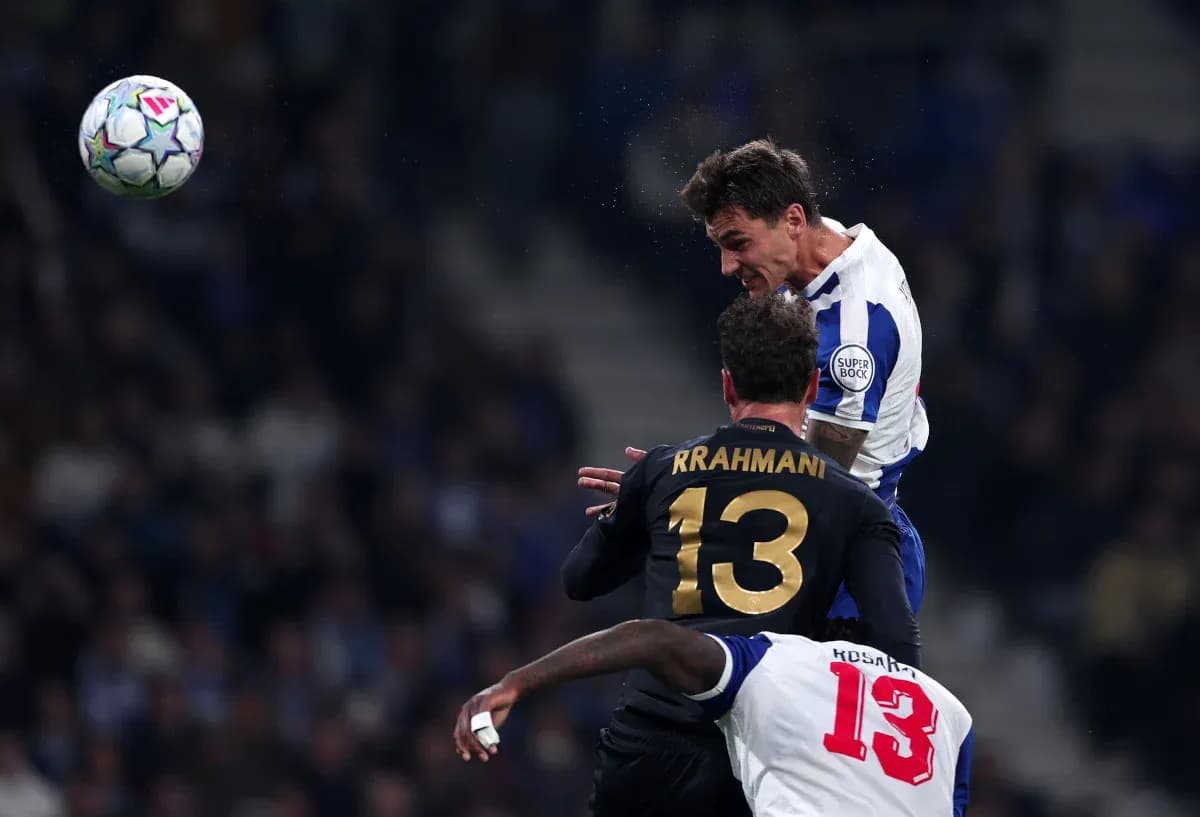
Napoli’s “Shield” was an improvised back three of S. Beukema, A. Rrahmani and Rafa Marín. Marín’s profile across the campaign was that of a proactive defender: 10 tackles, 2 successful blocks and 5 interceptions in 340 minutes, with 16 duels won from 30. Yet he also carried the stain of a red card, the only one in Napoli’s European campaign so far. Against Porto’s mobile front three, his aggression was both an asset and a liability.
In midfield, F. Anguissa and S. McTominay were charged with enforcing around B. Gilmour’s passing hub, while A. Vergara and M. Politano offered width from deeper starting positions. The plan was clear: compress the centre, force Porto wide, then spring De Bruyne and Hojlund in transition.
But this ran into Porto’s own structural strengths. Napoli’s away defensive average of 3.5 goals conceded per game collided with a Porto side whose biggest home win was already 4-1. The Hunter vs Shield matchup was tilted from the outset.
IV. The Narrative of the Match and Statistical Prognosis
The first half, ending 1-1, looked like the tactical arm wrestle Allegri had hoped for. Napoli’s five-man midfield made central progression difficult for Porto, and De Bruyne’s presence between the lines gave the visitors just enough threat to keep Farioli cautious.
Yet the underlying numbers and profiles were always pointing towards a Porto surge after the interval. Napoli’s season-long pattern of conceding heavily away, combined with their late-game disciplinary issues, meant that any rise in Porto’s intensity in the second half risked overwhelming a tired and patched-up back line.
Porto’s card distribution, with 40.00% of their yellows coming between 46-60 minutes, suggested a team that often turned the dial up immediately after half time, sometimes at the cost of bookings. Here, that same surge of aggression translated into dominance rather than self-destruction. Their midfield began to win second balls higher up the pitch, and the front three exploited the spaces outside Beukema and Marín with relentless runs.
Napoli, by contrast, lacked the stabilising presence of Lobotka and the defensive leadership of Di Lorenzo and Buongiorno. The 3-5-1-1 that had been designed to protect a fragile defence gradually became a low block under siege. As the match moved into its final third – the period where Napoli’s yellow and red card history hinted at frayed nerves – Porto found their finishing touch.
Without penalties to skew the numbers and with both sides still searching for their first clean sheet of the campaign, the expectation on underlying chance creation would have leaned towards a reasonably high xG contest. Given Porto’s home scoring rate and Napoli’s away concession rate, a statistical model would have projected Porto as narrow favourites, perhaps by a goal. Instead, the tactical imbalances and injury-driven voids turned that edge into a rout.
The 4-1 full-time scoreline felt like the logical extreme of all the pre-match data: Porto’s attacking ceiling finally reached, Napoli’s defensive floor collapsing under the weight of absences, fatigue and structural strain. In a league stage where both sides had been living on the margins, this night at the Dragão redrew their European narratives in emphatic, unforgiving terms.