PSV Eindhoven vs Club Brugge: A Clash of Contrasting Trajectories
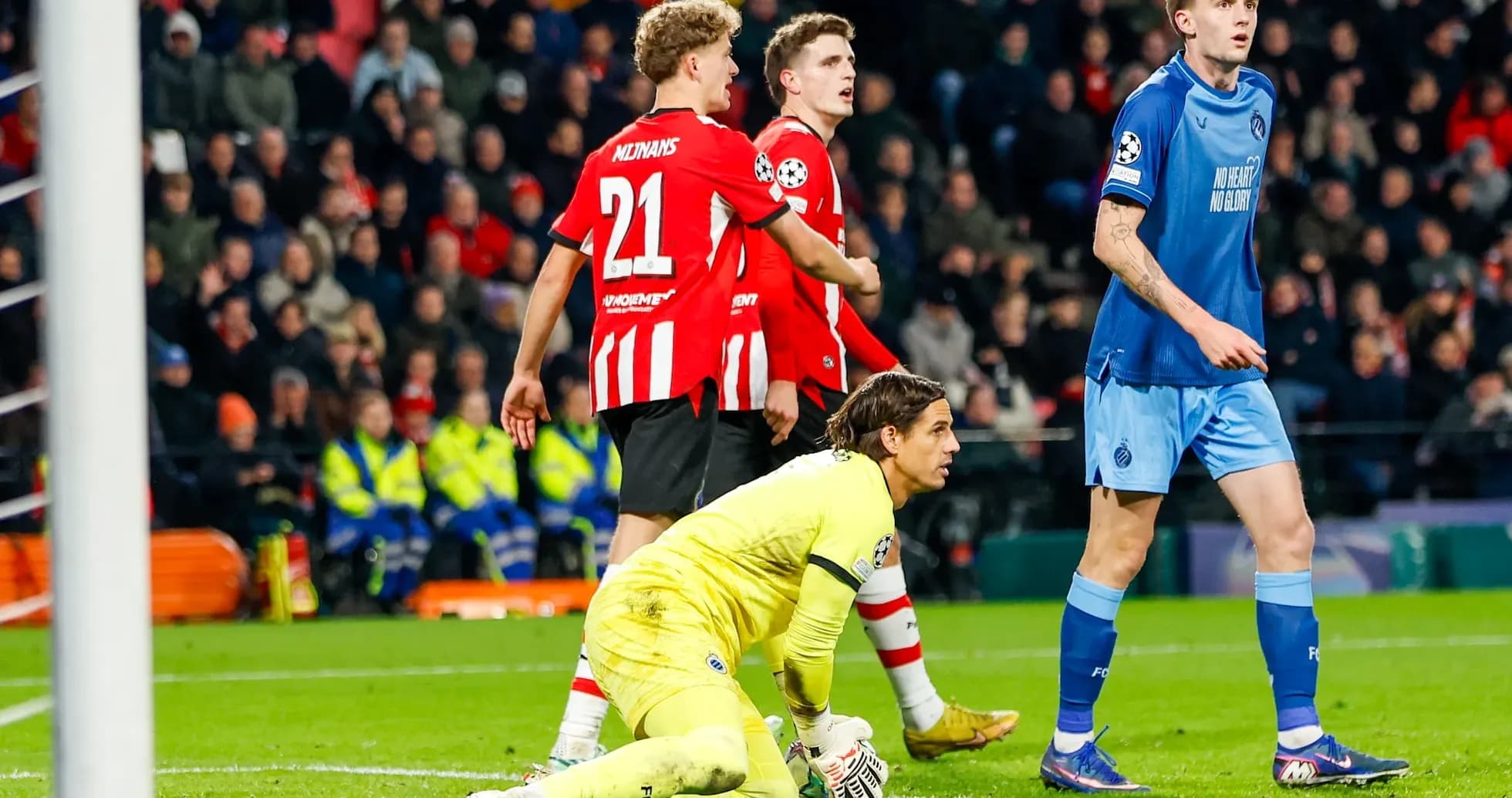
The Philips Stadion lights had barely dimmed when the numbers began to tell a harsher story than the narrow 2–1 scoreline. For PSV Eindhoven, this was more than just a home defeat to Club Brugge KV in the UEFA Champions League League Stage – it was a snapshot of a campaign teetering between promise and fragility.
I. The Big Picture – contrasting trajectories
Heading into this game, the table already framed the duel as a clash of opposites. PSV stood 24th overall in the league standings with 4 points from 4 matches, their overall goal difference at -1, derived from 3 goals scored and 4 conceded. At home, they had yet to win in this campaign: 2 matches, 0 victories, 1 draw, 1 defeat, with 2 goals scored and 3 conceded in Eindhoven.
Club Brugge arrived in a very different mood. Ranked 9th with 9 points from 4 games, they had built a goal difference of +4 by scoring 11 and conceding 7 overall. On their travels, they had been perfect: 2 away matches, 2 wins, no draws or losses, with 6 goals scored and 4 conceded. This away confidence met a PSV side still trying to turn the Philips Stadion into a European fortress.
The formations told their own story. Peter Bosz trusted his familiar 4-2-3-1, a shape PSV had already used 3 times in this Champions League run. M. Kovar started in goal, shielded by a back four of S. Dest, L. Geertruida, A. Obispo and F. Kostic. The double pivot of K. Sano and Mauro Junior sat behind an attacking trio of I. Perisic, S. Mijnans and R. van Bommel, with G. Til as the nominal striker.
Opposite them, Ivan Leko’s Club Brugge lined up in a 4-1-4-1 – a variation on the flexible back-four systems they have alternated between (4-2-3-1, 4-5-1, 4-1-4-1). Y. Sommer anchored the side in goal, behind a defence of K. Sabbe, J. Spileers, B. Mechele and J. Seys. F. Potts held the single pivot role, with a dynamic midfield line of C. Forbs, H. Vetlesen, H. Vanaken and J. Virgili supporting lone forward N. Tresoldi.
II. Tactical Voids – absences and psychological weight
PSV’s squad sheet carried more than just names; it carried the imprint of who was missing. S. Lammers (lacking match fitness), A. Nagalo (injury), S. Ouaissa (muscle injury), A. Plea (surgery), J. Schouten (knee injury) and P. Wanner (foot injury) were all unavailable. That stripped Bosz of options in the spine: no Schouten to steady midfield, no Plea or Lammers to alter the attacking profile from the bench, no Nagalo to reshape the back line.
For Club Brugge, the list was mercifully shorter: J. Ordonez was out with a foot injury, limiting defensive rotation but not destabilising the core structure.
Discipline has been another quiet storyline of PSV’s campaign. Their yellow cards are spread but spiky: 28.57% between 31–45 minutes, 14.29% from 46–60, and a combined 57.14% in the 61–75 and 76–90 windows. It suggests a side that often ends each half on edge, chasing or protecting situations rather than controlling them. Club Brugge, by contrast, show a clear late-game bite: 41.67% of their yellows arrive between 61–75 minutes, with another 25.00% from 76–90 and 8.33% in added time, reflecting a team that pushes intensity as matches stretch.
From the spot, the psychological contrast is stark. PSV have had 1 penalty overall this campaign and missed it, giving them a 0% conversion rate and 1 penalty missed in total. Club Brugge have taken 2 penalties overall, scoring both, a perfect 100.00% record with no misses. In tight European nights, that mental edge matters.
III. Key Matchups – Hunter vs Shield, and the battle for control
No figure loomed larger over this fixture than N. Tresoldi. Heading into this game, he was one of the competition’s standout forwards: 5 goals in 4 appearances, all as a starter, supported by 13 shots (8 on target). His overall rating of 7.54 underlines a striker who offers more than just finishing – he had also won 23 of 41 duels and even blocked 1 shot defensively.
Against a PSV defence that had conceded 3 goals at home in just 2 Champions League matches, Tresoldi was always likely to find space. The Eindhoven back line, which had already allowed 1.5 goals per home game on average, needed near-perfection in their defensive shape and penalty-box management. Instead, Club Brugge’s confidence, especially away where they average 3.0 goals scored and 2.0 conceded per match, tilted the balance.
Behind Tresoldi, C. Forbs operated as the primary creative engine. With 2 goals and 2 assists in 4 appearances, plus 9 key passes and 18 dribble attempts (6 successful), he arrived as one of the competition’s most dangerous wide playmakers. His 7.58 rating and 101 completed passes at 77% accuracy point to a player equally comfortable breaking lines with the ball or combining in tight spaces. Up against PSV’s double pivot and full-backs, his capacity to drag defenders out of position was central to Brugge’s plan.
In PSV’s camp, the creative burden was spread across I. Perisic, S. Mijnans and R. van Bommel, with G. Til asked to link and finish. Yet the numbers show an attack still searching for ruthless clarity: overall, PSV average 0.8 goals per game in this Champions League campaign, with 1.0 at home and just 0.5 on their travels. They have failed to score once overall and kept only 1 clean sheet, away from home.
IV. Statistical Prognosis – why the night tilted blue and black
When you overlay the season’s patterns on this single match, the 2–1 outcome feels like the logical expression of broader trends.
Club Brugge arrived with an attacking profile that is simply heavier and sharper: 11 goals overall in 4 matches, an average of 2.8 per game, compared to PSV’s 3 goals overall and 0.8 per game. Defensively, both sides are imperfect – PSV concede 1.0 goal per match overall, Brugge 1.8 – but the Belgians’ firepower gives them more margin for error.
PSV’s inability to turn the Philips Stadion into a scoring stronghold is perhaps the most worrying sign. At home they score 1.0 goal per game and concede 1.5; in a competition where fine margins decide progression, that is a fragile platform. The missed penalty earlier in the campaign lingers as a symbol of wasted opportunity.
Club Brugge, by contrast, have crafted an identity as fearless travellers. Six away goals in 2 matches, underpinned by the cutting edge of Tresoldi and the creativity of Forbs, make them a side that can survive chaotic spells and still land decisive blows.
Following this result, the trajectories feel confirmed rather than reshaped. PSV remain a side with structure but lacking punch and depth, their absences and penalty woes compounding the issue. Club Brugge continue as one of the League Stage’s most assertive outfits, their 4-1-4-1 in Eindhoven another proof that they can adapt shapes without losing their attacking identity.
On a cold European night in Eindhoven, the story was simple: one team’s numbers hinted at efficiency and belief, the other’s at tension and missed chances. Over 90 minutes, the scoreboard merely brought those truths to life.