Arsenal Triumphs Over Slavia Praha in UEFA Champions League Clash
Under the cold Prague lights of Sinobo Stadium, this League Stage clash in the UEFA Champions League brought together two clubs living very different European realities. Slavia Praha, 34th in the overall table with 1 point from 4 matches, were fighting for credibility as much as results. Arsenal, sitting 3rd with 10 points from the same number of games, arrived as a side already moulded in the image of a contender. The 2–1 away win for Arsenal confirmed the trajectory of both: one team learning the limits of its bravery, the other quietly sharpening its edge.
Final Score: Arsenal 2 - 1 Slavia Praha
Slavia’s season-long numbers had already sketched the story. Overall, they had scored 5 and conceded 9 in 4 matches, a goal difference of -4, with no wins and just a single draw. At home, the pattern was even starker: 3 goals for and 5 against across 2 games, averaging 1.5 scored and 2.5 conceded. The Champions League had exposed their defensive fragility, and yet Jindrich Trpisovsky doubled down on ambition here, rolling out a 4-2-3-1 that tried to meet Arsenal on something like equal terms rather than retreat into damage limitation.
That ambition was shaped by absences. The spine of Slavia’s squad had been chipped away: I. Ogbu out with an Achilles tendon injury, A. Ouanda missing through injury, I. Schranz sidelined by illness. T. Chory was again omitted by the coach’s decision, while H. Kante and O. Kolar remained off the roster. Even the fringes were unsettled, with S. Isife and E. Pitak listed as questionable due to illness and health problems. For a side already conceding an overall average of 2.3 goals per game, these absences forced Trpisovsky to trust youth and versatility over experience.
The back four of O. Kubiak, D. Zima, T. Holes and T. Vlcek embodied that compromise. Zima and Holes were asked to hold a high line against one of Europe’s most fluid attacks, while Kubiak and Vlcek had to choose constantly between stepping out to Arsenal’s wingers and protecting the half-spaces. In front of them, the double pivot of D. Moses and M. Sadilek was less about deep control and more about firefighting: screening V. Gyokeres’s movements between the lines and trying to disrupt the rhythm of M. Zubimendi and D. Rice.
Higher up, Trpisovsky placed his faith in energy and improvisation. E. Ayaosi, M. Suleiman and D. Sturm formed the trio behind lone forward W. Nowak. It was a band of runners and risk-takers rather than pure technicians, tasked with springing forward whenever Slavia could break Arsenal’s first press. Nowak, often isolated, had to play as both target and outlet, fighting for long balls and trying to pin Gabriel and E. Konsa just long enough for red shirts to join him.
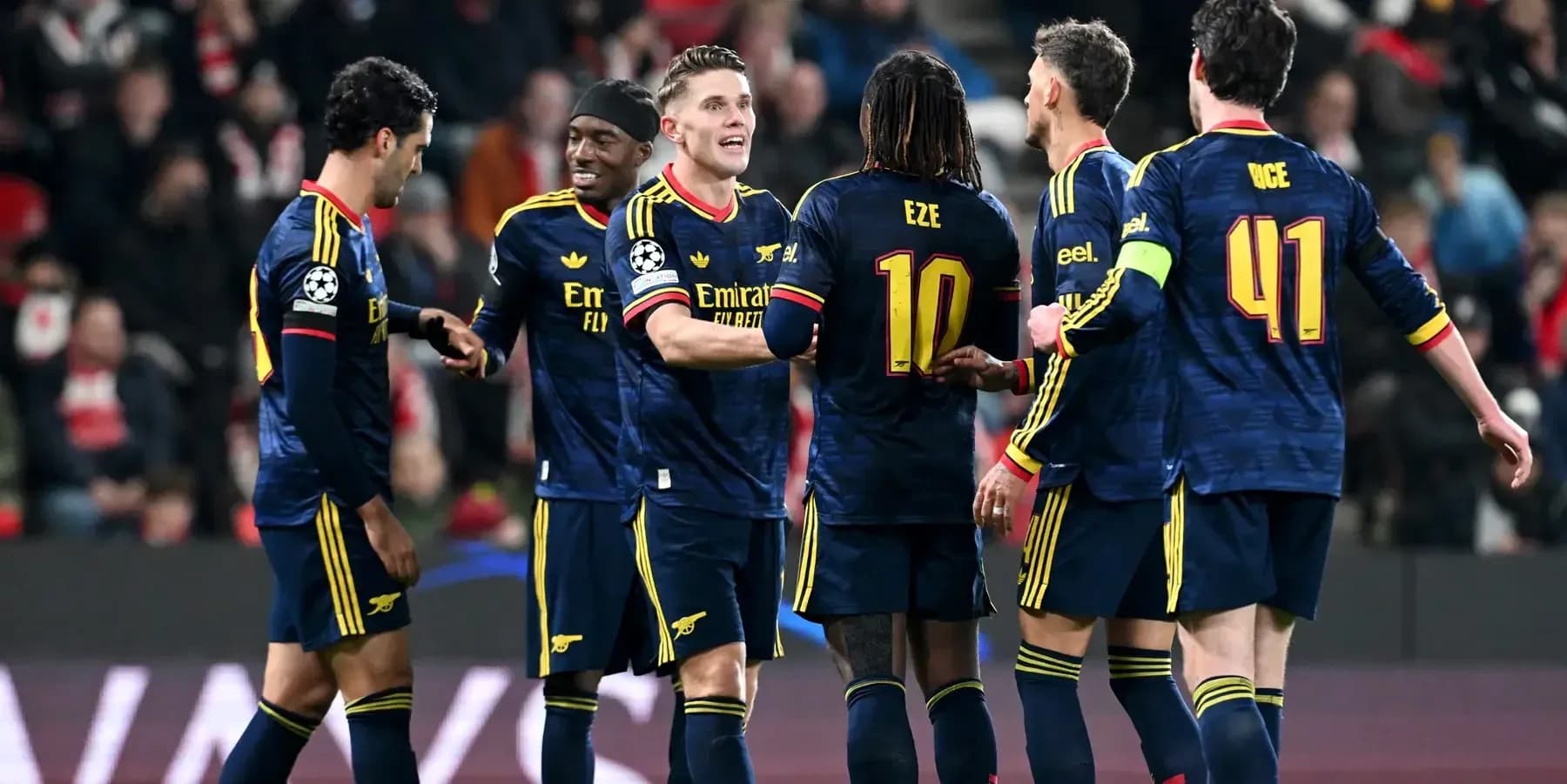
If Slavia’s selection was shaped by necessity, Arsenal’s was defined by choice. Even without B. Saka, ruled out by a thigh injury, Mikel Arteta could field a starting XI that looked more like a late-stage knockout side than a group-phase experiment. Arsenal’s overall record in the competition — 8 goals scored and 3 conceded, a goal difference of +5, unbeaten with 3 wins and 1 draw — underpinned the confidence in another 4-2-3-1.
At the base, M. Zubimendi and D. Rice formed a double pivot that blended positional discipline with range. Zubimendi anchored, shuttling across the central channel to offer constant passing angles to the back four, while Rice could surge forward when space opened, turning Arsenal’s structure into a 4-3-3 in possession. Behind them, the defensive line of B. White, E. Konsa, Gabriel and P. Hincapie was built to both defend and initiate: White and Hincapie stepping high and wide to stretch Slavia’s first line, Konsa and Gabriel comfortable holding a high block against Nowak.
The attacking band was where Arsenal’s superiority truly told. N. Madueke, M. Merino and E. Eze offered three different types of threat between the lines: Madueke as the direct dribbler who could attack Kubiak one-on-one; Merino as the late-arriving midfielder who could exploit gaps around Moses and Sadilek; and Eze as the free spirit, floating into pockets where Slavia’s zonal responsibilities blurred. Ahead of them, V. Gyokeres served as the reference point, constantly dragging Zima and Holes into uncomfortable decisions — step out and leave space behind, or drop off and allow Arsenal’s midfielders time to turn.
Arsenal’s season data framed the tactical battle with clinical clarity. Overall, they had averaged 2.0 goals scored per match, with 1.7 on their travels, while conceding just 0.8 per game in total and 1.0 away. Their attacking profile showed a pronounced second-half surge: 50.00% of their Champions League goals had arrived between 61 and 75 minutes, with another 12.50% in the final 15. That late-game wave matched ominously with Slavia’s discipline curve; the Czech side’s yellow cards were evenly spread, but their single red card this campaign had come in the 46–60 minute window, a sign of how stress can spike just after half-time.
It is here that the “Hunter vs Shield” dynamic crystallised. Arsenal’s hunter was not a single name but a structure: Gyokeres occupying centre-backs, Madueke and Eze attacking full-backs, and Merino ghosting into the box. Against a Slavia defence conceding an overall average of 2.3 goals per game and 2.5 at home, this multi-pronged threat was always likely to carve chances. On the other side, Slavia’s shield was collective rather than individual — Moses and Sadilek tracking runners, Zima and Holes trying to hold their line under constant movement.
The “Engine Room” duel was just as decisive. Zubimendi and Rice against Moses and Sadilek was a mismatch on paper: Arsenal’s pair used to dictating tempo at this level, Slavia’s duo more often scrambling to close gaps. Every time Rice stepped past the first press or Zubimendi switched play to a full-back, Slavia’s midfield was forced to turn and sprint towards its own goal. That cumulative fatigue is precisely what Arsenal’s scoring distribution exploits; the 61–75 minute surge is not an accident but the product of repeated structural stress.
Discipline and depth added further weight to Arsenal’s edge. They had yet to receive a red card in the competition, while Slavia’s campaign already included a dismissal for young defender M. Konecny — a reminder that when the tempo rises, their margin for error shrinks. From the bench, Arteta could call on J. Timber, W. Saliba, R. Calafiori, M. Odegaard, Bruno Guimaraes, K. Havertz and C. Tzolis, each capable of sustaining or even increasing the intensity. Trpisovsky’s options, by contrast, leaned on youth and squad players: M. Konecny himself, L. Provod, T. Diakite, M. Chytil and M. Kotrba, more suited to changing energy than changing the game’s level.
Statistically, the prognosis before a ball was kicked pointed where the final scoreline eventually landed. Arsenal’s blend of controlled aggression, late-game scoring spikes and defensive solidity against a Slavia side conceding heavily and still searching for its first win made an away victory the likeliest outcome. The 2–1 result in Prague did not just confirm form; it illustrated the gap between a team building towards the 1/8 final and one discovering, in real time, what this competition demands.