Atlético Madrid's Trust Issues with VAR After Controversial Matches
The tension inside the Wanda Metropolitano is no longer just about missed chances or dropped points. It is about trust.
After a bruising week in which Atlético Madrid again felt decisions went against them in high‑profile clashes with Real Madrid and Barcelona, the club’s anger has hardened into something more serious: open suspicion of how the VAR system is being used in Spain.
Flashpoint against Barcelona
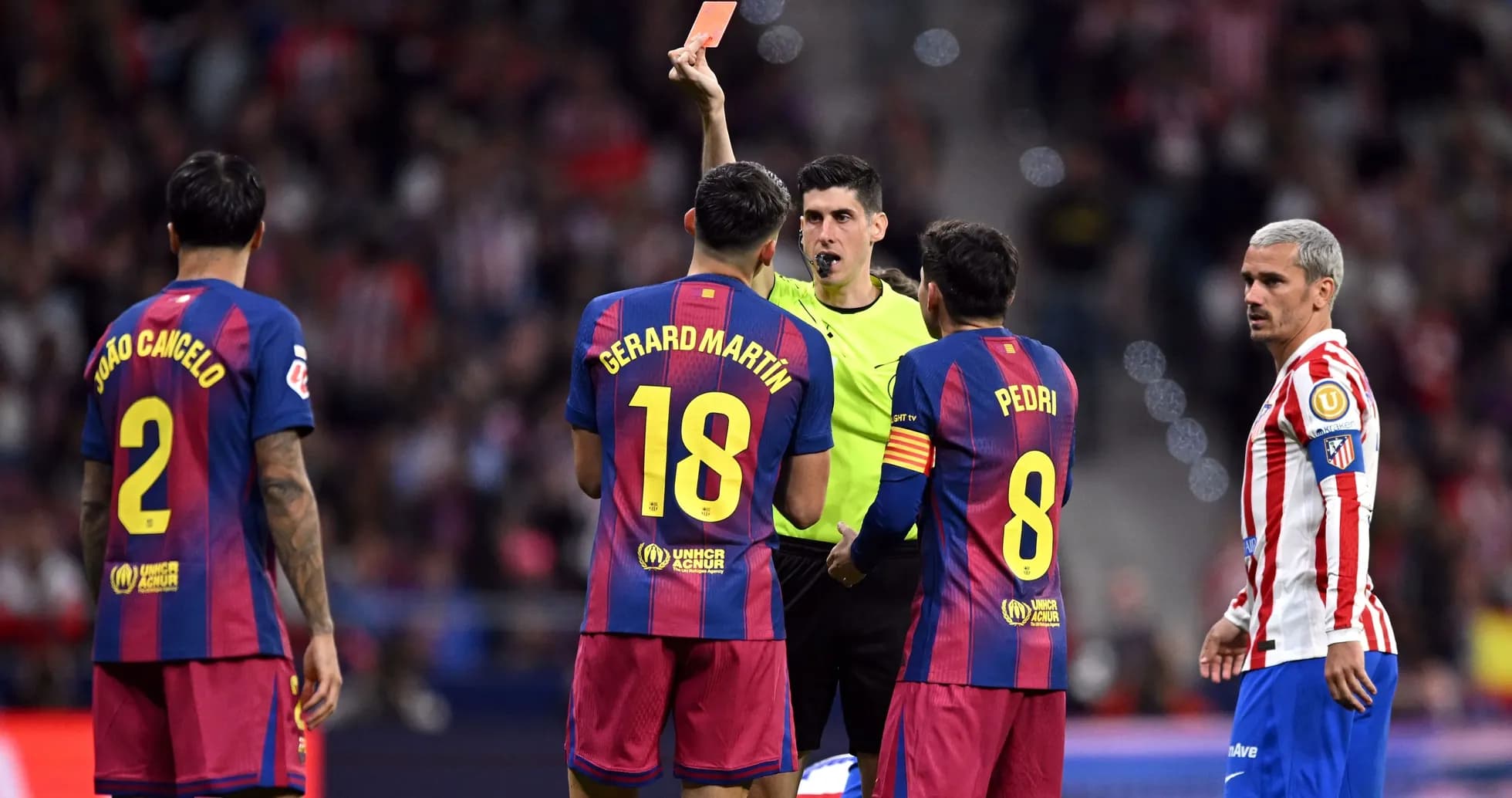
The latest storm centres on an incident in Atlético’s 2-1 defeat to Barcelona on Saturday. With the game finely poised, Barça defender Gerard Martin flew into a high challenge on Thiago Almada. Referee Busquets Ferrer went straight to his pocket and showed a red card.
Then the screens lit up.
From the VAR room, Melero López advised a review. After a long check and a trip to the monitor, the red became yellow. Barcelona stayed with eleven men. Atlético’s players surrounded the referee in disbelief; the stands erupted. By full time, with the points gone, the sense of injustice had boiled over.
Inside the club, that moment has become a symbol of something deeper.
Marin: “We can only feel ashamed”
Atlético chief executive Miguel Ángel Gil Marín did not soften his words when reacting to the Federation’s release of the VAR audio from the incident. For him, the recording did not bring transparency. It confirmed his worst fears.
“When we see the images and hear the audio shared by the Federation, all we can do is feel ashamed,” Marín said, as quoted by Marca. “It’s unacceptable that they let us hear their comments, which are completely contrary to how VAR should function correctly, and nothing happens.”
He drew a sharp line between human error and what he views as interference.
“Referees have the same right to make mistakes as players, coaches, and managers, but mistakes in the game are just that: mistakes. It’s another thing entirely when a referee in the VAR booth influences the main referee when he’s judging a play.”
That, in Marín’s eyes, is the heart of the problem. VAR, a tool designed to correct “clear and obvious” errors, is now — he argues — steering the match, not quietly correcting it from the background.
“The on-field referee must be responsible and make decisions by interpreting the intentions of each player,” he continued. “VAR should only intervene to correct uninterpretable errors, not to decide in place of the main referee.”
“Different decisions for identical plays”
The frustration at Atlético does not come from one isolated call. It comes from what they see as a pattern, and from a lack of consistent criteria.
“It’s not normal that different decisions are made for identical plays, that the criteria change, and that we don’t know what to expect,” Marín said. “It’s happened to us in the last two matchdays. It makes no sense.”
That reference cuts to the core of La Liga’s current refereeing debate. The same type of challenge, in different games, appears to be judged in different ways. For a club fighting on multiple fronts, those margins matter. When they arrive in consecutive matches against Real Madrid and Barcelona, the sense of grievance only intensifies.
Inside the Wanda Metropolitano, every replay of Martin’s tackle on Almada now carries a second image: the Betis–Rayo Vallecano clash, and a similar incident that did end in a red card.
Le Normand: “Everyone who understands football knows it was”
In the dressing room, the players feel it just as strongly. Robin Le Normand did not hide his anger when he faced the microphones after the defeat.
“Now they’re going to say it wasn’t a red card, but everyone who understands football knows it was,” he said. “If I did that, it would almost certainly be a red. We saw it recently in the Betis–Rayo Vallecano match, and the CTA (Technical Committee of Referees) ruled it a red. I don’t know what happened today with the same action. He reviews it and sees it’s dangerous. I don’t understand it either.”
The defender also painted a picture of a game where dialogue with the officials felt impossible.
“Today, you couldn’t talk to anyone, not even the captain,” he added. “Every time something happened, he handed out a yellow card and raised the bar for the game instead of lowering it. Everyone can make mistakes, and today I think he made one. Everyone saw it. Today, it was the little things that affected the game. It was the little things that hurt us.”
Those “little things” — the cards, the tone, the feeling that every protest would be punished — stacked up alongside the big call on Martin. Together, they left Atlético convinced they were climbing a steeper hill than Barcelona.
A question of authority
Strip away the emotion and a clear theme remains: who truly controls a match in Spain now? The referee on the pitch, or the officials in the VAR booth?
Marín’s comments go beyond a single controversy. He is challenging the structure, the hierarchy, and the philosophy behind VAR in La Liga. For Atlético, the audio released by the Federation did not calm the waters. It suggested, in their view, that VAR is shaping decisions instead of merely correcting the rare, glaring mistake.
At a club where every point is weighed against Champions League qualification, title races, and reputations built over years, that is not a marginal concern. It is existential.
The Wanda Metropolitano will move on to the next fixture, as it always does. The question now is whether the trust between Atlético, the referees, and the VAR room can move with it.