Barcelona Triumphs Over Levante in High-Scoring Clash
Under the hard September light at Estadio Ciudad de Valencia, Levante and Barcelona stepped into a Round 5 contest that felt less like an early‑season skirmish and more like a stress test of identities. The scoreboard’s 4–2 final in Barcelona’s favour told one story; the squads, their structures, and the way they bent – but did not break – told another.
I. The Big Picture: Styles Colliding
Heading into this game, the table framed the duel starkly. Levante sat 13th in La Liga with 5 points from 5 matches, their overall goal difference at -2, with 7 goals scored and 9 conceded. At home, though, they had been wild and open: 2 matches, 1 win and 1 loss, 7 goals for and 6 against, averaging 3.5 goals scored and 3.0 conceded per home game. This is a side that turns the Ciudad de Valencia into a chaos lab.
Barcelona arrived as the league’s early juggernaut. Top of the table with 15 points from 5 matches, they had won every outing, scoring 21 and conceding just 4 overall – a towering goal difference of +17. On their travels, they were even more ruthless: 3 away wins from 3, 14 goals scored and only 2 conceded, averaging 4.7 goals for and 0.7 against per away match. It is the profile of a team that not only wins, but suffocates.
Luis Castro’s Levante lined up in a 4‑4‑2, a clear statement that they would not simply absorb. M. Ryan anchored the side in goal behind a back four of J. Toljan, Dela, A. Mandi and M. Sanchez. In midfield, V. Garcia and R. Brugue worked the flanks, with H. Sotelo and J. A. Olasagasti inside, while D. Requena and P. Ratkov formed a two‑man strike force. Across from them, Hansi Flick kept faith with Barcelona’s 4‑3‑3: J. Garcia in goal; a back line of E. Garcia, P. Cubarsi, G. Martin and X. Espart; a midfield trio of Fermín, Rodri and Pedri; and a front three of Lamine Yamal, Raphinha and A. Gordon.
II. Tactical Voids: Absences and Discipline
Both coaches had to navigate notable absences. Levante were without K. Etta Eyong and A. Primo, both ruled out through injury. Their absence thinned Castro’s rotational options and pushed even more responsibility onto the starting midfield four, particularly Sotelo and Olasagasti in the central lanes.
Barcelona’s midfield was also compromised. F. de Jong, their most natural tempo‑setter from deep, missed out with a knee injury, while R. Bardghji was another attacking option unavailable. Flick responded by leaning into youth and dynamism: Fermín’s box‑to‑box energy, Rodri’s verticality, and Pedri’s orchestration between the lines.
Disciplinary trends added another layer. Levante’s yellow cards this season have been spread across the middle and late phases of games: 20.00% of their cautions in each of the 31–45, 46–60, 61–75, 76–90 and 91–105 minute windows. It paints the picture of a side that grows increasingly stretched and reactive as matches open up. Barcelona’s bookings, by contrast, are concentrated in the heart of the second half: 60.00% of their yellows arriving between 46–60 minutes, with another 20.00% between 16–30. Flick’s side tends to tackle aggressively just after the restart, when they press hardest to kill games.
III. Key Matchups: Hunter vs Shield, Engine Room vs Enforcer
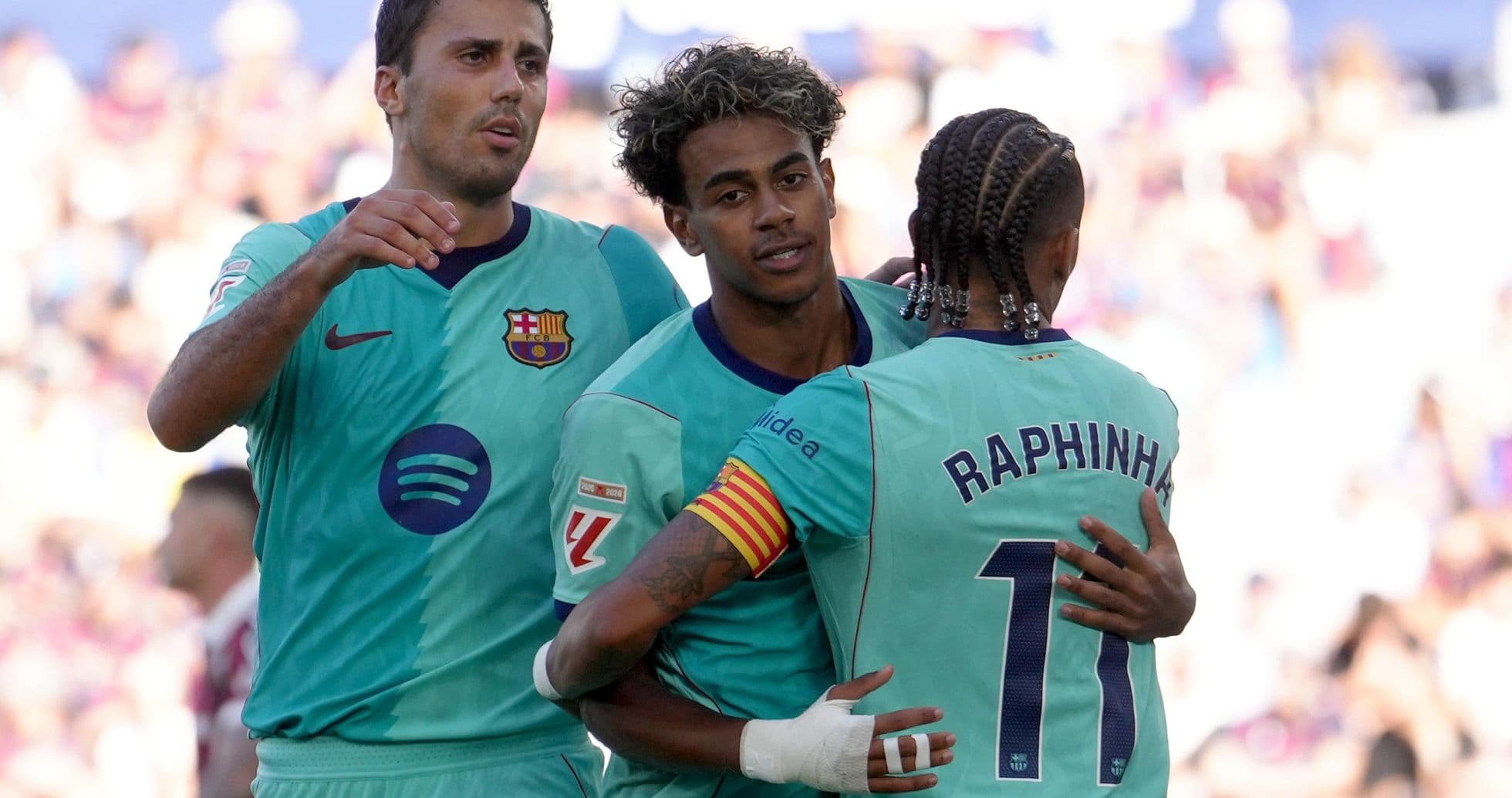
The most compelling individual duel was always going to be on Barcelona’s right. Raphinha came into the fixture as one of La Liga’s deadliest attackers: 6 goals and 3 assists in 5 league appearances, with 11 shots (9 on target) and 13 key passes. His blend of end product and creativity is elite, and he has already converted 1 penalty from 1, underlining his composure from the spot.
Facing him was Levante’s left‑side defensive pairing of M. Sanchez and the left‑sided centre‑back Dela. Levante’s defensive record at home – 6 goals conceded in 2 matches, an average of 3.0 per game – suggested that this flank would be under siege. The “hunter vs shield” dynamic tilted heavily towards the Brazilian, and the 4–2 scoreline confirms that Levante’s back line was stretched repeatedly.
On the opposite side, Levante’s own attacking spearhead came from midfield. R. Brugue – listed among the league’s top scorers with 3 goals from 4 appearances – is more than a wide runner. He arrived at this fixture with 11 shots (5 on target), 40 duels contested and 6 successful tackles, a hybrid of creator, presser and finisher. His battle with Barcelona’s right‑back E. Garcia and the covering of P. Cubarsi was central to Levante’s hope of turning transitions into real damage.
In the engine room, Fermín embodied Barcelona’s new‑look midfield. With 4 goals and 2 assists in 5 appearances, 184 completed passes at 84% accuracy, plus 6 tackles and 1 blocked shot, he is both conductor and disruptor. His opposite numbers, Sotelo and Olasagasti, had to balance screening duties with the need to release Requena and Ratkov quickly into the channels behind Barcelona’s high line. Without a natural destroyer in Levante’s central two, Fermín and Pedri were often able to step into pockets between the lines, forcing Levante’s back four to compress and opening space wide for Lamine Yamal and Raphinha.
On Barcelona’s left, A. Gordon arrived as La Liga’s leading assist provider, with 4 assists in 5 matches and 7 key passes at a 90% pass accuracy. His partnership with Lamine Yamal drifting inside and Rodri surging from midfield created constant overloads against J. Toljan and V. Garcia. For Levante, the wide midfielder’s defensive work rate was critical; any lapse left Toljan isolated in two‑versus‑one situations.
IV. Statistical Prognosis and Tactical Verdict
The numbers heading into this match pointed towards a high‑event, attack‑heavy contest – and the 4–2 final confirmed it. Levante’s overall scoring rate of 1.4 goals per game, combined with Barcelona’s overall 4.2, made a multi‑goal game almost inevitable, especially given Levante’s openness at home and Barcelona’s ferocity away.
Defensively, the contrast was stark. Levante’s overall average of 1.8 goals conceded per match, against a Barcelona attack that had already hit 14 goals on their travels, suggested that Castro’s 4‑4‑2 would be under near‑constant strain. Barcelona’s defensive record – just 4 goals conceded overall, 2 of those away – indicated that even if Levante did land punches, they would have to do so with ruthless efficiency.
In the end, Levante’s bravery in sticking with a front two and an adventurous midfield earned them two goals but left their back four exposed to the full force of Barcelona’s front line and surging midfield. Flick’s 4‑3‑3, powered by Raphinha’s finishing, Lamine Yamal’s directness, Gordon’s service and Fermín’s all‑court influence, imposed its will over 90 minutes.
Following this result, the squads walk away clearly defined: Levante as an entertaining, high‑variance home side still searching for defensive balance; Barcelona as a relentless, structurally coherent machine whose squad depth and attacking stars are already bending the season to their will.