Barcelona Dominates Rayo Vallecano 5-2 in La Liga Showdown
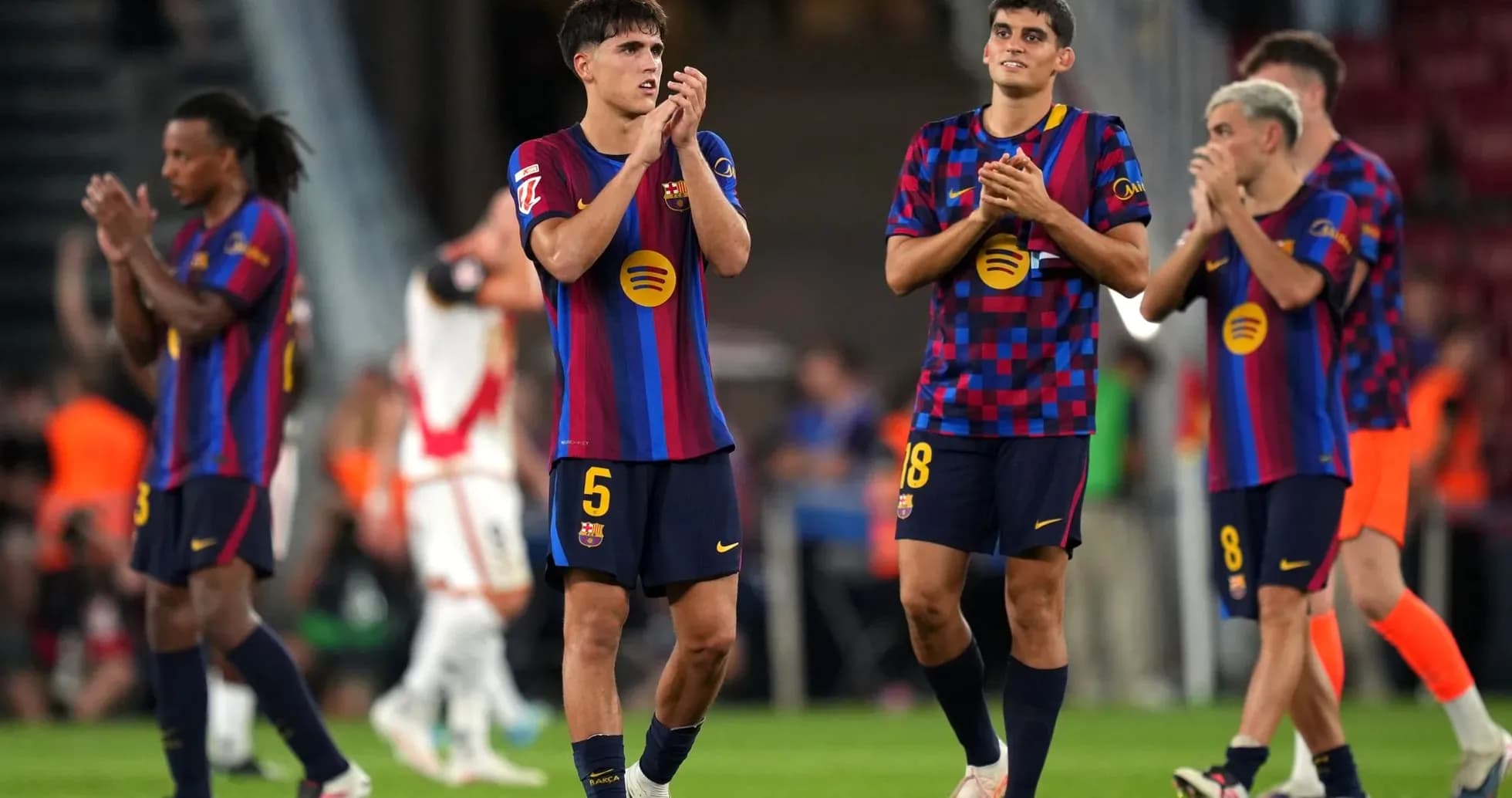
The Camp Nou lights had barely dimmed when the numbers began to tell their own story. Barcelona’s 5-2 dismantling of Rayo Vallecano in Regular Season - 3 was not just three points; it was a statement of early-season identity from a side already shaping La Liga in its image.
I. The Big Picture – A table-topping machine versus a team in turbulence
Following this result, Barcelona sit top of La Liga with 9 points from 3 matches, perfect in both record and rhythm. Overall this campaign they have scored 12 goals and conceded 2; the goal difference of 10 underlines a side that is not merely winning but overwhelming. At home, the Camp Nou has already become a scoring ground: 7 goals for and 2 against in 2 league outings, an average of 3.5 goals scored and 1.0 conceded per home match.
Rayo Vallecano, by contrast, leave Barcelona with their vulnerabilities exposed. They stand 18th with just 1 point from 3 matches. Overall this campaign they have scored 4 and conceded 8, a goal difference of -4 that encapsulates their struggle to keep games under control. On their travels, the numbers are even harsher: 2 away fixtures, 2 defeats, 3 goals scored but 7 conceded, an away defensive average of 3.5 goals allowed per match.
Both sides lined up in a 4-2-3-1, but what followed showed how the same structure can house very different footballing ideas.
II. Tactical Voids – Absences and fault lines
Barcelona’s dominance came despite a notable absentee list. R. Bardghji and M. Casado were unavailable by coach’s decision and knee injury respectively, but it was the absence of F. de Jong and Gavi, both sidelined with knee injuries, that could have reshaped the midfield dynamic. D. Livakovic was also missing, listed as inactive, forcing Hansi Flick to lean fully into J. Garcia as his starting goalkeeper and to trust the double pivot of M. Bernal and Pedri.
The response was telling: Bernal and Pedri anchored the structure, allowing the attacking four of Lamine Yamal, D. Olmo, A. Gordon and Raphinha to play with aggressive verticality. The 4-2-3-1, which Barcelona have already used twice this season, looked like the settled blueprint.
Rayo’s problems were different and more structural. Missing A. Batalla, M. Kumbulla, Luiz Felipe and I. Palazon stripped Benat San Jose of defensive depth and creative spark. With two centre-backs out, the back line leaned heavily on F. Lejeune and P. Ciss, with J. Vertrouwd and I. Balliu as full-backs. It was a back four that never quite found its distances once Barcelona’s wide overloads began.
Discipline also framed the match in narrative terms. Barcelona’s season card profile is remarkably clean: only one yellow card overall, and that coming between minutes 16-30, with no reds. Rayo, however, carry a different pattern. Overall this campaign, 3 yellow cards have arrived between minutes 61-75 (50.00% of their total), 2 between 76-90 (33.33%), and 1 in stoppage time between 91-105 (16.67%). This late-game accumulation of bookings hints at a team that increasingly defends on the edge as matches slip away – a trait that was visible again as Barcelona turned the screw after the break.
III. Key Matchups – Hunter vs Shield, Engine Room battles
The headline duel was always going to be Raphinha against Rayo’s back line. As La Liga’s top-rated attacker so far, Raphinha came into this fixture with 5 goals and 1 assist in 3 appearances, from just 8 shots (7 on target). His blend of efficiency and volume, paired with 9 key passes and 90% passing accuracy, makes him both finisher and creator. Against a Rayo side conceding an overall average of 2.7 goals per match, and 3.5 on their travels, the matchup was lopsided before a ball was kicked.
Flanking him, Lamine Yamal added another layer of menace. With 2 goals, 13 key passes and 18 dribble attempts (11 successful) in 3 games, he offers a constant 1v1 threat. Rayo’s full-backs, particularly J. Vertrouwd on the left and I. Balliu on the right, were tasked with containing two elite isolation wingers while also tracking the underlapping runs of A. Gordon and the advanced positioning of X. Espart.
Espart, quietly one of Barcelona’s most important structural players, again showed why he sits high in the assist charts with 2 assists already this season. Across 270 minutes he has completed 156 passes at 86% accuracy, with 4 key passes, 8 tackles and 5 interceptions. His presence at left-back allowed Gordon to stay higher and narrower, creating a quasi-front three with Raphinha and the central striker slot, while still maintaining defensive security.
In the middle, Pedri and Bernal formed the engine room. Pedri’s role as tempo-setter freed D. Olmo to drift between lines, linking with Raphinha and Lamine Yamal. For Rayo, O. Valentin and G. Bouare had to screen this carousel while also tracking late runs from the second line – a task made more complex by the need to double up on the wings.
Up front, S. Camello arrived as Rayo’s spearhead and one of the league’s early standouts: 3 goals from 5 shots (4 on target), supported by 6 fouls drawn and a willingness to battle in 28 duels. Yet he was often isolated, feeding on transitions rather than sustained possession. When Rayo did manage to break, the combination of Camello and A. Garcia – who has 1 goal, 1 assist and 4 tackles this season – offered glimpses of danger, but too infrequently to tilt the momentum.
IV. Statistical Prognosis – Why this result fits the underlying trend
Barcelona’s season numbers make this 5-2 feel less like an outlier and more like the logical extension of their early form. Overall this campaign they average 4.0 goals scored per match and concede just 0.7. They have yet to fail to score, and already have 2 clean sheets from 3 fixtures. Their biggest wins – 5-2 at home and 5-0 away – show a side capable of both volume and control.
Rayo’s profile points in the opposite direction. Overall this campaign they average 1.3 goals scored but 2.7 conceded. They have no clean sheets and have already suffered a heaviest defeat of 5-2 on their travels. Their late-game yellow-card surge, combined with a porous away defence, suggests a team that is forced into desperate defending once the game state turns against them.
Even without explicit xG data, the shot, chance creation and scoring patterns of key individuals are clear indicators. Raphinha’s 7 shots on target from 8 attempts, Lamine Yamal’s 13 key passes, Gordon’s 3 assists, and Espart’s dual role as creator and stopper all point toward a Barcelona side whose attacking process is repeatable and sustainable. Their penalty record – 1 taken, 1 scored, 0 missed – reinforces an efficiency that extends to set-piece moments.
Rayo, for their part, have a genuine weapon in Camello and a hardworking wide threat in A. Garcia, but their defensive structure on the road is not yet robust enough to withstand an elite, multi-lane attack like Barcelona’s.
Following this result, the tactical verdict is stark. Barcelona look every inch a Champions League league stage contender in waiting, with a clear identity built on an aggressive 4-2-3-1, wide overloads and high technical quality. Rayo Vallecano, meanwhile, must repair their away defensive scheme and reduce their late-game disciplinary strain if they are to climb away from relegation trouble. At Camp Nou, the gap between the two was not just on the scoreboard; it was written across every phase of play.