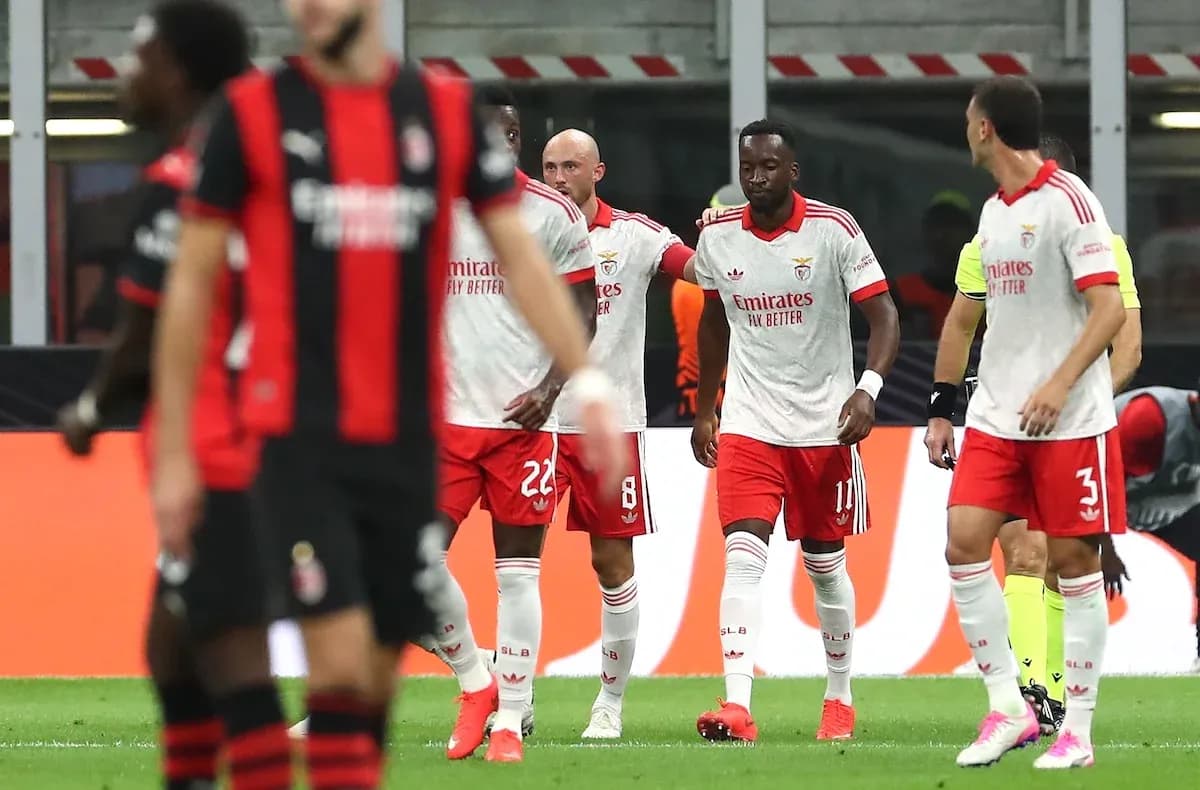
Benfica vs Celtic: UEFA Europa League Clash Preview
On 15 October 2026, under the Lisbon lights, Benfica welcome Celtic in a UEFA Europa League night that already feels bigger than a routine “League Stage - 2” fixture. The venue name is not yet confirmed, but wherever the match is finally staged in Lisbon, the stakes are clear: for Benfica, it is a chance to turn continental momentum into an early statement; for Celtic, it is the true beginning of their campaign, a first real test on foreign soil with European credibility on the line.
Season Context
Benfica arrive in the Europa League ranked 4th in the overall “League Round” table with 0 points from 0 matches so far, but that bare line hides a side in excellent continental rhythm. Their official record in this phase is still a blank canvas (0 played, 0 goals scored, 0 conceded), yet their broader Europa League body of work this year shows a team used to winning and scoring heavily.
Celtic sit 9th in the same League Round, also on 0 points from 0 matches. The Scottish champions are marked with a “Play Offs” description, underlining expectations that they should at least be in the mix for the knockout picture. For now, though, their Europa League numbers are a clean sheet in the statistical sense: 0 games, 0 goals for, 0 against, and everything still to prove.
Form & Momentum
Benfica’s recent continental form is powerful and polished, encapsulated by the sequence “WWDWW” in their Europa League record. That run has been built over 6 matches, in which they have scored 19 goals and conceded just 6, an average of 3.2 goals scored and 1.0 conceded per game. Such attacking productivity (19 goals in 6 matches) justifies calling them one of the competition’s most dangerous forward units so far, while a defence that allows only 1 goal per match on average underlines a controlled, rather than reckless, approach.
For Celtic, there is no form string yet in the Europa League standings and no statistical footprint in the current campaign (0 played, 0 scored, 0 conceded). That makes them something of an unknown quantity at this level in 2026: neither in crisis nor in form, simply untested in this specific competition context.
Head-to-Head Patterns
History between these two clubs in Europe hints at a finely balanced rivalry with a slight Portuguese tilt. The most recent meeting came in a UEFA Champions League group game that finished 2-1 in favour of Benfica (UEFA Champions League, season 2012, November 2012). That night in Lisbon, the hosts found a way to edge a tight contest and protect home advantage.
Earlier that same Champions League campaign, the sides had cancelled each other out in Glasgow in a 0-0 draw (UEFA Champions League, season 2012, September 2012). It was a night defined by organisation and caution, with neither attack able to break through. Those two results, both in 2012, are the only competitive meetings in the supplied data, and together they suggest that while Benfica have previously found a winning formula at home, Celtic know how to keep the tie close.
Tactical Preview
Benfica’s tactical identity in this Europa League run has been clear: a front-foot, possession-oriented side that leans on a 4-2-3-1 as its primary structure (used in 3 matches), with a 4-1-3-2 as a flexible alternative (2 matches). Across 6 Europa League fixtures in the wider sample, they have produced 19 goals and conceded only 6, figures that match the attacking and defensive profiles suggested by their formations. The double pivot in 4-2-3-1 provides stability for creative midfielders like Rafa and H. Sudakov to link with a prolific spearhead in V. Pavlidis, who has already scored 5 goals and supplied 1 assist in this competition. Wide threats such as D. Lukebakio, J. Kamiński and G. Prestianni add pace and 1v1 quality, while defenders like C. Lenglet and Tomás Araújo have even contributed goals, highlighting Benfica’s set-piece and second-line danger.
Celtic, by contrast, arrive without any Europa League statistical record in 2026, but their squad list points towards a side built on a strong defensive core and energetic wide play. Centre-backs such as C. Carter-Vickers, L. Scales and A. Trusty form a robust spine, while full-backs like A. Johnston and K. Tierney offer overlapping width. In midfield, the presence of C. McGregor and A. Oxlade-Chamberlain suggests a blend of control and forward running, with options like Yang Hyun-Jun and O. Sørensen to stretch the game. Up front, K. Høgh and B. Nygren give Celtic penalty-box presence and mobility. Without hard Europa League numbers yet, the tactical expectation is that Celtic will initially prioritise compactness and transitions, trying to absorb Benfica’s pressure and exploit any space left by the hosts’ adventurous full-backs.
Statistical Snapshot
- Competition: UEFA Europa League, season 2026 — 15 October 2026.
- Venue: null, Lisbon.
- Prediction: null — Winner : Benfica.
- Win Probabilities: Home 50% / Draw 50% / Away 0%.
- Model: Benfica 73.5 — Celtic 26.5.
Betting Verdict
The prediction model leans clearly towards Benfica, with a total comparison index of 73.5 against Celtic’s 26.5, and the advice explicitly pointing to “Winner : Benfica”. That stance is grounded in Benfica’s excellent Europa League form (WWDWW, 19 goals scored and 6 conceded over 6 matches) and the fact that they have previously beaten Celtic 2-1 at home in European competition. Celtic’s lack of current Europa League data, combined with a 0% rating across their last-five indices in the model, reinforces the sense that they are stepping into a difficult away assignment. With the probabilities split at 50% home, 50% draw and 0% away, the analytical case favours backing Benfica on the outright result, perhaps with a degree of caution around the draw given Celtic’s history of keeping this matchup tight, as seen in the 0-0 stalemate in Glasgow in September 2012.