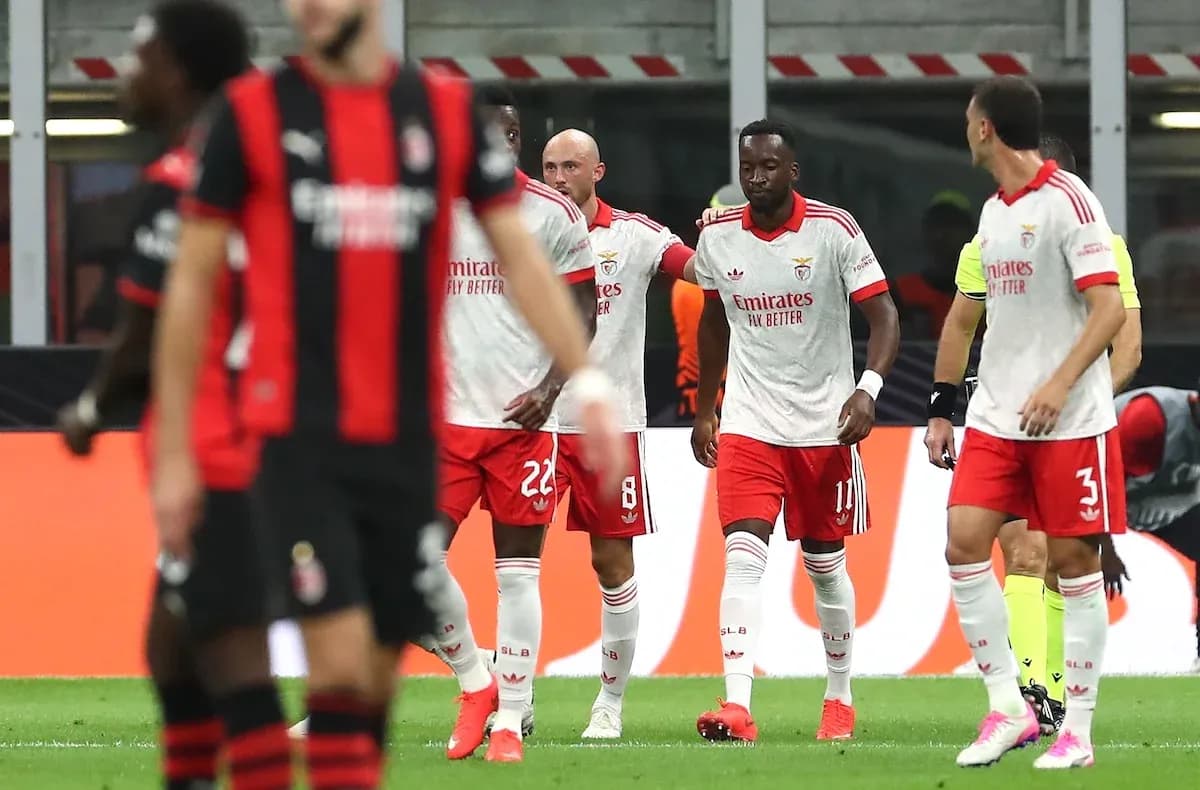
Benfica Dominates Hearts 6-1 in UEFA Qualifying Match
Benfica’s 6-1 dismantling of Heart Of Midlothian at Estádio da Luz was the product of a clear structural superiority and ruthless exploitation of territory. Marco Silva’s 4-2-3-1 dominated the ball (67% possession) and, more importantly, controlled where it was played, hemming Hearts into their own half and forcing a reactive 4-4-2 into a low block that never settled. The statistical gap in attacking output – 11 shots on goal to 2, with an additional 5 Benfica efforts blocked to Hearts’ 3 – underlined a game in which the Portuguese side repeatedly created clean shooting lanes while limiting the visitors to sporadic, low-volume counters.
From the outset, Benfica’s positional play around the double pivot of L. Barreiro and E. Barrenechea (before his substitution) set the tone. Barreiro, in particular, was influential between the lines, stepping forward from the base of midfield to connect with Rafa Silva, G. Sudakov and G. Prestianni. The early opener at 3' from Rafa Silva, assisted by Barreiro, was a direct expression of this structure: Benfica advanced quickly through the central lane, with the No. 18 finding the attacking midfielder in a pocket that Hearts’ midfield four failed to close. That sequence revealed a recurring theme – Hearts’ central pair could not track vertical runs while also screening passes into the half-spaces.
Benfica’s back four were aggressive in their rest defence, enabling sustained pressure. Full-backs A. Bah and S. Dahl pushed high and wide, pinning Hearts’ wingers C. Miller and A. Kyziridis deep. This allowed Sudakov and Prestianni to drift inside as auxiliary No. 10s, overloading the half-spaces around L. Mendy and Blair Spittal. With Hearts’ forwards C. Braga and P. Kabore often isolated and forced to defend in their own half, any attempted counter was immediately challenged by centre-backs T. Araujo and C. Lenglet stepping into midfield. Araujo’s goal at 23', assisted by Sudakov, came from this territorial advantage: a defender free to attack the box because Hearts were pinned and unable to clear their lines.
Hearts’ 4-4-2 was designed to be compact, but their distances were consistently stretched by Benfica’s width and rotations. The visitors committed 12 fouls – the same as Benfica – yet their yellow-card count (4 to Benfica’s 2) reflected how often they were late into challenges and forced into emergency defending. With only 33% of the ball and just 2 shots on goal, Wouter Vrancken’s side rarely progressed cleanly through midfield. The front two were starved, and when Hearts did break, they lacked the numbers to sustain attacks, typically running into a red wall of four or five Benfica players behind the ball.
The penalty converted by V. Pavlidis at 42' for 3-0 effectively ended the contest before half-time, but tactically it highlighted another Benfica strength: constant presence in the box. Pavlidis’ movement across the Hearts centre-backs dragged the line deeper, opening channels for late runs from Rafa Silva and Sudakov. Even when Benfica attacks did not immediately result in shots, the cumulative pressure forced Hearts’ defenders into risky challenges in the area and on the edge of the box.
At 4-0, via Prestianni’s goal on 59', Benfica were able to rotate without losing control. The triple change at 65' – J. Duran for Pavlidis, R. Rios for Barrenechea, and A. Schjelderup for Sudakov – subtly reconfigured the attack but maintained the same principles. Duran offered more direct running in behind, Schjelderup brought fresh creativity between the lines, and Rios ensured the double pivot’s defensive balance remained intact. The fact that Benfica continued to generate high-quality chances late on, with Duran scoring at 87' and Schjelderup adding a second penalty at 90', showed that the system, not just the initial personnel, was overwhelming Hearts.
Hearts’ substitutions were largely reactive attempts to stem the tide or inject energy. The double change at 46' – J. McCart for H. Milne and T. Renaud for L. Mendy – aimed to stabilise the left side and freshen central midfield, but it did not significantly alter the pattern of play. Renaud’s goal at 72', assisted by S. Guendouz, was more a product of a rare moment when Benfica’s back line relaxed with a four-goal cushion than of any sustained tactical shift. Later introductions of J. McPake for C. Miller and S. Kerjota for A. Kyziridis marginally improved Hearts’ ball-carrying options, yet the team remained structurally second best.
Defensively, Benfica’s aggression occasionally tipped over, as shown by yellow cards for G. Prestianni and Alexander Bah, but these incidents did not disrupt their control. Hearts’ bookings for Laurent Mendy, Blair Spittal, Oisin McEntee and Cláudio Braga, by contrast, reflected mounting frustration and strain in repeatedly defending deep. Despite both sides finishing with 12 fouls, Benfica’s fouling profile was mostly in advanced areas, preventing transitions, whereas Hearts’ came in and around their own defensive third.
Statistically, the match painted a clear picture of dominance. Benfica’s 11 shots on goal and 5 blocked efforts indicate a constant threat, while Hearts’ 2 shots on goal and 3 blocked shots underline their limited attacking presence. The 67%-33% possession split was not sterile; it translated directly into territory and chance volume. Corner kicks (6-2 in Benfica’s favour) further emphasised how the home side camped in the attacking third, forcing Hearts to clear repeatedly under pressure.
Within the broader context of the UEFA Europa League 3rd Qualifying Round, this performance positions Benfica as a side with a well-drilled positional framework capable of overwhelming opponents both with and without the ball. Hearts, meanwhile, leave Lisbon having been outplayed in every major metric – possession, shots on goal, blocked shots, and disciplinary control – and will need a far more proactive and structurally compact display in any return leg to avoid a similar tactical mismatch.