Beşiktaş Dominates FC Midtjylland in UEFA Europa League
Beşiktaş’s 1-0 win over FC Midtjylland at Tüpraş Stadyumu was a textbook example of territorial and possession dominance being converted into a narrow but controlled advantage in the UEFA Europa League 2nd Qualifying Round. The home side’s 4-1-4-1 under Vincenzo Italiano pinned Midtjylland deep for long stretches, forcing the Danish side’s 4-3-3 into a low block and, after the early red card, effectively into a 4-4-1 survival shape. Despite the modest scoreline, the statistical profile – 75% possession, 28 total shots to 5, and a 606–146 edge in accurate passes – underlined how comprehensively Beşiktaş dictated the game’s structure and tempo.
The match’s tactical hinge came early. Friday Etim’s red card at 15 minutes immediately stripped Midtjylland of one of their front-line outlets and compelled Mike Tullberg to prioritise defensive integrity over any high-pressing intentions. From that point on, Beşiktaş’s single-pivot 4-1-4-1 became a platform for methodical siege rather than a balanced contest.
Out of possession, Beşiktaş’s base shape was clear: a back four of M. Murillo, T. Djalo, E. Topcu and R. Yilmaz protected by S. Ozcan as the lone holding midfielder. Ahead of him, a line of four – V. Cerny, J. Olaitan, O. Kokcu and I. Fakili – rotated between half-spaces and wide channels, with Oh Hyeon-Gyu as the nominal striker. In practice, the structure morphed into a 2-3-5 in settled attack: full-backs pushed high, Ozcan dropped between or just ahead of the centre-backs to recycle possession, and both interiors plus wingers occupied the last line.
The numbers support this picture of sustained territorial pressure. Beşiktaş attempted 685 total passes with 606 accurate, a striking accuracy combined with volume that reflects both their technical control and the lack of pressing from a 10-man Midtjylland. With 15 shots inside the box and 13 from outside, they were able to vary the point of attack, using circulation to drag the compact block from side to side before looking for shooting lanes. Five blocked shots show how often Midtjylland’s last line had to throw bodies in front of efforts, but the 16 shots off target also hint at Beşiktaş’s occasional impatience from range when central spaces were crowded.
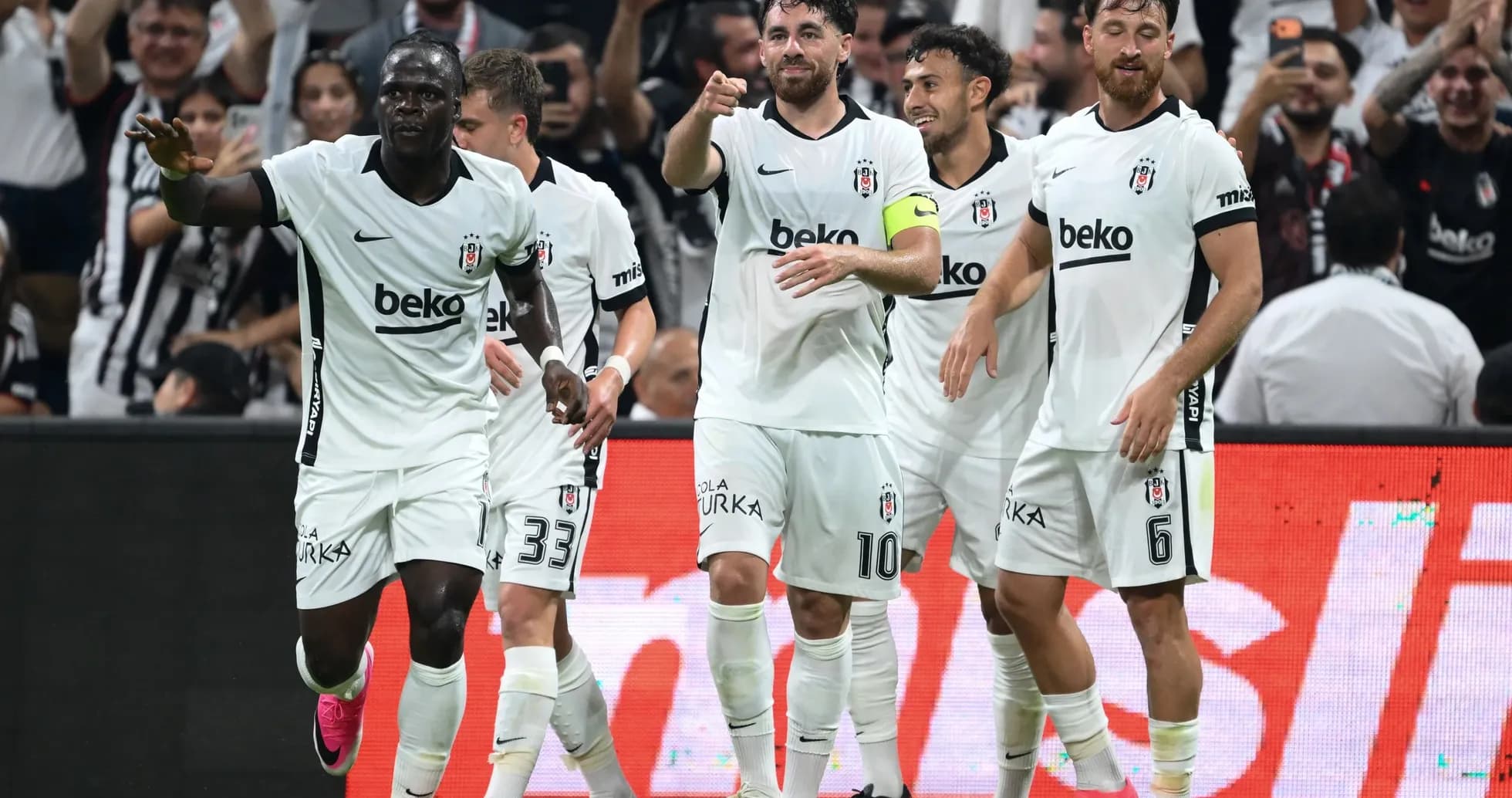
The decisive moment came in the 26th minute, and it encapsulated the home side’s positional ideas. O. Kokcu’s goal, assisted by V. Cerny, came after Beşiktaş had already established their rhythm against the reduced opposition. Cerny’s contribution from the right side of the midfield line was consistent with his role as a creative wide interior, drifting into pockets to receive and combine. Kokcu, operating between lines, exploited the vertical gap created by the stretched Midtjylland midfield. The fact that this was Beşiktaş’s only goal despite their shot volume reflects more on final-third efficiency than on chance creation, which was abundant.
Defensively, Beşiktaş were rarely stretched. They committed 12 fouls to Midtjylland’s 9, a reasonable figure given how high they defended and how often they counter-pressed after losing the ball. With only 5 total shots conceded (3 inside the box, 2 outside) and just 1 shot on goal against them, the back four plus Ozcan were largely in control of transitions. The low number of offsides (1) against Beşiktaş also indicates that they built patiently rather than constantly attacking the depth behind Midtjylland’s line.
In goal, A. Nubel (Beşiktaş) was mostly a spectator in terms of shot-stopping, officially required to make just 1 save. His role was more about sweeping and initiating build-up, taking advantage of the lack of pressure on the first line. At the other end, E. Olafsson (FC Midtjylland) had a far more demanding evening, credited with 6 saves. Given Beşiktaş’s 7 shots on goal, Olafsson’s interventions were crucial in keeping the tie alive, especially as the match wore on and the Turkish side ramped up their shot frequency.
Midtjylland’s attacking structure never fully materialised. On paper, their 4-3-3 with P. Billing, P. Bravo and V. Byskov in midfield, and D. Osorio plus the front pair Franculino and Etim, suggested a side capable of pressing and breaking quickly. The red card forced an immediate reconfiguration: V. Byskov was withdrawn at 18 minutes for D. Castillo, signalling a shift towards a more conservative, ball-retentive profile in midfield. Later substitutions – M. Erlic for Franculino at 46 minutes and Cho Gue-Sung for D. Osorio at 62 minutes – were about shoring up the spine and adding a more direct outlet, but with only 237 total passes and 146 accurate, Midtjylland’s possessions were too brief to sustain pressure.
Their 25% possession, 2 corner kicks, and just 1 shot off target alongside the single shot on goal underline how rarely they reached the final third with structure. The 12 free kicks they earned were more about relief from pressure than about creating set-piece danger. Even after K. Watjen entered at 83 minutes, the pattern did not change: the visitors remained pinned back, defending their box and relying on Olafsson.
Beşiktaş’s bench usage was tactically coherent with game state. With the lead secured and dominance established, Italiano’s substitutions around the hour and beyond – M. Rashica for I. Fakili, S. Kilicsoy for Oh Hyeon-Gyu at 63 minutes, K. Kayra Yilmaz for S. Ozcan and K. Ouattara for R. Yilmaz at 73 minutes, and E. Agbadou for T. Djalo at 78 minutes – were less about chasing another goal and more about maintaining intensity and fresh legs across the structure. Rotating the pivot and both full-backs while preserving the overall 4-1-4-1 framework allowed Beşiktaş to keep pressing and circulating without losing their positional references.
Discipline played a quiet but decisive role. The single red card to Midtjylland – the only card of the match, with no yellows shown to either side – skewed the tactical landscape from the 15th minute onward. Beşiktaş, with 0 yellow and 0 red cards, managed their aggression smartly despite the high territorial dominance, avoiding unnecessary risks that might have reopened the contest.
Statistically, the verdict is clear: Beşiktaş transformed a massive possession and passing advantage into territorial suffocation and a steady stream of chances, even if the scoreline remained 1-0. Their 5 corner kicks to Midtjylland’s 2, 9 free kicks earned, and 28–5 shot differential show a side in complete control. The defensive contribution of Nubel (Beşiktaş) – 1 save – reflects how well the structure in front of him protected the box, while Olafsson’s (FC Midtjylland) 6 saves highlight how reliant the visitors were on their goalkeeper.
From a broader tactical lens, this match reads as a controlled first-leg-type performance: Beşiktaş asserted their game model, minimised defensive risk, and forced Midtjylland into a reactive, low-possession posture from which they never truly emerged. The underlying metrics and on-pitch patterns both suggest that, beyond the narrow margin, the Turkish side established a clear superiority that should carry weight in the rest of their Europa League campaign.