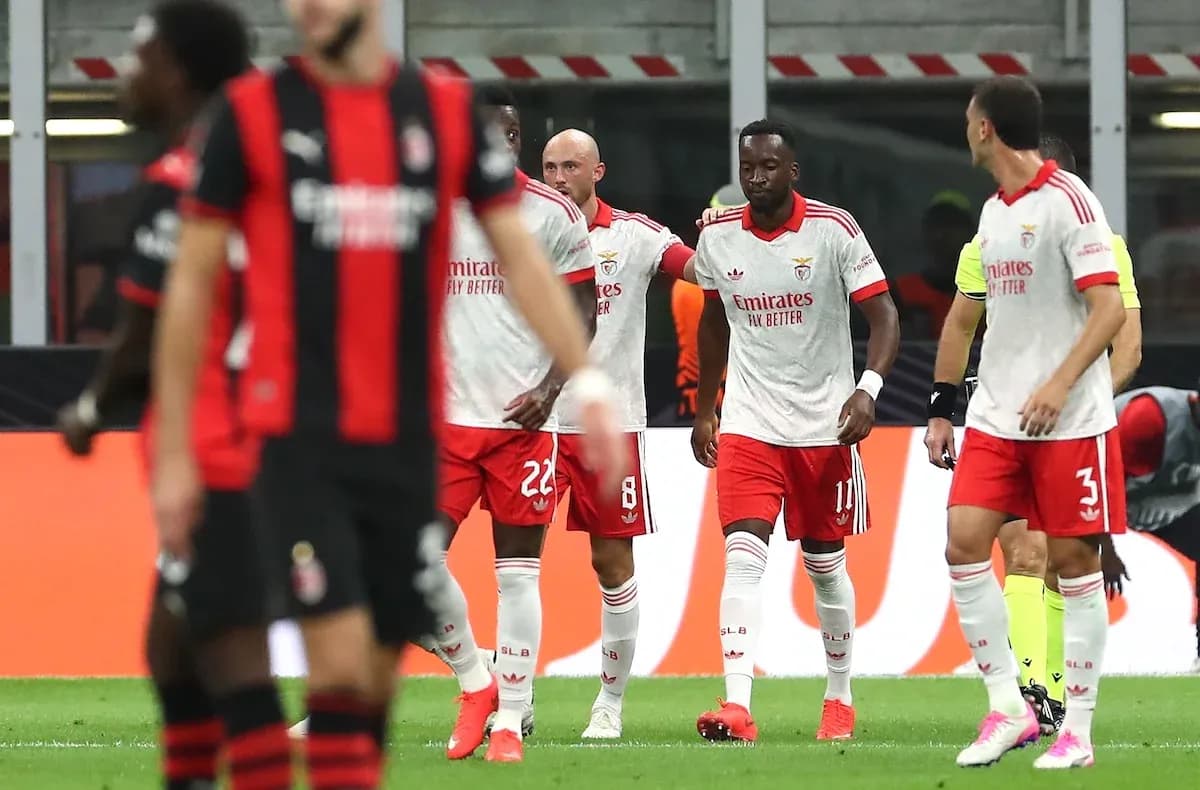
Beşiktaş Dominates Kauno Žalgiris in 3-0 Victory
Beşiktaş’s 3-0 win over Kauno Žalgiris at Tüpraş Stadyumu was built on structural dominance and territorial suffocation rather than sheer volume of chances. Vincenzo Italiano’s 4-1-4-1 imposed a high-possession, high-territory game that pinned the visitors deep and converted early pressure into a decisive 2-0 platform by the 12th minute, before a controlled second-half sealed the tie.
Beşiktaş’s shape was textbook for a ball-dominant side. The back four of R. Yilmaz, T. Djalo, M. Murillo and E. Topcu played extremely high, compressing the pitch and enabling the single pivot S. Ozcan to operate as a circulation hub rather than a pure shield. Ahead of him, the line of four – V. Cerny, J. Olaitan, O. Kokcu and L. Trossard – rotated fluidly around lone striker Oh Hyeon-Gyu, constantly overloading wide channels and half-spaces. The 77% possession figure underlines how consistently Beşiktaş kept the ball and recycled attacks.
The early goals were a direct consequence of that structure. On 6', Oh Hyeon-Gyu exploited the advanced full-back positioning, finishing after service from R. Yilmaz. Just six minutes later, centre-back M. Murillo stepped into an aggressive position to score from another R. Yilmaz assist, illustrating how high Beşiktaş’s defensive line was allowed to play against a Kauno Žalgiris side struggling to escape their own third. With Kauno Žalgiris registering 0 shots on goal and only 2 shots off goal, Beşiktaş’s rest-defense and counter-press were so effective that A. Nubel (Beşiktaş) was largely a distributor rather than an active shot-stopper.
Kauno Žalgiris lined up in a 4-2-3-1 under Eivinas Cerniauskas, but the double pivot of V. Slivka and A. Kalik was overwhelmed. With only 23% possession, they were forced into a reactive, low-block stance, often with the wide players L. Krekovic and A. Benchaib dropping to form an improvised 4-5-1. The visitors’ inability to play through pressure is reflected in their 16 fouls and 4 yellow cards, a sign of repeated late or desperate interventions as Beşiktaş circulated the ball around their block.
The penalty converted by O. Kokcu on 59' to make it 3-0 effectively ended the contest and highlighted Beşiktaş’s ability to keep Kauno Žalgiris pinned in their box. By then, Italiano had already begun to manage minutes and energy through substitutions that preserved the tactical framework. At 46', I. Fakili (IN) came on for V. Cerny (OUT), a like-for-like change in the advanced midfield band that maintained the 4-1-4-1’s vertical connections. On 60', A. Hadziahmetovic (IN) replaced J. Olaitan (OUT), giving Beşiktaş fresh legs in central areas while keeping the same positional roles, and D. Vlahovic (IN) came on for Oh Hyeon-Gyu (OUT) to lead the line with similar movement patterns.
Later, at 72', M. Rashica (IN) replaced L. Trossard (OUT), adding directness on the flank without altering the team’s spacing. K. Ouattara (IN) for R. Yilmaz (OUT) on 81' was one of the few changes that touched the back line, but by that stage Beşiktaş’s territorial grip was complete and the risk profile low. The 15 corner kicks to Kauno Žalgiris’s 2 show how relentlessly Beşiktaş kept play in the attacking third, with their full-backs and wingers repeatedly forcing clearances and blocks (7 blocked shots for Beşiktaş versus 1 for Kauno Žalgiris).
For Kauno Žalgiris, the substitution pattern was more about damage limitation and fresh legs for chasing than about changing the game’s logic. At 46', L. Kastrati (IN) came on for J. Moutachy (OUT), and M. Burba (IN) for G. Debeljuh (OUT), but the shape remained a defensive 4-2-3-1 with limited pressing. Renan Oliveira (IN) replaced A. Kalik (OUT) on 62', and F. Ourega (IN) came on for L. Krekovic (OUT) on 63', slightly refreshing the attacking midfield line without solving their progression issues. Finally, at 79', I. Fiolic (IN) replaced A. Benchaib (OUT), but by then Beşiktaş were in full control of tempo and territory.
Discipline further illustrates the tactical story. Beşiktaş committed only 3 fouls and received 1 yellow card, while Kauno Žalgiris’s 16 fouls and 4 yellows reflected continuous strain in defensive duels and transitions. With Beşiktaş barely threatened, A. Nubel (Beşiktaş) was protected by a compact high line and effective counter-press. At the other end, T. Svedkauskas (Kauno Žalgiris) faced 6 shots on goal from a barrage of 15 corners and sustained pressure, even if his exact save count is not specified.
Statistically, the match was a one-sided tactical exercise. Beşiktaş’s 77% possession, 6 shots on goal, 8 shots off goal and 7 blocked shots depict a team that not only controlled the ball but also generated repeated shooting opportunities from varied zones. Kauno Žalgiris, with 0 shots on goal and 2 off goal, posed virtually no attacking threat and rarely progressed beyond their defensive block. The corner count (15–2) and foul differential (3–16) reinforce the picture of Beşiktaş dictating location and rhythm, while Kauno Žalgiris reacted, fouled, and cleared rather than constructed.
In sum, Beşiktaş’s 4-1-4-1 under Italiano functioned as a territorial machine: high line, single pivot, rotating advanced midfielders and an active full-back in R. Yilmaz created constant width and depth. Kauno Žalgiris’s 4-2-3-1 never established a stable build-up or pressing scheme, leaving them camped in their own half and ultimately overrun both on the scoreboard and in every key tactical metric.