Bournemouth vs Manchester City: A Tactical Chess Match Ends 1-1
Under the low May sky at Vitality Stadium, Bournemouth and Manchester City closed out a heavyweight chess match that finished 1-1, a result that said as much about Bournemouth’s evolution as it did about City’s title-chasing tension. Following this result, the table tells its own story: Bournemouth in 6th on 56 points, City 2nd on 78, both with 37 matches played. One is punching upwards towards Europe, the other straining for the summit – and yet, over 90 minutes, the gap narrowed to a single goal and a shared point.
I. The Big Picture – Styles That Have Grown Into Each Other
Bournemouth’s season-long identity under Andoni Iraola has hardened into something coherent and stubborn. Overall this campaign they have scored 57 goals and conceded 53, a goal difference of 4 that reflects their commitment to front-foot football: 1.5 goals scored on average overall, 1.5 at home and 1.6 on their travels. At home, they have been quietly formidable: 7 wins, 10 draws and only 2 defeats in 19 matches, with 29 goals for and 20 against. Vitality has become less a relegation battleground and more a Europa League launchpad.
Manchester City arrive with a more familiar statistical roar. Overall they have scored 76 and conceded 33, a goal difference of 43 built on a machine-like attack that averages 2.1 goals per game overall – 2.4 at home and 1.7 away – and a defence that allows just 0.9 goals per match. Even on their travels they have been strong: 9 away wins, 6 draws, 4 defeats, with 32 goals scored and 21 conceded.
On the night, the formations told us the story before a ball was kicked. Bournemouth in their staple 4-2-3-1, City in a 4-1-4-1 they have leaned on 13 times this season. Iraola set up to compress the middle and spring into space; Pep Guardiola to dominate the ball and suffocate transitions.
II. Tactical Voids – Suspensions and Discipline Shadows
The absences sheet tilted the tactical board before kick-off. Bournemouth were without R. Christie, missing through a red card, and Álex Jiménez, suspended. Christie’s red this season is not an isolated flash; he has 1 red card and 3 yellows, and his energy between the lines would have been invaluable in breaking City’s rhythm. Jiménez, who has collected 10 yellow cards, is a high-volume duelist and tackler – 69 tackles, 11 blocked shots and 27 interceptions – whose aggression down the flank often sets Bournemouth’s pressing tone.
Without Jiménez, Iraola turned to A. Smith at right-back and J. Hill alongside M. Senesi, with A. Truffert on the left. The back four became more conservative by necessity, less able to step in and duel high, more inclined to hold a slightly deeper line against City’s waves.
Discipline, too, shaped the emotional undercurrent. Heading into this game, Bournemouth’s yellow card timing showed a late-game spike: 26.44% of their yellows between 76-90 minutes and another 21.84% between 91-105. City, by contrast, spread their cautions more evenly but still saw 19.70% between 76-90 and 19.70% between 46-60. This statistical profile foreshadowed a contest that would fray as legs and minds tired – exactly the kind of environment where a team like Bournemouth, who live on emotional edges, can either snatch glory or self-destruct.
III. Key Matchups – Hunter vs Shield, Engine Room vs Engine Room
Hunter vs Shield
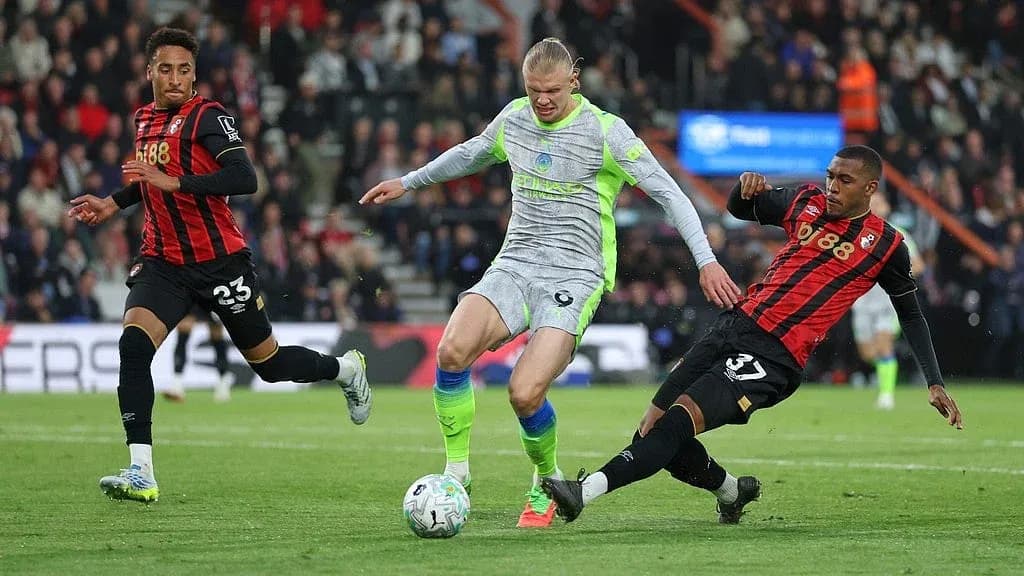
At the sharp end, this fixture was always going to be framed as E. Haaland against Bournemouth’s defensive structure. Haaland’s season is brutal in its simplicity: 27 league goals, 8 assists, 102 shots with 59 on target, and a penalty record that is dangerous but not flawless – 3 scored, 1 missed. City’s away attack, averaging 1.7 goals per game on their travels, is built around his presence, the gravitational force that bends defensive lines.
Bournemouth’s “shield” is collective rather than individual. Overall they concede 1.4 goals per match, with 1.1 at home. M. Senesi anchors the line, flanked by Hill and Truffert, and protected by a double pivot of T. Adams and A. Scott. The plan was clear: narrow the central corridor where Haaland thrives, deny him clean service from wide and half-spaces, and trust D. Petrovic to handle the volume that inevitably leaks through.
Engine Room – Rodri vs Adams & Scott
If Haaland is the spear, Rodri is the arm that throws it. Sitting as the lone pivot in City’s 4-1-4-1, he had M. Kovacic and B. Silva ahead of him, with J. Doku and A. Semenyo as wide midfielders. Semenyo’s presence is particularly intriguing: he has 10 goals and 3 assists this season as a Bournemouth player in the league data, but here he wore City colours, a reminder of how his directness and duels (297 contested, 121 won) translate to any pressing structure.
Against them, Adams and Scott formed a pragmatic axis. Adams’ brief was to harry Rodri’s first touch and block the vertical lanes into Haaland and the interior midfielders. Scott, more progressive, was tasked with connecting to the three behind the striker – Rayan, E. J. Kroupi and M. Tavernier – and helping Bournemouth play through City’s first press.
Further up, Kroupi was the quiet wildcard. With 13 league goals, 21 key passes and a 75% pass accuracy, he is both finisher and connector. Operating as one of the three behind Evanilson, his ability to find pockets between Rodri and the centre-backs offered Bournemouth a route to turn City around.
IV. Statistical Prognosis – Margins, xG Logic and What Comes Next
Even without explicit xG numbers, the profiles of these sides sketch a likely expected goals landscape. City, with 76 goals overall and 16 clean sheets, typically generate higher xG than their opponents and suppress chances well; Bournemouth, with 57 scored and 11 clean sheets, tend to trade more openly.
At Vitality, the 1-1 scoreline feels like the meeting point between those curves. City’s away defence, conceding 1.1 goals per match, was breached once; Bournemouth’s home defence, allowing 1.1 on average, also gave up a single goal. Both teams landed roughly on their seasonal norms.
From a tactical forecasting perspective, this draw reinforces a few truths. Bournemouth’s 4-2-3-1 is now battle-tested against elite possession sides; their home resilience and balanced goal difference of 4 overall suggest they will continue to grind out results in high-pressure games. City, for all their dominance, remain slightly less explosive away from home than at the Etihad, their 1.7 away goals per match leaving just enough room for disciplined opponents to take something.
Following this result, the narrative is not of an underdog fluke, but of a side in Bournemouth whose structure, mentality and numbers now allow them to share the stage with Manchester City – and to make a 1-1 feel less like an upset and more like a statement of belonging.