Bournemouth's Tactical Mastery in 2-1 Victory Over Newcastle
St. James’ Park had the feel of a crossroads rather than a celebration. Newcastle, 14th in the Premier League with 42 points and a goal difference of -3 heading into this game, were trying to drag their season back toward European contention. Bournemouth arrived as the quieter success story: 8th place, 48 points, and a perfectly balanced goal difference of 0, built on stubborn draws and a growing attacking edge.
By full time, the table told the story. Following this result, Bournemouth’s 2-1 win underlined the contrast between a side still searching for a stable identity and another that has learned to live on the margins of tight games.
I. The Big Picture – Systems, Context, and Seasonal DNA
The formations on the teamsheet mirrored their seasonal blueprints. Newcastle lined up in Eddie Howe’s favoured 4-3-3, a shape they have used in 27 league matches this season. It is a system built to stretch the pitch, lean on aggressive full-backs and a rotating midfield three. At home they have been potent enough: 30 goals at St. James’ Park, an average of 1.8 per game, but that comes at a cost – 28 conceded at home, 1.6 per match.
Bournemouth, under Andoni Iraola, stayed loyal to their 4-2-3-1, the framework they have used in 31 league fixtures. It is a system that thrives on verticality and counter-pressing. On their travels they have been quietly dangerous: 27 away goals at an average of 1.6 per game, even if that has come with a leaky 33 conceded away (1.9 per match). They live in chaos – but they’ve learned to manage it.
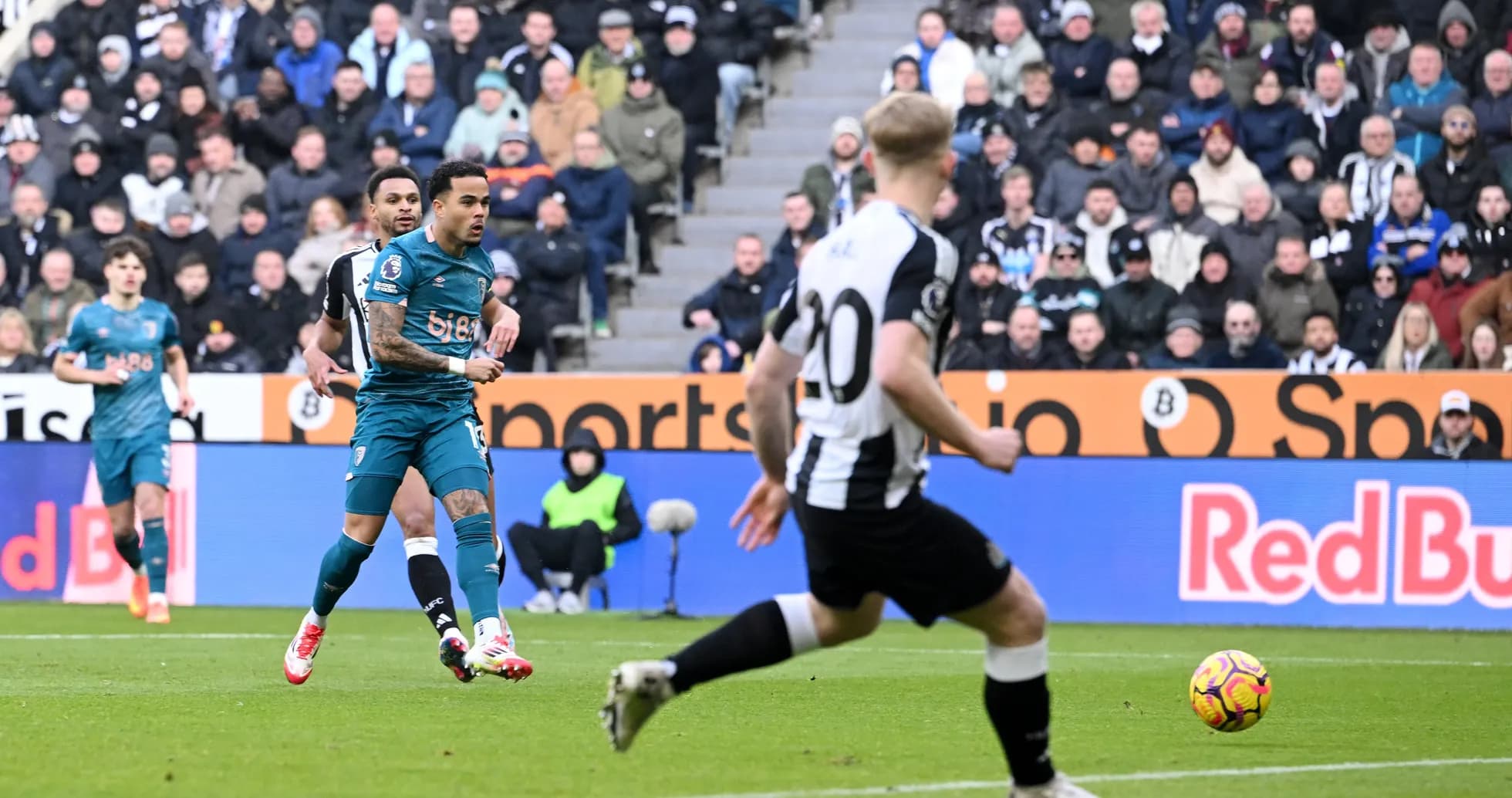
The match itself fit those season-long patterns. Bournemouth’s compact double pivot and mobile three behind the striker allowed them to control transitions, especially in the first half, when they went in 1-0 up at the interval. Newcastle, for all their territorial pressure after the break, could not entirely shake their defensive fragility, conceding again and ultimately falling 2-1.
II. Tactical Voids – Absences and Discipline
Both managers had to navigate notable absences that shaped the tactical tone.
For Newcastle, the suspension of Joelinton for yellow cards removed their most combative midfielder and one of the league’s primary enforcers. Across the season he has accumulated 10 yellow cards, a reflection of the edge he brings to duels and second balls. Without him, Howe turned to a more technical trio: Sandro Tonali, Lewis Miley and Jacob Ramsey. It offered control and passing angles but lacked Joelinton’s raw disruption and physicality between the lines.
Defensively, the absence of Fabian Schar (ankle injury) and Emil Krafth (knee injury) stripped Newcastle of experience and depth at the back. Malick Thiaw and Sven Botman formed the central pairing, with Lewis Hall and Valentino Livramento as full-backs. On paper, it is an athletic, progressive back four; in practice, it remains a work in progress in terms of collective timing and box defence, something Bournemouth exploited at key moments.
Bournemouth had their own creative voids. Lewis Cook (hamstring), Justin Kluivert (knee) and Javi Soler (hamstring) all missed out, thinning Iraola’s options for rotation in the middle and final third. That placed a heavier creative burden on Ryan Christie, Alex Scott, Marcus Tavernier and the precocious Eli Junior Kroupi.
Disciplinary trends added another layer of risk management. Heading into this game, Newcastle’s yellow cards showed a clear late-game spike: 27.12% of their cautions arrived between 76-90 minutes, with a further 18.64% between 91-105. Bournemouth shared a similar pattern, with 29.49% of their yellows in the 76-90 window and 20.51% in added time. This match was always likely to become more ragged, more dangerous, as legs tired and space opened – and the closing stages did feel stretched, with Newcastle chasing and Bournemouth breaking.
III. Key Matchups – Hunter vs Shield, Engine Room Battles
The “Hunter vs Shield” narrative belonged to Bournemouth’s attack against Newcastle’s porous home defence. Overall, Newcastle concede 1.5 goals per game this campaign, and at home that figure is 1.6. Bournemouth, meanwhile, carry genuine multi-source threat: 50 league goals overall, split between 23 at home and 27 away.
Even without Antoine Semenyo in the XI, his season provides the template for Bournemouth’s forward line. With 10 league goals and 3 assists from midfield, plus 42 shots (27 on target), he embodies Iraola’s vertical aggression. Eli Junior Kroupi, who also sits on 10 league goals, started here as the nominal No. 10 line runner. His 25 shots with 17 on target underline his efficiency when he finds pockets between the lines. Around them, Tavernier and Rayan gave Bournemouth the width and pressing triggers to pin Newcastle’s full-backs.
On the other side, Newcastle’s most polished attacking brain sat on the bench at kick-off: Bruno Guimarães. Across the season he has 9 goals and 4 assists, with 40 key passes and 1,193 completed passes at an 86% accuracy. When he did appear, he tried to tilt the midfield battle back in Newcastle’s favour, but the structural issues behind him – especially in defensive transitions – persisted.
The “Engine Room” duel pitted Tonali and Miley against Scott and Christie. Scott and Christie, operating as Bournemouth’s double pivot, were tasked with breaking Newcastle’s central rhythm and launching quick counters. Their screening allowed Marcos Senesi and J. Hill to hold a relatively high line, compressing the space in which Harvey Barnes, Anthony Elanga and William Osula could operate.
Senesi’s season numbers explain a lot about Bournemouth’s resilience. He has made 41 successful blocks and 49 interceptions in the league, with 321 duels contested and 169 won. In this match, his anticipation and positioning repeatedly shut down Newcastle’s attempts to slide passes into the channels, especially from the left where Barnes tried to isolate Alex Truffert.
Out wide, the duel between Elanga and Alex Jimenez was a microcosm of the game’s physical intensity. Jimenez, who has 63 tackles, 11 blocked shots and 25 interceptions this season, again played on the disciplinary edge – he has already collected 9 yellow cards in the league – but his aggression was vital in stopping Newcastle’s wide overloads from turning into clear chances.
IV. Statistical Prognosis – xG, Margins, and What This Result Says
Even without explicit xG numbers, the season-long data frames how this 2-1 away win fits the broader arc. Newcastle’s overall scoring average of 1.4 goals per game, against 1.5 conceded, describes a team living on a negative expected balance: they need to be clinical just to break even. Bournemouth, by contrast, sit at 1.5 goals for and 1.5 against overall, but crucially they have turned that neutrality into 48 points through game management and an extraordinary 15 draws.
On their travels, Bournemouth’s profile – 1.6 goals scored and 1.9 conceded per away match – points to high-variance football. At St. James’ Park, they managed to bend that variance in their favour by striking early, then punishing Newcastle again when the hosts opened up after the break.
Following this result, the tactical verdict is stark. Newcastle’s 4-3-3 remains capable of volume and pressure, but without Joelinton’s edge and Schar’s organisation, the spine is fragile against mobile, counter-punching sides. Bournemouth’s 4-2-3-1, meanwhile, looks increasingly like a mature, mid-table weapon: a system that can go toe-to-toe in open games yet still squeeze out narrow wins away to traditionally difficult venues.
In the end, this was not just a 2-1 scoreline. It was a snapshot of two trajectories: Newcastle still searching for balance between ambition and control, Bournemouth quietly mastering the art of surviving – and thriving – in the Premier League’s grey areas.