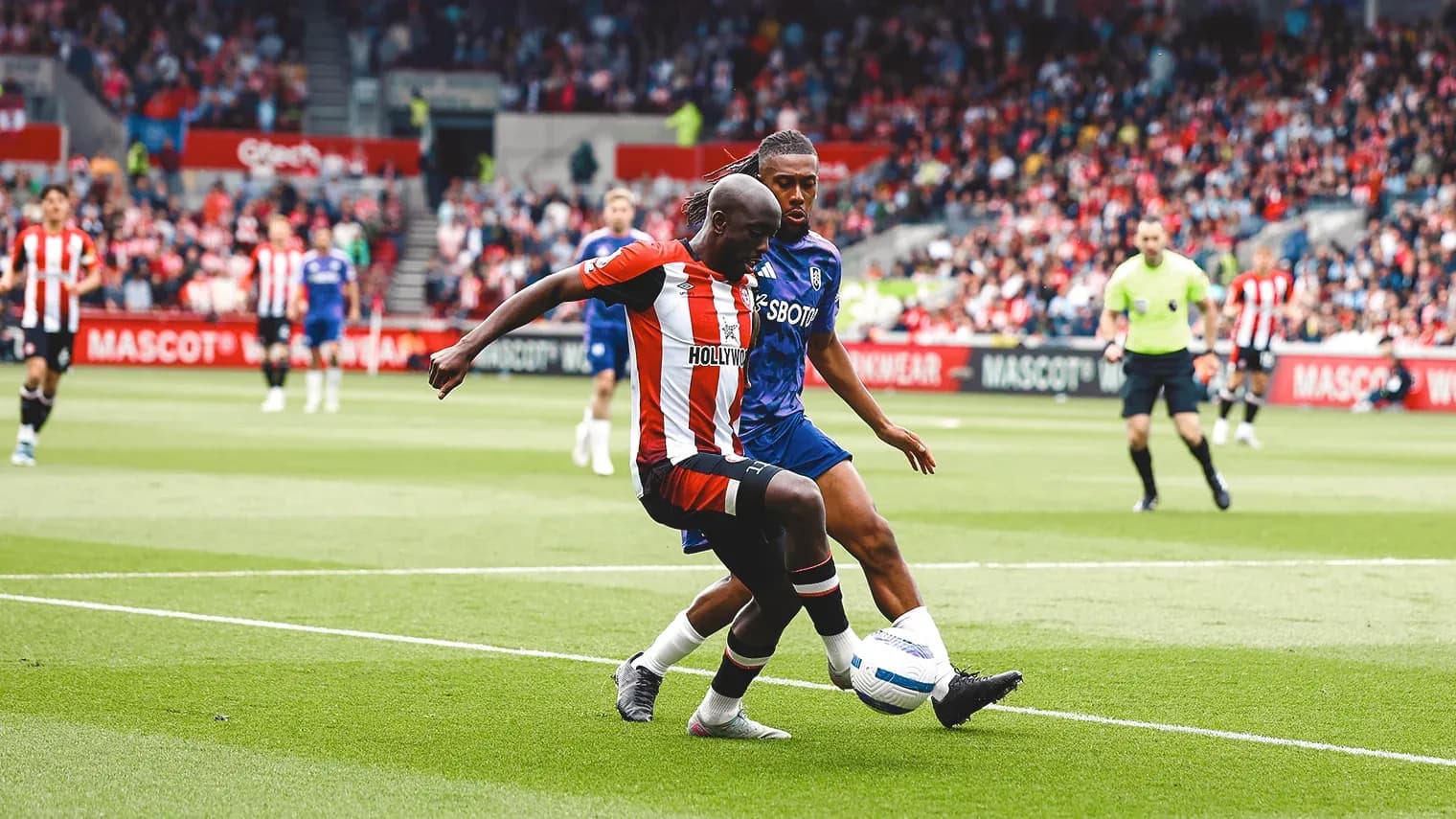
Brentford vs Fulham: Tactical Draw in Premier League Clash
Brentford and Fulham played out a goalless but tactically layered draw at the Brentford Community Stadium, a match defined more by structure and control than by penalty-box chaos. Across 90 minutes in this Premier League Round 33 fixture, the sides mirrored each other in a 4-2-3-1 shape yet produced contrasting versions of it: Brentford’s was vertical and territory-focused, Fulham’s more possession-oriented and risk-averse. The 0-0 scoreline matched the balance in expected goals – 1.36 for Brentford to Fulham’s 0.74 – and underlined a contest where Brentford carried the greater threat without ever fully overwhelming a Fulham side anchored by Bernd Leno’s assured goalkeeping and a disciplined, if conservative, defensive block.
The disciplinary and substitution story was almost entirely Fulham’s. The only card of the game arrived early: Sasa Lukic was booked on 6' for a foul, a signal that Fulham’s double pivot would be under stress as Brentford tried to accelerate play through the middle. That caution subtly reshaped Lukic’s approach, limiting his aggression in duels and nudging Fulham further towards a positional, rather than combative, midfield game.
The first structural shift came at 43', when Samuel Chukwueze (IN) came on for Alex Iwobi (OUT). With no goals on the board and the game finely poised, Marco Silva sought more verticality and one‑v‑one threat on the flank before halftime rather than waiting for the interval. This change hinted at Fulham’s concern over Brentford’s ability to push their wide midfielders high and pin the full-backs.
The second wave of Fulham changes arrived as a double substitution on 67'. Raul Jimenez (IN) came on for Rodrigo Muniz (OUT), and Joshua King (IN) replaced Emile Smith Rowe (OUT). These moves were less about chasing an open game and more about refreshing a tiring attacking line that had struggled to generate shots on target – Fulham finished with 0 shots on goal from 10 attempts. Jimenez offered more back-to-goal hold-up play, while King provided legs between the lines, but Brentford’s compact defensive unit held firm.
Finally, at 81', Silva completed his five changes with another double switch: Oscar Bobb (IN) came on for Tom Cairney (OUT), and Antonee Robinson (IN) replaced Ryan Sessegnon (OUT). Bobb’s introduction aimed to add creativity and ball-carrying from midfield, while Robinson injected pace and overlapping threat on the left. Yet, despite these late adjustments, Fulham’s attacking structure remained too sterile to break Brentford down. There were no further cards, and the match ended with the disciplinary ledger showing Brentford on 0 yellows and Fulham on 1.
Team Structures
Both sides set up in a 4-2-3-1, but their interpretations diverged. Brentford, under Keith Andrews, used Caoimhin Kelleher behind a back four of Michael Kayode, Sepp van den Berg, Nathan Collins, and Keane Lewis-Potter. In front, Yehor Yarmolyuk and Mathias Jensen formed a double pivot, with an advanced line of Dango Ouattara, Mikkel Damsgaard, and Kevin Schade supporting centre-forward Igor Thiago.
With 48% possession and 384 total passes (79% accuracy), Brentford were comfortable without dominating the ball. Their 13 total shots, 4 on target, and 12 from inside the box reveal a clear intent: use structured build-up to reach advanced zones, then commit numbers into the penalty area. The extremely low volume of shots from distance (just 1 outside the box) underlines a patient, chance-quality-first approach. Ouattara and Schade, starting high and narrow, repeatedly attacked the channels, while Damsgaard drifted inside to link with Jensen and Yarmolyuk. This created interior overloads that forced Fulham’s midfield two to compress centrally, opening half-spaces for full-backs Kayode and Lewis-Potter to advance.
Defensively, Brentford’s control is evident in Fulham’s shot profile: 10 attempts, but none on target and only 7 from inside the box. The centre-back pairing of van den Berg and Collins managed depth well, limiting space for Muniz and later Jimenez to receive in dangerous zones. Kelleher, notably, finished with 0 saves, a testament less to inactivity and more to the effectiveness of the block in front of him. Fulham reached shooting positions but were consistently forced into low-probability efforts or blocked attempts (5 Fulham shots were blocked).
Fulham’s 4-2-3-1, with Leno behind a back four of Timothy Castagne, Joachim Andersen, Calvin Bassey, and Sessegnon, was built on controlled possession: 52% of the ball, 435 passes at 81% accuracy. Lukic and Cairney were tasked with progressing play, while Harry Wilson, Smith Rowe, and Iwobi supported Muniz. On paper, this should have given Fulham a technical edge between the lines, but Brentford’s mid-block denied them clean central access. As a result, much of Fulham’s possession was recycled in front of Brentford’s shape, leading to sterile control rather than incision.
Leno’s role was critical. He made 4 saves, all of Brentford’s efforts on target, and his presence underpinned Fulham’s defensive resilience. With Brentford generating 1.36 xG and Fulham’s goalkeepers registering 0 goals prevented, the model suggests that Leno largely dealt with shots of a saveable profile rather than spectacular interventions. Still, his command of the box and positioning allowed Fulham’s high defensive line to hold without collapsing under Brentford’s late pressure and 9 corner kicks.
Statistical Overview
Statistically, the match tilts slightly towards Brentford on threat and territory. They outshot Fulham (13–10), produced all 4 of the game’s shots on target, and generated the higher xG (1.36 to 0.74). Their 9 corners to Fulham’s 3 further illustrate territorial advantage, as does the fact that Fulham committed more fouls (13 to 8) and collected the only yellow card. Yet Fulham’s marginal edge in possession and pass completion reflects their capacity to dictate tempo, even if they struggled to convert that control into genuine chances.
From an overall form perspective, Brentford’s display suggests a side with a clear attacking framework and a solid defensive platform, but still lacking the final detail in the box to turn control into wins. Fulham’s overall form reads as defensively stable but attacking-light, leaning heavily on structure and Leno’s reliability. Defensively, Brentford’s index is strong: no shots on target conceded, disciplined fouling, and a compact block that rendered their goalkeeper almost redundant. Fulham’s defensive index is similarly positive in outcome – a clean sheet away from home – but more reliant on last-line interventions and Leno’s 4 saves to survive a higher volume and quality of chances.