Burnley vs Wolves: Tactical Analysis of a 1-1 Draw at Turf Moor
Burnley’s 1-1 draw with Wolves at Turf Moor closed their Premier League season with a match defined by territorial domination from the hosts and ruthless early punch from the visitors. Burnley, under Mike Jackson in a 4-2-3-1, controlled 70% of the ball and outshot Wolves 16-16 in volume but 8-4 on goal, yet needed a second-half adjustment to cancel out an early penalty from A. Armstrong. Rob Edwards’ Wolves, set up in a 3-4-2-1, leaned heavily on transition and penalty-box presence, generating the higher xG (2.05 to Burnley’s 1.06) despite long stretches without the ball. The final 1-1 reflected a tactical arm-wrestle between structure and verticality more than simple dominance.
Wolves’ plan was obvious from the opening exchanges. With a back three of Y. Mosquera, S. Bueno and L. Krejci, they defended compactly in a narrow block, inviting Burnley to circulate in front. The early “Var – Penalty confirmed” incident involving Ladislav Krejčí at 4' underlined their intent to attack quickly once possession was won. A. Armstrong’s converted penalty at 5' gave Wolves the ideal game state for a low-possession approach: they could sink deeper, protect the box and spring through A. Gomes, Andre and the front three of M. Mane, Hwang Hee-Chan and Armstrong.
Burnley’s 4-2-3-1 had structural control but initially lacked incision. The double pivot of Florentino and L. Ugochukwu provided a secure platform, allowing full-backs K. Walker and Lucas Pires to push high and stretch Wolves’ wing-backs. Ahead of them, the trio of L. Tchaouna, Hannibal Mejbri and J. Anthony operated between the lines behind Z. Flemming. Burnley’s 558 passes to Wolves’ 223, and 87% pass completion versus Wolves’ 74%, show how comfortably they progressed through the thirds. But in the first half, much of that possession was sterile, with Wolves’ back three plus double screen denying central penetration.
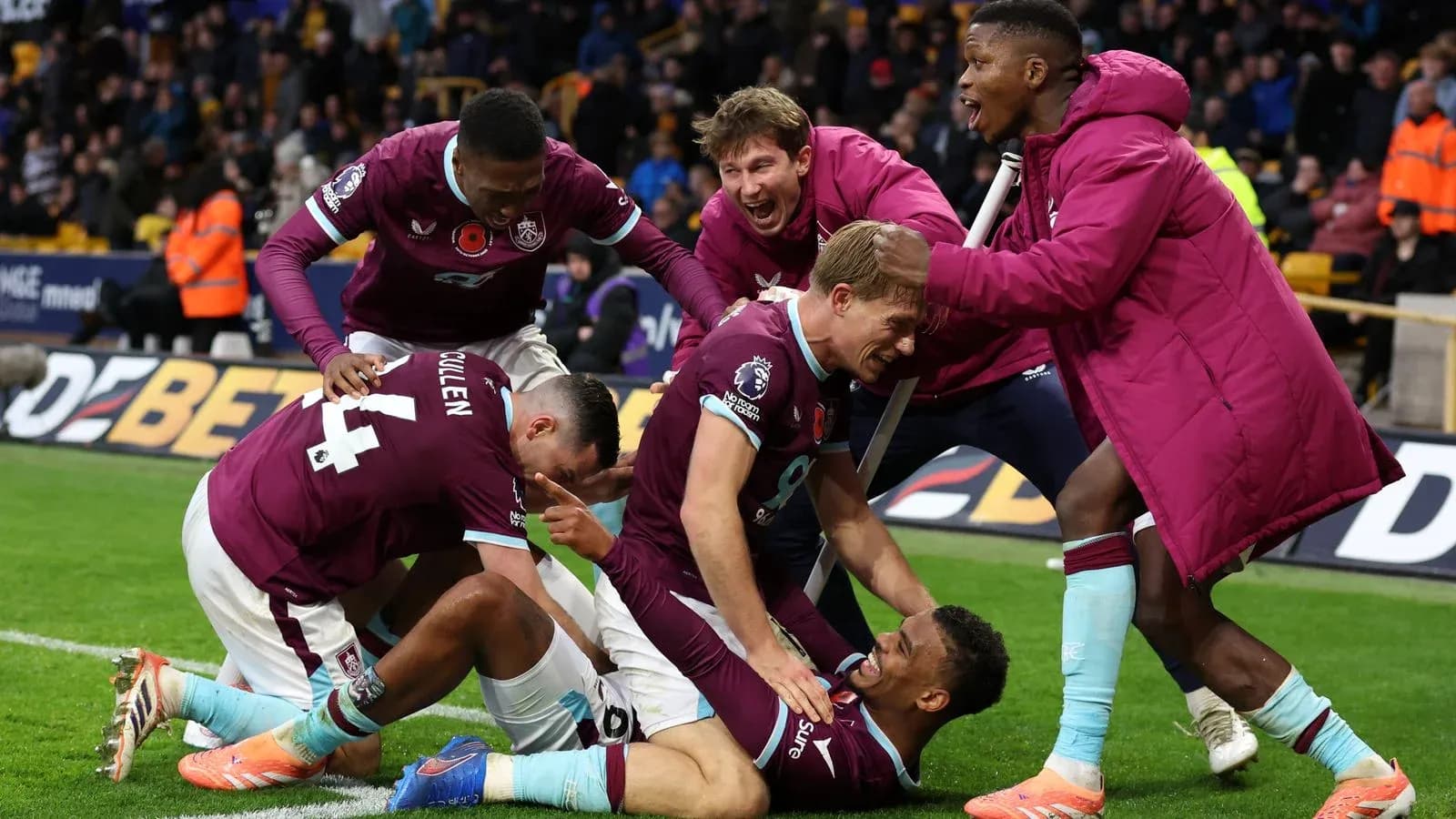
The turning point came after the interval. Burnley started the second half with more aggression between the lines, and the 47' equaliser captured their improved occupation of the half-spaces. L. Tchaouna found space to assist Z. Flemming, whose “Normal Goal” brought the score to 1-1 and validated the 4-2-3-1’s attacking potential when the wide midfielders attacked the channels with greater conviction. That move reflected Burnley’s emphasis on combination play around the box: 7 shots inside the box from 16 total, with 6 blocked, show how often they managed to work the ball into traffic in front of Wolves’ goal.
In goal, M. Weiss (Burnley) had a quieter but still significant afternoon. Wolves produced 4 shots on goal from their 16 attempts, and Weiss made 3 saves, with goals prevented measured at 0.29. That figure suggests he marginally outperformed the xG of the shots he faced, stabilising Burnley after the early penalty shock. His counterpart, J. Sa (Wolves), was far busier. Burnley’s 8 shots on goal demanded 7 saves from Sa, who also posted 0.29 goals prevented, a sign of sharp shot-stopping underpinning Wolves’ low-block strategy. Without that performance, Burnley’s territorial pressure and repeated entries into the box would likely have turned the game.
Jackson’s in-game management sought to tilt the balance further once parity was restored. At 66', he replaced Hannibal Mejbri with Z. Amdouni: Z. Amdouni (IN) came on for H. Mejbri (OUT). This swap injected more penalty-box threat and directness from the No.10 space, reducing Burnley’s reliance on Hannibal’s connective play and aiming for more final-third punch. Later, at 75', L. Ugochukwu made way for J. Ward-Prowse: J. Ward-Prowse (IN) came on for L. Ugochukwu (OUT), adding set-piece quality and forward passing from deep. Simultaneously, M. Edwards (IN) came on for L. Tchaouna (OUT), giving Burnley a fresher, more dribble-oriented wide option to attack tired Wolves legs.
The final offensive reshuffle arrived at 84', when A. Barnes (IN) came on for Z. Flemming (OUT) and J. Bruun Larsen (IN) came on for J. Anthony (OUT). Barnes’ introduction signalled a more direct, penalty-box focused endgame, with crosses and second balls around a traditional centre-forward. J. Bruun Larsen offered a different wide profile, cutting inside and attacking the half-spaces. These changes matched the statistical picture: Burnley’s 7 corners and 16 total shots reflected a late bombardment, but Wolves’ back line and J. Sa’s shot-stopping held.
Edwards’ substitutions were equally geared toward maintaining defensive solidity and counter-threat. At 66', T. Arokodare (IN) came on for A. Gomes (OUT), adding physical presence higher up to contest long clearances. In the same minute, Toti (IN) came on for L. Krejci (OUT), refreshing the left side of the back three without altering the 3-4-2-1 structure. At 74', H. Bueno (IN) came on for D. M. Wolfe (OUT), shoring up the flank, while J. Abbey (IN) came on for A. Armstrong (OUT), preserving legs up front and adding energy for late transitions. Finally, at 82', Pedro Lima (IN) came on for R. Gomes (OUT), reinforcing the wing-back line to cope with Burnley’s increasing width and volume of crosses.
The disciplinary pattern further coloured the tactical tone. Hwang Hee-chan’s yellow at 41' — “Off the ball foul” — illustrated Wolves’ readiness to disrupt Burnley’s rhythm even away from the immediate defensive block. Hannibal Mejbri’s booking at 45+9' — “Argument” — came at the end of a frustrating half for Burnley’s creative hub, emblematic of their struggle to turn dominance into chances before the break. In stoppage time, with the game stretched and emotionally charged, A. Barnes received a yellow at 90+4' — “Argument” — shortly followed by Yerson Mosquera’s own yellow at 90+4' — “Argument” — as both sides contested decisions in a tense finale.
Statistically, the match underlines a clash between volume possession and high-quality chances. Burnley’s 70% possession, superior passing volume (558 passes to 223) and accuracy, plus 8 shots on goal, reflect a team comfortable in structured buildup. Their xG of 1.06, however, shows that many of those attacks were forced into crowded areas, with 6 blocked shots and only 7 attempts inside the box. Wolves, by contrast, leveraged their transitions superbly: 10 of their 16 shots came from inside the box, and their xG of 2.05 indicates they manufactured the better-quality opportunities despite only 4 shots on goal and 30% possession.
From a broader tactical lens, Burnley’s 4-2-3-1 provided control but still needs greater vertical threat and variety against low blocks, while Wolves’ 3-4-2-1, anchored by a resilient back three and an excellent display from J. Sa, showed how a compact, counter-attacking side can repeatedly generate dangerous situations even while conceding territory. The 1-1 at Turf Moor, in the end, felt like a compromise between Burnley’s structural authority and Wolves’ situational efficiency.