Charleston Battery Triumphs Over Pittsburgh Riverhounds in USL League One Cup
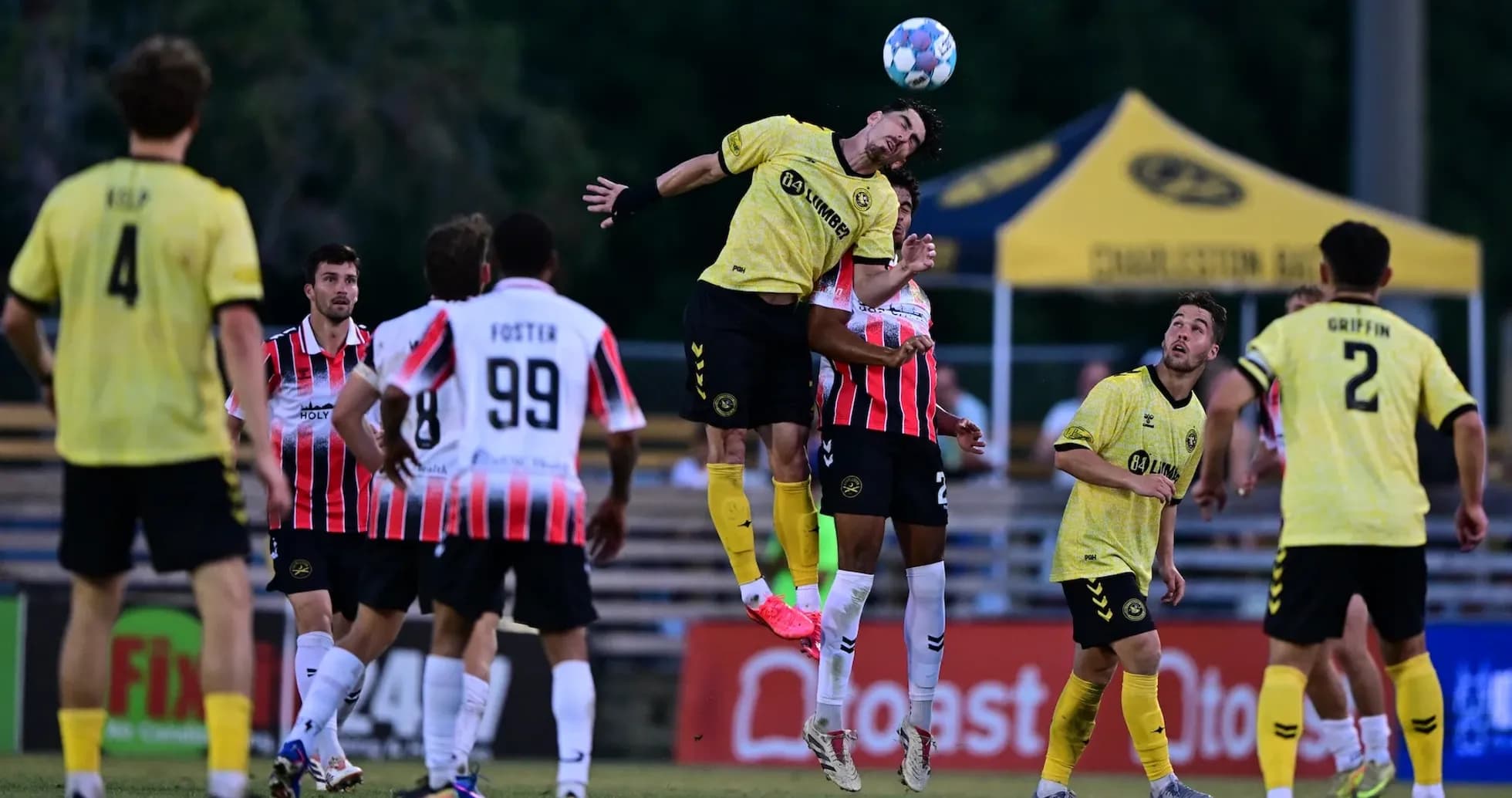
Under the lights at Patriots Point Soccer Complex, Charleston Battery and Pittsburgh Riverhounds played out the kind of stalemate that says as much about squad character as it does about structure. Over 120 minutes they refused to yield, and in the end Charleston’s campaign identity – control, defensive parsimony, and calm under pressure – carried them through a 4–2 penalty triumph after a 0–0 draw.
I. The Big Picture – Group heavyweights in a knife-edge cup tie
This was no ordinary group-stage fixture in the USL League One Cup. Heading into this game, Charleston sat top of Group 6 with 8 points and a goal difference of 7, their overall record a ruthless 3 wins from 3, with 10 goals for and 3 against in the standings snapshot. Pittsburgh, by contrast, were chasing, ranked 3rd with 5 points and a goal difference of -1, their path marked by inconsistency: 1 win, 2 losses, 8 goals scored and 9 conceded overall.
The season’s statistical DNA framed the narrative. Charleston’s campaign has been built on balance and control: overall they average 2.3 goals for and concede just 0.3, with clean sheets in 2 of 3 matches and no failures to score. At home they had been minimalist but efficient, with 1 goal for and 0 against, while on their travels they were far more expansive, hitting 6 and conceding 1.
Pittsburgh’s profile was more volatile. Overall they average 1.3 goals for and 1.0 against, but that masks a stark home/away split. At home they have scored 3 and conceded 0, an average of 3.0 goals for and 0.0 against; away, they have managed only 1 goal while shipping 3, an away average of 0.5 scored and 1.5 conceded. That fragility on their travels was always going to be tested by a Charleston side that rarely allows chaos.
On the night, the scoreboard refused to budge through 90 and then 120 minutes, but the penalty shootout revealed the underlying hierarchy: Charleston, the group’s most complete side, held their nerve to win 4–2 from the spot.
II. Tactical Voids – Discipline, durability, and the cost of aggression
With no formal injury list or suspensions reported pre-match, both coaches were able to lean into near-strongest XIs. Ben Pirmann built Charleston’s spine around goalkeeper J. Berner, with a defensive unit featuring D. Martinez, G. Smith, J. Akpunonu and N. Messer. In front of them, K. Pakhomov and S. Suber offered the ballast, while the creative and attacking lanes ran through M. Foster, E. Ycaza, L. Blackstock and the spearhead M. Berry.
Rob Vincent’s Pittsburgh answered with M. Sheridan in goal and a back line anchored by P. Barnes, V. Souza, O. Mikoy and L. Kelp. The midfield mix of E. Goldthorp, R. Mertz and D. Griffin was designed to knit transitions, with C. Ahl, S. Bassett and T. Amann providing attacking thrust.
Season-long card patterns hinted at how this game might feel in the duels. Charleston’s yellow cards are spread but spike between 46–60 minutes, where 50.00% of their cautions arrive, suggesting a side that emerges from half-time on the front foot, sometimes overstepping. Pittsburgh mirror that tendency: 42.86% of their yellows also come in that 46–60 window, with additional late-game aggression (14.29% between 76–90). Crucially, Pittsburgh carry a red-card risk late; 100.00% of their reds this campaign have come in the 76–90 minute band.
That disciplinary profile framed the extra-time narrative. Both squads were stretched physically, but Pittsburgh’s track record of late-game red cards imposed a psychological brake on their pressing and tackling as the tie wore on. Charleston, with no red cards recorded in any time band, could afford to maintain their line-stepping intensity without the same mental baggage.
III. Key Matchups – Hunter vs Shield, and the battle for the engine room
Without explicit top-scorer data, the “Hunter vs Shield” duel is best read through collective tendencies rather than one standout striker. Charleston’s overall attacking output – 7 goals in 3 matches in the team statistics, with an away average of 3.0 goals – speaks to a multi-pronged threat. Berry’s presence up front, supported by Blackstock and Foster, gave them varied angles: Berry as the reference point, Blackstock attacking half-spaces, Foster able to drift and link.
That front unit ran into a Pittsburgh defence that, on their travels, had conceded 3 goals in 2 matches, an away average of 1.5 against. The Riverhounds’ home defensive perfection (3 scored, 0 conceded) simply has not travelled, and that dichotomy shaped Vincent’s conservative tilt: Barnes and Souza stayed compact, Mikoy and Kelp were less adventurous, and the midfield double work of Griffin and Mertz was tasked with screening central lanes into Berry.
In the “Engine Room”, the contrast was just as sharp. Charleston’s midfield triangle of Pakhomov, Suber and Ycaza was built for control. Pakhomov sat, Suber patrolled the half-spaces, and Ycaza offered the line-breaking pass. Their season record of conceding only 1 goal overall in the team stats, with an overall average of 0.3 against, is as much about midfield protection as it is about back-line quality.
Opposite them, Pittsburgh’s central trio of Goldthorp, Mertz and Griffin had to be both creators and destroyers. Overall, Pittsburgh concede 1.0 goal per match, but away that rises to 1.5, a sign that their midfield screen can be stretched when forced backward. C. Ahl’s role between the lines was therefore pivotal: drop too deep and Pittsburgh lost their out-ball; stay too high and Charleston’s midfield three could suffocate supply.
On the bench, both coaches had meaningful change-up options. Pirmann could turn to C. Allan or A. Cabrera to stiffen or freshen the back line, while A. Hughes and J. Wayne offered energy and direct running if the game opened up. Vincent’s options were even more varied: A. Dikwa as a penalty-box striker, M. Viera and B. Larsen as fresh legs in wide or central roles, and A. Flowers-Gamboa or W. Agostoni to adjust the defensive profile. That depth set the stage for extra-time chess, even if the scoreboard never reflected it.
IV. Statistical Prognosis – Why Charleston were always favoured in the margins
Strip away the drama of penalties and the numbers still leaned Charleston’s way. Heading into this game, they had not lost in the competition, with 3 wins from 3 in the team statistics, a perfect record both at home and away, and 2 clean sheets overall. They had never failed to score. Their biggest away win, 0–4, underscored their ability to dismantle opponents when the game state turns in their favour.
Pittsburgh, meanwhile, carried the burden of two away defeats in the team stats, with just 1 goal scored and 3 conceded on their travels. They had already failed to score once overall, and their only clean sheet came at home. Their overall form line of WLL in the team statistics hinted at a side still searching for a stable identity.
In xG terms – even without explicit values – Charleston’s profile suggests a team that regularly creates enough to justify their 2.3 goals-per-game overall average while conceding very little. Pittsburgh’s 1.3 goals-for average overall is respectable, but the away drop to 0.5 hints at a side whose attacking xG on the road would likely be modest, reliant on moments rather than sustained pressure.
Defensively, Charleston’s overall average of 0.3 goals against per match and just 1 goal conceded in total in the team statistics point to an underlying solidity that tends to drag games into their preferred rhythm. Pittsburgh’s overall 1.0 conceded, and especially their away 1.5, suggest more variance and vulnerability when stretched.
In a knockout-style scenario decided from the spot, those underlying trends matter. The team that concedes less, manages game states better, and carries a cleaner disciplinary record is more likely to arrive at the penalty mark with clear heads. Charleston did exactly that. The 4–2 shootout win was less an upset of a cagey 0–0 and more the logical extension of a campaign in which they have been the group’s most balanced, resilient squad.