Crystal Palace Dominates Tottenham with Tactical Mastery
Crystal Palace’s 3-1 win at Tottenham Hotspur Stadium was built on control through possession and superior exploitation of key moments rather than volume of attacks.
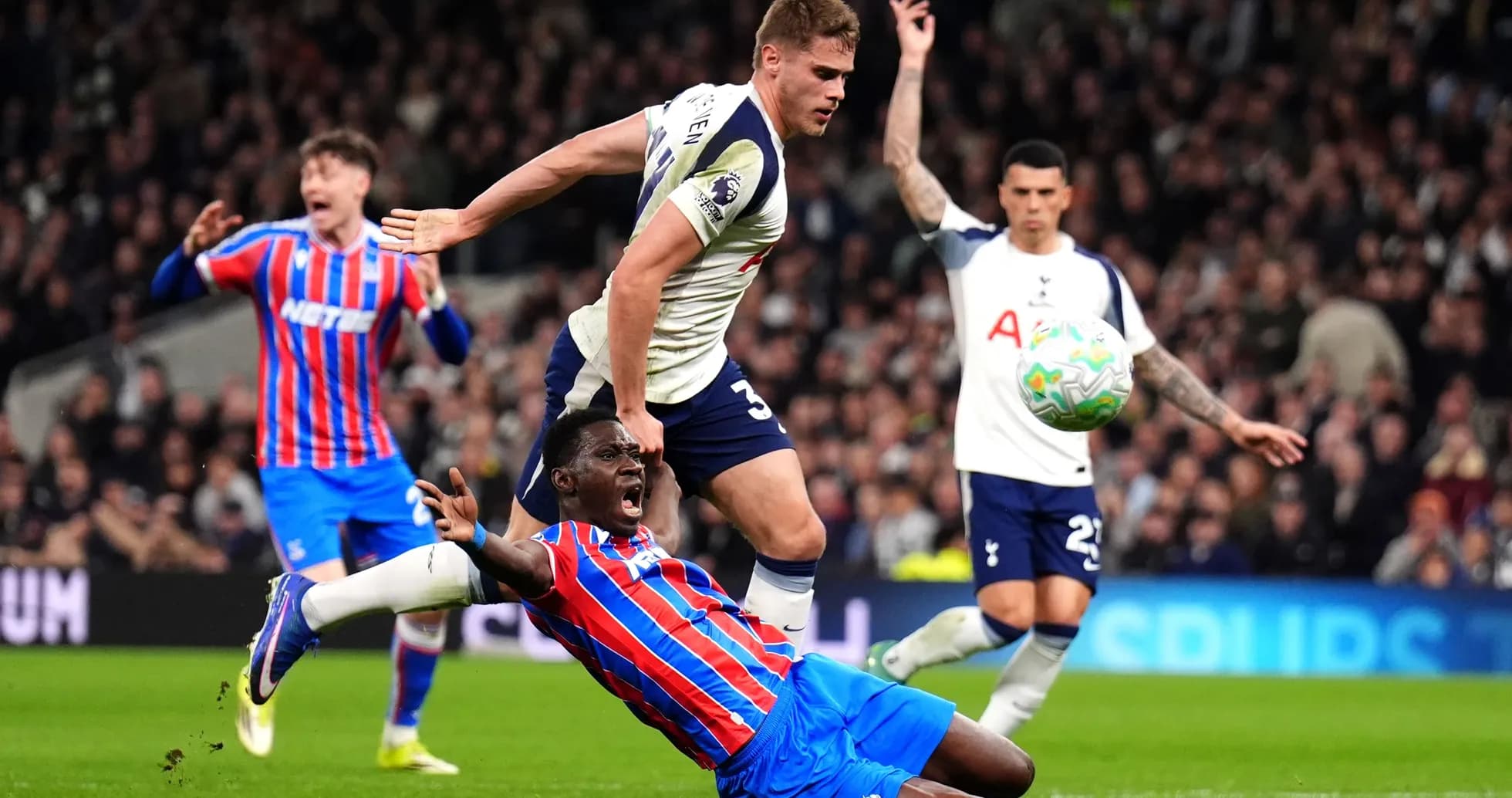
The battle for control tilted clearly towards Palace. With 60 percent of the ball and 463 passes at 87 percent accuracy, they dictated tempo and forced Tottenham’s 3-4-2-1 into long defensive phases, especially after the 38th-minute dismissal of Micky van de Ven for a last-man professional foul. Spurs, limited to 40 percent possession and 311 passes at 78 percent, were reactive for most of the contest, with their structure reshaped around damage limitation rather than sustained pressing.
Offensively, the shot profile shows Tottenham tried to stay direct and vertical even with ten men. They produced 12 attempts, 10 from inside the box, but only four on target and a modest scoring threat of roughly one goal. Crucially, Tottenham had 5 shots blocked by Crystal Palace, underlining how often Palace’s back three plus midfield screen were set in position to protect the area. Palace, by contrast, were more selective but more incisive: nine shots, eight in the box, four on target and a higher chance quality of around 1.8 goals. The cancelled strike for Ismaïla Sarr at 32 minutes, followed by a successful penalty and a further two goals before the break, reflects a plan to attack the space behind Tottenham’s high line and isolate central defenders once Spurs were down to ten.
Disciplinary Actions
Defensively, both sides committed 14 fouls, but the nature of the disciplinary actions reveals different game states. Tottenham’s early yellow for Souza on seven minutes (foul) and Pape Matar Sarr’s card on 25 minutes (argument) hinted at frustration and strain in midfield duels. Yves Bissouma’s late yellow on 82 minutes, again for argument, reinforced that emotional tilt as Spurs chased a lost cause. Van de Ven’s red was the pivotal tactical moment: it forced Ange Postecoglou to sacrifice Randal Kolo Muani on 43 minutes for Bissouma, shifting from an aggressive front three to a more conservative, double-pivot oriented block.
Palace’s cards were more controlled: Jørgen Strand Larsen on 22 minutes and Nathaniel Clyne deep into added time, both for fouls, aligned with a side managing transitions and breaking up counters rather than one under siege. In goal, Guglielmo Vicario made one save, Dean Henderson three; both keepers performed at a standard level without needing extraordinary saves, consistent with the idea that the decisive edge came from shot quality and game state, not goalkeeping heroics.
Substitutions
Substitutions reinforced the tactical narrative. Tottenham’s double change on 43 minutes (Bissouma and Conor Gallagher on for Kolo Muani and Souza) was a forced rebalancing after the red, trading attacking presence for midfield stability. Later, introducing Xavi Simons and Richarlison on 74 minutes was an attacking gamble to chase the game. Palace’s changes were about energy management: early full-back rotation at 14 minutes, then fresh forwards and midfielders from 67 minutes onward to preserve pressing intensity and protect the lead.
Overall, Palace’s plan married possession control with targeted, high-quality incursions into the box, while Tottenham’s aggressive initial setup was undone by the red card and an inability to turn territory into efficient finishing against a compact, blocking-heavy Palace defense.